The Lost Parvaneh Writing Desk and the Line That Wavered
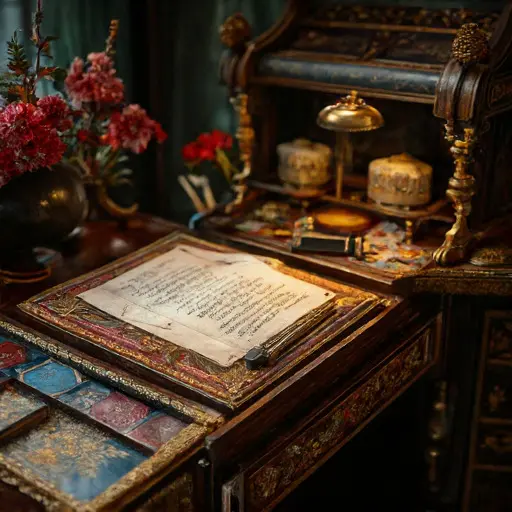
A hush settles over the Study Chamber, where the inlaid surfaces of the writing desk gleam faintly under the dim lamp. A reed pen balances across a shallow groove, poised over a half-finished flourish. Several sheets lie fanned on the floor, their edges curling as if dropped gently rather than flung.
The scent of cardamom and dried ink murmurs through the air. On the desk’s upper tier, a displaced inkstone marks a small divergence in the dust—hinting at a gesture interrupted, or reconsidered, with no explanation offered.
The Quiet Labor of Farid Reza Parvaneh, Calligrapher
Clues across these rooms recall Farid Reza Parvaneh, born 1877 in Shiraz, shaped by traditions that prized careful strokes and disciplined practice. In the Manuscript Alcove, reed pens are trimmed to precise tapers; pigments ground on porcelain plates reflect the jewel tones of Persian illumination. A silk-wrapped folder holds pattern guides for nasta‘liq script, notations added in firm but elegant hand. His routine emerges in subtle habits: brushes resting on wool-lined trays, water cups placed in exact reach, pages weighted by modest brass stones.
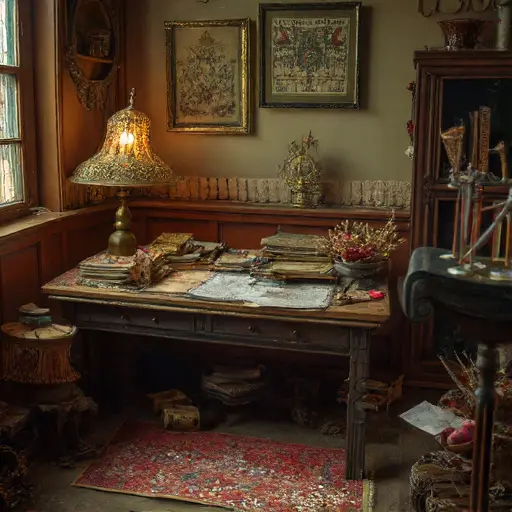
He likely worked from predawn into twilight, refining fluid strokes until each curve resonated with balance. The Sitting Niche displays framed samples he practiced for clients abroad—petal motifs, slender lines, illuminated initials. His temperament appears patient, solitary, and quietly devout, expressed in the gentle alignment of tools and the rhythmic repetition of strokes across practice sheets.
Subtle Strains Along His Chosen Script
Trouble emerges in small, crafted corners. In the Upper Hall Cupboard, a cracked pigment dish leans against a folded note from a distant patron—its seal marred by moisture, its margins rippled as if read often. Near it, a jar of gum arabic appears coagulated, signaling a lapse in his once meticulous maintenance. On the Guest Cot, a travel cloak carries faint ink smudges along the hem, and a roll of export paper remains uncut, though marked for dispatch. Whether financial disappointment or waning eyesight encroached, the signs gather without raising their voice.
Reading the Inkstone for His Final Resolve
Back at the writing desk, the inkstone defines the room’s tension. Its dried pool reveals an uneven streak where the brush may have trembled. A single reed pen nearby is split slightly at the nib, suggesting force applied in frustration. Under a corner blotter rests a sheet of illuminated script: the upper lines steady, the final curve wavering—an irregularity that feels like doubt captured mid-motion.
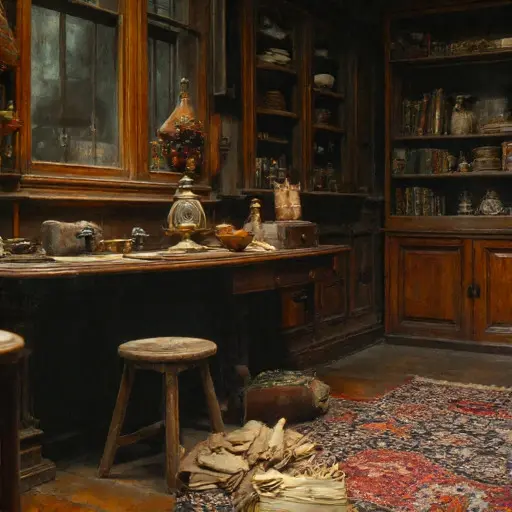
Beneath the writing desk, tucked behind a splintered support, lies his final attempt: a page bearing a single verse whose last word fades abruptly, ink thinned to a pale whisper. No note explains why his line faltered; the room only offers silence where intent once flowed.
The house yields no verdict, and it remains abandoned still.
