The Lost Parlor of Thornevale House
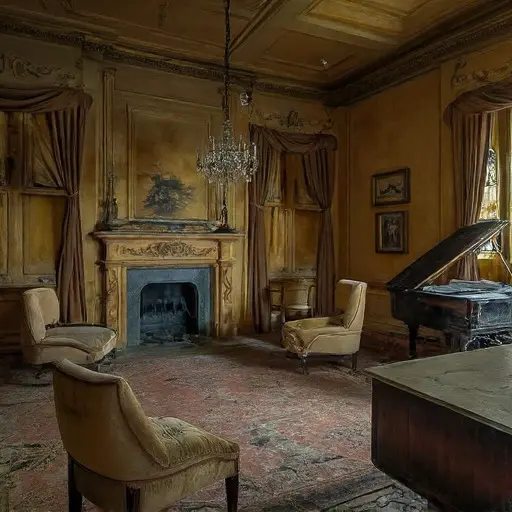
Nothing here is staged. Thornevale House remains as it was left — not abandoned in haste, but simply forgotten. To enter its rooms is to be met with silence so complete that it seems to press against the ears.
Floorboards breathe beneath each step. The faint scent of old books, crumbling wood, and dried wine lingers, as though the party ended just a day too late. The paint peels not from neglect, but from the long, slow breath of still air, heat, and winters unbroken.
The furniture is coated in dust, but remains positioned as if waiting for someone to sit again. The keyword lost applies not just to objects, but to intentions, names, and final thoughts never spoken aloud.
The Withering of Atticus Renford Thorne
Atticus Renford Thorne, born 1855, was the sole child of an embittered shipping magnate who died young. Atticus, a bachelor scholar of botany and founder of the now-defunct Hudson Botanical Circle, commissioned Thornevale House in 1891 as a monument to lineage and learning. But the house, far from any port, became less a retreat than a refuge. According to correspondences found behind a wall panel in the library, Thorne became increasingly withdrawn after the death of his mother, Honoria Thorne, in 1894.
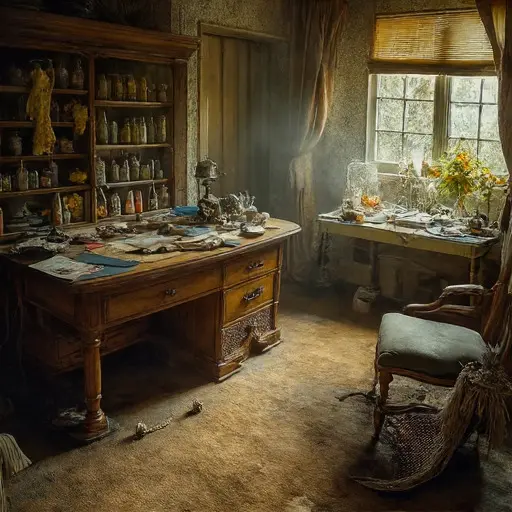
The house was his whole world — a place of specimens, pressed flowers, and long unread volumes. The morning room holds the clearest evidence of his habits: an herbarium spread open across a table, tweezers still poised above a drying flower. Newspaper clippings pinned to the wall detail changes in railway lines, weather patterns, and botanical discoveries. A letter never sent reads: “There are none left to impress. The world has quite forgotten me, and I have returned the favor.”
His death certificate is dated 1920, but no obituary was printed. The house was inherited by no one.
The Lost Specimen Cabinet
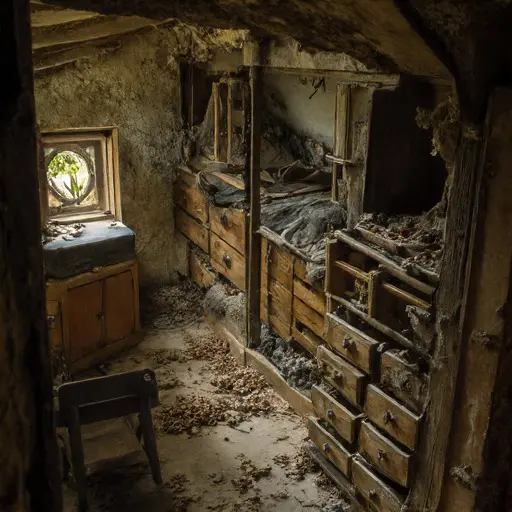
Down a narrow hall behind the servant stair lies the specimen room, a space not on the original floor plans. A hand-cut plaque above the door reads “Vita Brevis.” Within: rows of cabinets built floor to ceiling, drawers labeled with Latin names. The lower half of the room is intact — drawers still open to reveal pressed petals, pinned insects, and mineral samples in wax paper envelopes. But the upper shelves have collapsed, their contents spilled into a mess of glass shards, dried matter, and wooden frames.
Near the far wall is a narrow cot, its sheet brittle and discolored. A leather-bound field journal lies open beside it. Inside: looping, obsessive handwriting, pages marked with circles and crossings-out. One page reads only, “I cannot identify it. I do not believe it belongs.”
No such specimen is found.
A Final Echo in the Smoking Room
In the smoking room, behind the mantel, a concealed compartment held a wooden case with Thorne’s seal. Inside: a single key, a lock of hair, and a telegram marked “Return denied. Proceed without me.”
There is no record of who it was for.
Thornevale House was not resold. It was removed from county tax rolls in 1946.
Thornevale House stands where it always has — door unopened, name unwritten on any directory.
It remains abandoned.
