The Lost Marcelli Music Room and the Score Left Unfinished
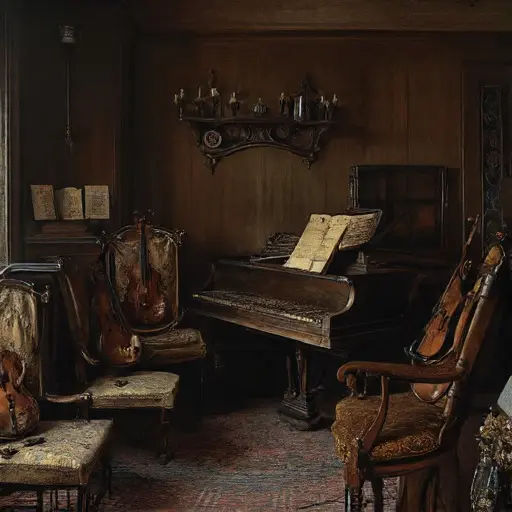
Dust lies softly over the music room, gathering in corners as if listening for a final chord. The once-vibrant rugs, woven in Florentine patterns, now fade beneath scattered pages of exercises and half-legible drafts. A faint scent of old varnish and lamp oil rises from the piano’s cracked soundboard.
Something here folded into silence long ago—an unfinished phrase, an unresolved gesture. In the stillness, one thinks of a missing motif, the smallest fragment of meaning that should connect everything but doesn’t.
A Composer’s Years Shaped Within These Walls
This room bears witness to the life of Giovanni Paolo Marcelli, a composer and music tutor born in 1872 near Verona. Educated modestly yet fiercely determined, he transformed this music room into both conservatory and sanctuary. A stack of Italian songbooks, their spines softened by use, sits beside a copper inkwell engraved with his mother’s initials. His temperament appears in every detail: chairs arranged in careful arcs for pupils, a chalkboard covered in delicate staves, and a leather folio bulging with notated fragments.
Giovanni’s routine unfolded in measured harmony. He rose at dawn to sketch melodies at the piano, taught pupils through late afternoon, then revised compositions deep into the night. On one side table rests a small carved lion—gift from his older brother Marco Marcelli—kept there for luck during premieres. A kettle sits on a cast-iron trivet, rim stained from countless cups of chicory brew. Though the work was steady rather than glamorous, his progress was real: performances in salons, polite reviews in regional journals, and an increasing demand for instruction.
A Brilliant Season, Subtle Tensions
During his strongest years, Giovanni expanded the room for more ambitious teaching. A harmonium was squeezed against the wall, its bellows patched with decorative lacquer. A tall cabinet stores quills, strings, and imported scores from northern Europe. Several autographed editions suggest correspondence with fellow musicians abroad. He even built a makeshift echo chamber beneath the floorboards by layering thin cedar boards—a quirk that lent his compositions a distinct resonance during rehearsals.
Yet small upheavals accumulated. A marked dip in the tuning fork’s accuracy is scribbled in the margins of his notes. The piano’s dampers show uneven wear, as though he struck certain chords repeatedly in frustration. Pupil rosters, once neatly ordered, are scrawled over with cancellations. On a distant shelf, a pile of parchment drafts shows frantic crossings-out, the handwriting taut, nearly tearing through the paper.
Hints of Collapse After the TURNING POINT
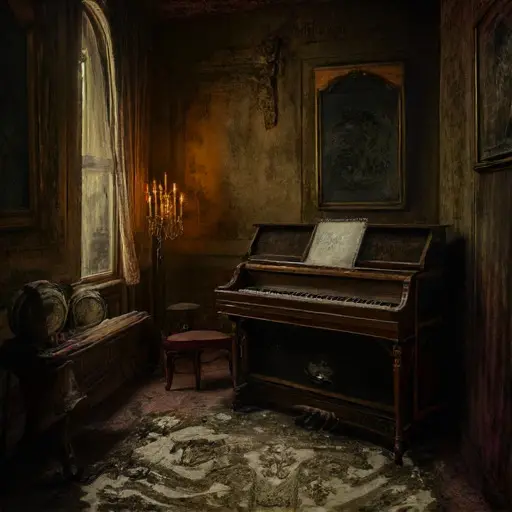
One evening’s disruption split Giovanni’s measured life. A violoncello bridge lies snapped inside its velvet case, an accident he would never have ignored. The piano bench, usually aligned with staunch precision, is skewed sharply to the left. On the chalkboard, a sequence of intervals ends mid-notation, chalk dropped beside a fractured eraser stone. Something unsettled his discipline—perhaps a dispute with a patron, or a letter bearing unwelcome news from Marco abroad. A half-burned envelope rests in the hearth tray, address smudged, suggesting hesitation rather than destruction.
His methodical teaching faltered swiftly. A teaching contract sits unsigned on the escritoire; blotches of ink mark where he attempted a signature and stopped. One drawer contains a ledger of payments, the final pages riddled with corrections, numbers overwritten until unreadable. A physician’s tonic bottle—unrelated to any previous tales—stands empty, suggesting sleepless nights rather than physical illness. More telling is the single string from a mandolin wound tightly around a chair arm, frayed at the point where tension exceeded strength.
Unsettling Discoveries Above the Rafters
Behind the harpsichord’s decorative paneling, a thin seam separates from the molding. Pressing it inward reveals dust-bowed boards and a narrow crawlspace. Within lies an unfinished manuscript pinned between two tuning pegs: the first page immaculate, the following pages torn out entirely. The margin bears a penciled admission: “Not ready… must leave before they return.” The identity of “they” stands unmarked.
Elsewhere, tucked beneath the piano’s pedals, lies a folded apron from one of Giovanni’s pupils, its corner embroidered with an unfamiliar monogram. A small tin of sealing wax rests beside it, lid dented. The room offers no reason for these objects to share hiding places, except that they were removed in haste.
The Final Quiet Note Uncovered
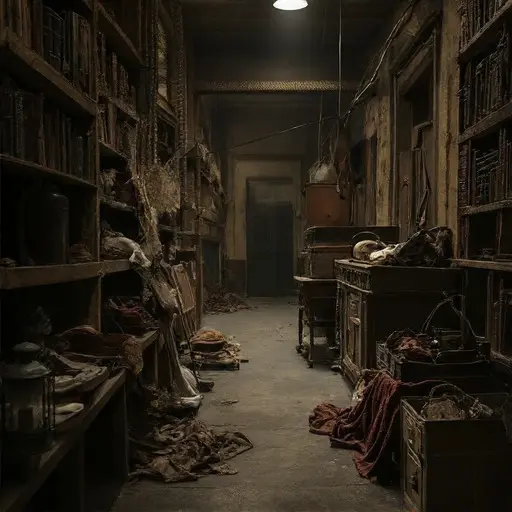
Within a slim book of madrigals, slid sideways as though hidden at the last moment, rests a torn scrap of staff paper. Only four bars remain: a hesitant phrase, drifting upward before falling unresolved. Beneath it, written in Giovanni’s thinning hand: “For the one I failed.” Nothing else. No signature, no date, no explanation.
The chord progression stalls on its penultimate note, refusing to resolve. Whatever happened—betrayal, departure, accusation, or simple exhaustion—echoes through every abandoned measure of this place.
And the house, with its silenced instruments and waiting shadows, remains abandoned.
