The Lost Ledger of Hawthorne’s Abandoned Clockmaker’s Workshop
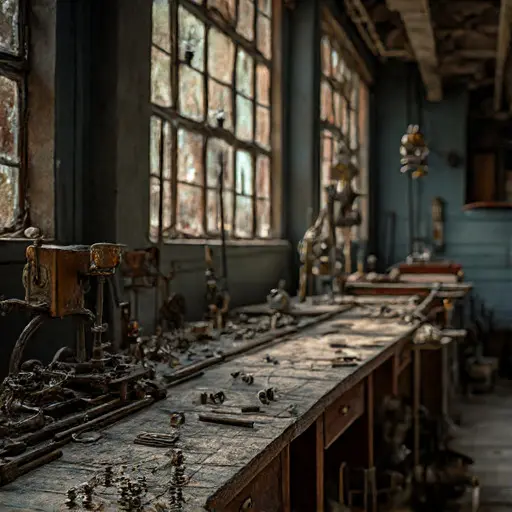
The workshop exudes quiet precision. On the central bench, the ledger lies open with partially drawn schematics, screwdrivers and tweezers left in mid-motion, and unfinished clock cases arranged as if recently handled. Every surface bears the faint imprint of hurried, interrupted labor, the quiet nearly tangible, resonating with the lost rhythm of mechanical work.
Measuring Time with Exactitude
The workshop belonged to Alfred Hawthorne, professional clockmaker (b. 1872, Vienna), trained in horology and mechanical engineering. His handwriting appears in the ledger, customer orders, and personal notes. A small photograph depicts his brother, Matthias Hawthorne, organizing gears and spare parts. Daily routines included morning inspection of mechanisms, midday assembly of complex movements, and evening recording of calculations in the ledger. Alfred’s temperament was meticulous, patient, and precise; every cog aligned, every pendulum measured, reflecting his lifelong dedication to perfect timekeeping and the careful management of every tool at his disposal.
Frozen Movements and Suspended Craft
Clock faces remain half-assembled, gears scattered, and tiny screws left on benches. The ledger ends abruptly mid-diagram, ink smudged across the page. Tools rest as if recently set down. Even delicate balance wheels lie idle. The careful placement of clocks, tools, and schematics conveys sudden interruption rather than gradual neglect, with every component poised mid-creation and the faint scent of machine oil lingering subtly in the air, emphasizing the suspension of work that once defined the workshop.
Decline Through Health and Obsolescence
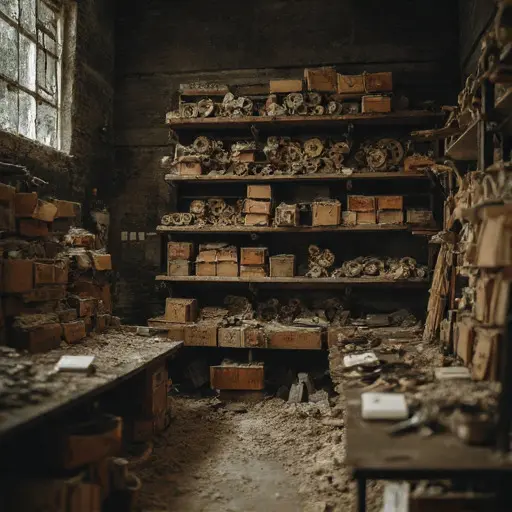
Later entries in the ledger are sporadic. Customer orders remain unfulfilled. Hawthorne’s decline was caused by failing eyesight and the advent of factory-made clocks, making his hand-crafted work increasingly unprofitable. Daily assembly slowed and then ceased entirely, leaving every tool, movement, and ledger entry mid-completion, neglected yet arranged with exacting care.
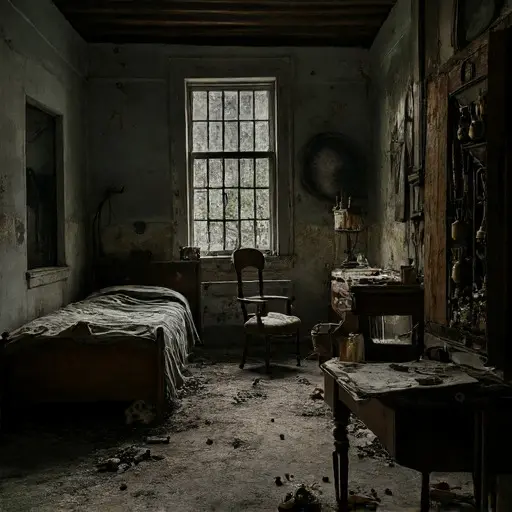
The final discovery is the silence of interrupted precision. No explanation survives. The house remains abandoned, mechanisms idle, clocks incomplete, and every ledger frozen mid-design, a testament to halted labor, disrupted vocation, and unresolved horological mastery lingering quietly in every room.