The Lost Herrera Puppet-Carving Nook Where the Lines Unraveled
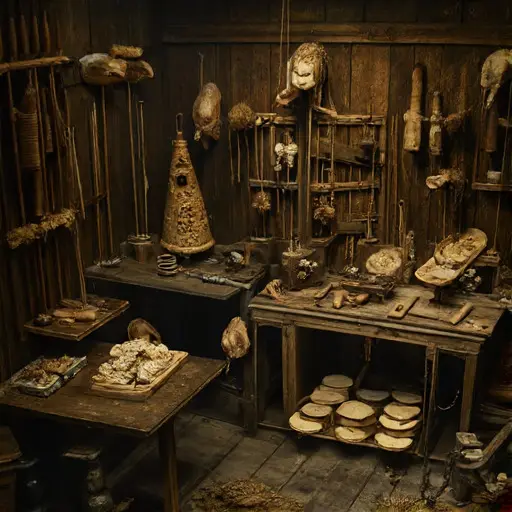
A muted hush clings to the cramped nook. On the central bench lies a puppet torso, its left side carved cleanly, its right side bearing hesitant gouge marks edging into rough uncertainty. A brush loaded with ochre rests against a palette where color has dried mid-blend.
A marionette crossbar leans awkwardly, one peg snapped in half. Nothing looks forced or rushed—only the quiet retreat of a once-assured discipline.
A Carver Who Worked in Silence, Grain, and Moving Strands
This puppet-carving nook belonged to Santiago Mateo Herrera, marionette maker and stage craftsman, born 1871 in Granada. Raised among modest woodworkers, he trained under a traveling puppeteer who taught him to balance weight in articulated joints, to carve expressive brows from a single stroke, and to tie linen threads so that motion felt like breath. A frayed red ribbon from his sister, Isabel Herrera, is looped around a drawer of spare dowel pins.
His days unfolded in careful ritual: dawn shaping of heads and hands, midday threading of crossbars, dusk painting cheeks under a steady lantern. Tools remain arranged with quiet reverence—gouges sorted by curve, pigments warmed gently, string bundles coiled like sleeping serpents. Patrons once praised his marionettes for their poise, humor, and uncanny subtlety.
When Articulation Slipped Away from Its Center
In his strong years, the nook thrummed with gentle mastery. Carved limbs dried beside patterns traced from Andalusian folk tales; control strings hung in neat verticals ready for rehearsal. Completed figures rested in cabinets, their limbs aligned with reassuring precision.
But disruptions crept in. A shoulder joint stiffens oddly. A carved lip twists off-character. A control string knots where it should glide. His commission ledger lists a troupe director’s order written, crossed out, rewritten, then blurred by a pigment smear. A terse Spanish note beside it reads: “Dicen que arruiné su obra”—they say I spoiled their performance.
Rumor drifted through small theaters: during a key festival staging, one of Santiago’s new marionettes faltered—its right arm stiffening mid-gesture, its head dipping out of rhythm, casting an unintended mockery on a solemn scene. Others whispered he refused the director’s demand to exaggerate features for comic effect, fueling quiet resentment.
The TURNING POINT Scored Into Wood and Hesitation
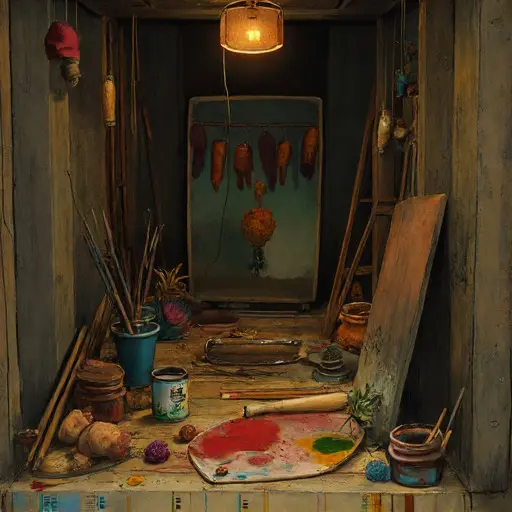
One dim evening left its subtle trace. A principal puppet for the disgruntled troupe rests on a cushion—its torso carved with perfect contour, its limbs cut from a finer cedar, yet its right knee joint gapes slightly where the dowel was never fully seated. A pot of lacquer sits uncapped, surface skinning over. A spool of linen thread has unwound itself across the bench as though dropped mid-motion.
Pinned beneath a curling sketch template is a torn scrap: “Exigen compensación por vergüenza.” They demand compensation for disgrace. Another fragment, water-blurred by a rinse cup, reads: “Seguí la figura… rehúsan creerlo.” I followed the form… they refuse to believe it. His handwriting tilts, shrinking like a retreating voice. Even his thread spools—normally coiled in bright symmetry—lie scattered as if brushed aside in a moment of doubt.
Across the floor, a marionette shoe lies unfinished, its sole half-sanded, its tiny buckle uncarved.
A Small Hollow Behind the Prop Cabinet
Behind the cabinet stacked with miniature props—fans, lanterns, tiny books—a concealed panel slides open. Inside rests a puppet Santiago meant for Isabel: its face serene, its hands carved with tender delicacy, its lower limbs only sketched in pencil on rough cedar. A folded note in his wavering script reads: “Para Isabel—cuando mis manos vuelvan a escuchar.” For Isabel—when my hands learn to listen again. The last word dissolves into faint graphite.
Beside this unfinished figure sits a pristine reel of linen thread, untouched, awaiting knots he could no longer trust himself to tie.
The Last Slackened Movement
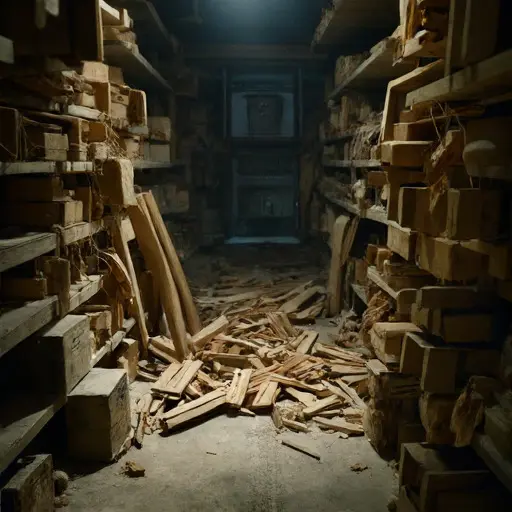
Inside a shallow drawer beneath the hanging frame lies a test limb: its shoulder joint rotates cleanly before the elbow collapses into a slack angle, pulling the entire figure off-balance. Beneath it Santiago wrote: “Even motion fails when resolve unthreads.”
The puppet-carving nook sinks back into cedar-scented quiet, gestures suspended in half-formed stories.
And the house, holding its abandoned marionettist’s chamber, remains abandoned.
