The Lost Darzi Weavers’ Loom Room Where the Threads Wandered Off
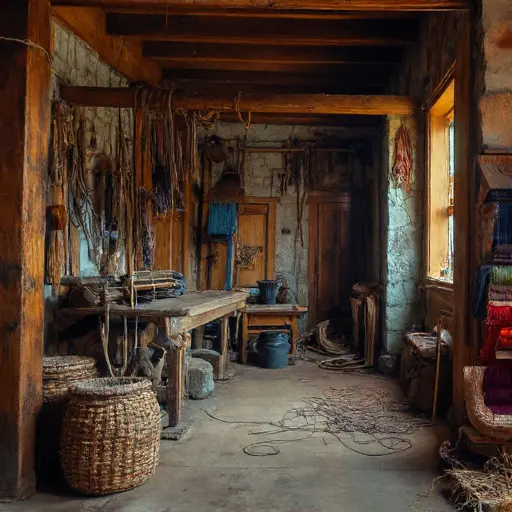
Silence pools between the beams. A sari border in progress stretches across the main loom, pattern broken mid-repeat. A shuttle lies on its side, thread unraveling toward the treadles.
A comb’s wooden teeth catch a faint glint of lamp soot. The room hums with the ghost of rhythmic foot-press and hand-pull—motions that once bound cloth into form, now severed without explanation.
A Weaver’s World Held Together by Rhythm
This loom room preserves the work of Samina Yusuf Darzi, textile weaver and pattern designer, born 1874 in a village near Lahore. Raised among modest dyers, she trained under a traveling master who taught her the mathematics of warp tension and the quiet intuition of color balance. A narrow silk ribbon from her sister, Mehreen Darzi, is tied around a loom beam, faintly frayed.
Samina’s days began before dawn: stretching warps, setting heddles, aligning color sequences. By afternoon she wove borders with intricate geometry; at night she finished delicate edging under a dim lantern. Her tools remain arranged by care—shuttles grouped by thread weight, heddles wound neatly, pattern cards tucked into woven baskets. Merchants prized her saris and shawls for their consistent tension and clarity.
Patterns That Once Flowed, Now Slightly Askew
In thriving years, fabric lengths draped over rails in brilliant hues. Indigo vats from coastal traders stood sealed and ready. Spindles rolled with dependable equilibrium. On a high shelf, finished borders shimmered with saffron-bright motifs.
But subtle irregularities seep through. One border repeats its motif out of alignment. A skein of thread knots in an unusual clump. A heddle hangs half-twisted, as though caught mid-adjustment. Her ledger lists a notable commission name written, crossed out, rewritten, then scratched heavily. Near it, a small Urdu note reads: “They claim my pattern lies.”
Rumors grew: a wealthy patron accused her of misweaving a ceremonial textile, claiming distorted motifs. Others said she refused to emulate imported designs that clashed with her own disciplined geometry.

The TURNING POINT Tangled in Color and Tension
One evening left signs too precise to ignore. A half-finished sari border droops unevenly across its warp, tension lost in the final inches. A pattern card slipped beneath the loom shows several motifs crossed out in frustration. A broken shuttle tip lies near the treadle beam.
Pinned under a warp weight is a note: “They insist I misread their design. I did not.” Another fragment mutters: “Demands beyond my means… unjust.” The ink trails reduce to faint scratches at the edge of the paper. Even the reed comb—her most consistent companion—bears a crack near the bracing line.
Across the room, scattered warp threads appear cut, not broken, each end fraying into uncertainty.
A Hidden Hollow Behind the Warp Rack
Behind the rack of warp beams, a loose plank reveals a small recess. Inside lies a carefully folded textile strip—her signature border pattern—woven flawlessly for several inches before stopping abruptly. The colors balance beautifully until the final motif, which remains only loosely sketched in thread.
A note in Samina’s neat handwriting reads: “For Mehreen—when alignment returns.” The last word thins, as if the pen tip hesitated. The strip’s edge curls gently, untouched by finishing starch.
Beside it rests a bundle of dyed threads in rare coastal hues, set aside for a commission never begun.
The Last Soft Thread of Evidence
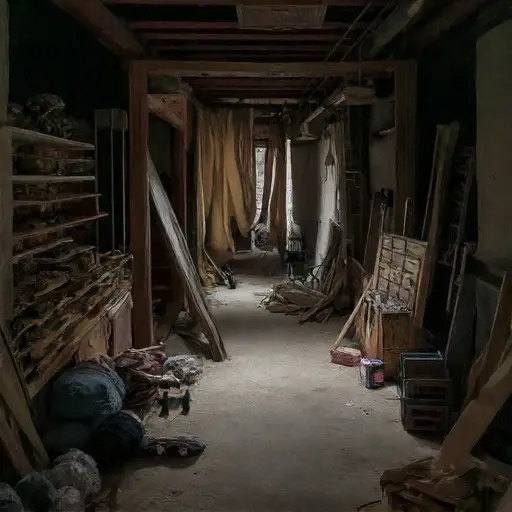
Inside a shallow drawer near the frame loom lies a practice swatch: a clean geometric motif disrupted by a sudden wobble in the lines. Beneath it Samina wrote: “Tension falters when belief unsettles.”
The loom room folds back into its fiber-filled quiet, shuttles unmoving in their final posture.
And the house, holding its abandoned weaving chamber, remains abandoned.
