The Lost Codex of Sinclair’s Study
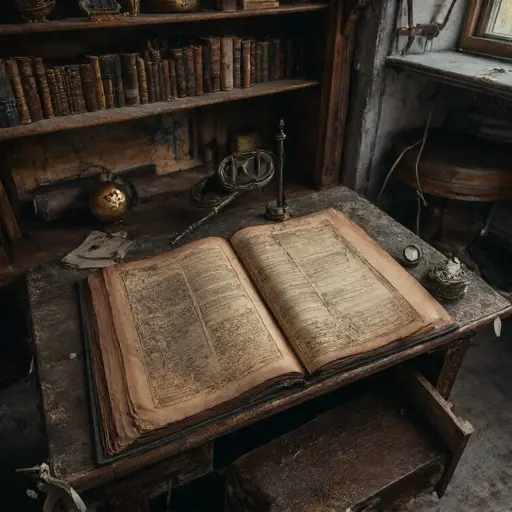
The Study hums with frozen inquiry. Here, the codex guided every calculation: observations recorded, formulas noted, diagrams traced. Quills rest mid-stroke, books lie open, and ink wells are half-filled.
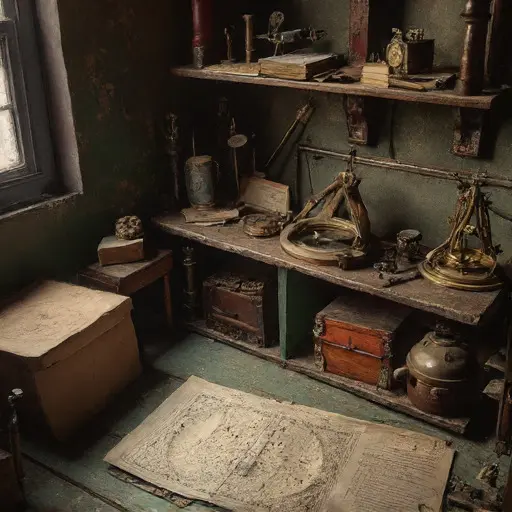
The absence of movement leaves a quiet tension, each object preserving the memory of scholarly labor abruptly interrupted. Even faint impressions of compass points on parchment suggest measurements left incomplete.
Pursuit of Knowledge
This study belonged to Edmund Sinclair, natural philosopher and amateur astronomer (b. 1872, Edinburgh), trained in British universities and private laboratories. His skill is evident in precise sketches of celestial bodies, handwritten formulae, and annotated reference texts. A small note pinned to a shelf references his mother, Margaret Sinclair, reminding him to “complete observations on lunar phases.” Edmund’s temperament was meticulous, analytical, and patient; ambition focused on documenting natural phenomena, preparing papers for scientific societies, and refining observations into precise diagrams. The careful arrangement of instruments and open notebooks reflects daily routines governed by discipline and quiet focus.
Experiments Left Unfinished
On the desk, a partially inscribed codex shows diagrams abruptly halted mid-page. Quills and measuring instruments lie untouched, dust settled into every line of writing. Loose notes, sketches, and calculation sheets remain scattered, evidence of repeated experimentation abandoned mid-study. Each unfinished observation reflects suspended intention, left unresolved. A faint smudge of ink at the margin hints at a calculation that may have been critical, yet no record clarifies its outcome.
Signs of Decline
Notes, sketches, and partially completed diagrams reveal repeated revisions; formulas recalculated and drawings retraced. Edmund’s decline was physical: deteriorating eyesight and a tremor in his hands hindered delicate measurements and writing. Each unfinished codex embodies halted intention, intellectual labor curtailed by bodily limitation, leaving inquiry permanently suspended.
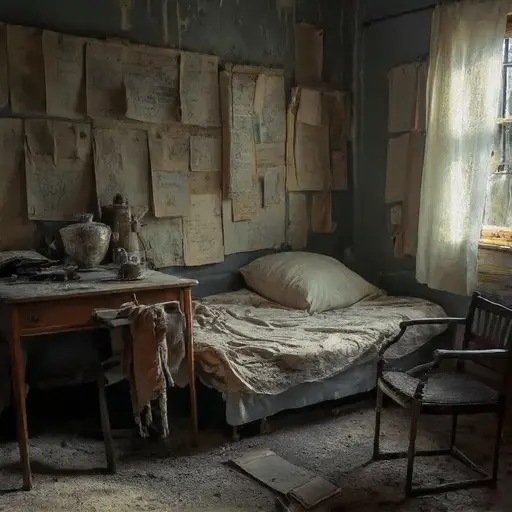
In a drawer beneath the desk, Edmund’s final codex remains half-inscribed, quills poised yet idle.
No explanation exists for his disappearance. No apprentice returned to continue his work.
The house remains abandoned, its instruments, writings, and codex a quiet testament to interrupted scholarship and unresolved devotion.