The Lost Choudhury Textile-Dyeing Loft Where the Colors Bled Beyond Their Line
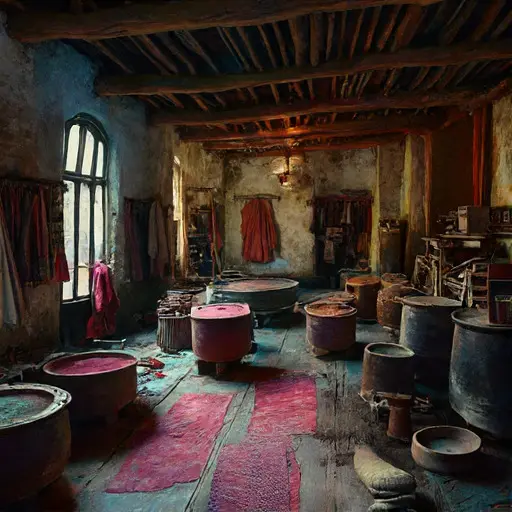
The loft breathes a humid quiet. On the central bench lies a half-printed textile, its motifs crisp on one side and blurred on the other, as though the block slipped at a decisive moment. A wooden stamp, floral and carefully carved, sits crusted with dried madder.
A stir paddle leans against a vat’s rim, its handle stained in a trembling transition between gold and red. Nothing shattered—only the soft collapse of precision once guided by steady rhythm.
A Dyer’s Life Built on Heat, Pattern, and Memory
This textile-dyeing loft was once the working world of Anirban Ratan Choudhury, block-printer and dyer, born 1870 in a district near Calcutta. Raised among modest cloth merchants, he learned under a traveling printmaker who taught him the careful heating of dye baths, the pressure needed for block alignment, and the importance of regulating humidity for colorfastness. A braid from his sister, Nalini Choudhury, is tied to the handle of his largest indigo vat.
Anirban shaped his days with measured cadence: dawn prepping pigment slurries, midday stamping patterns across stretched cloth, dusk rinsing dried lengths under lantern glow. His tools remain arranged with gentle deliberation—blocks stacked by motif group, ladles cleaned to near shine, vats ringed with cloths marked by previous work. Patrons once loved his textiles for their balanced colors and repeating harmony.
When the Reliable Routines Began to Blur
In earlier years, the loft brimmed with vivid purpose. Indigo cakes from Dhaka traders sat neatly on shelves. Sun-warmed cloths cooled on wooden racks, drying into crisp vibrancy. Patterns aligned cleanly, each repetition whispering of practiced patience.
Then disturbances spread. A floral repeat wavers along its seam. A wash of turmeric dries unevenly. A block’s carved edge chips into an unintended notch. His commission ledger bears a wealthy matron’s order written, crossed out, rewritten, then marked with a smear of dye. A quick Bengali note beside it reads: “She says I ruined her garments.”
Word carried through the market: the patron accused him of producing fabrics that bled their color during a gathering—staining garments and reputations alike. Others whispered he refused to darken the palette to her liking, prompting quiet retaliation.
The TURNING POINT Soaked into Cloth and Hesitation
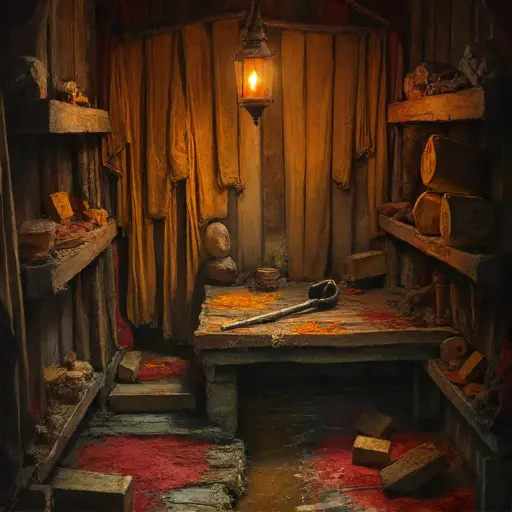
One night left its subtle testimony. A commissioned textile hangs near the main vat—top motifs aligned with flawless geometry, lower rows diffused into indecision. A stirring rod lies split along its grain. A bowl of turmeric paste has hardened into cracked layers along the rim.
Pinned beneath a crumpled cloth tag is a torn scrap: “They demand repayment for disgrace.” Another fragment, its ink feathered by damp dye, reads: “I followed the measures… they deny it.” His handwriting weakens as though he lifted the nib after each word. Even the printing blocks—normally kept in a measured stack—are tilted out of order.
Across the bench, a length of cloth remains half-wrung, one end stiff with dried pigment, the other still pale.
A Recess Hidden Behind the Drying Racks
Behind the tall array of drying racks, a slatted board slides inward. Inside rests a small, incomplete textile: its border pattern laid with serene clarity, its center left blank save for faint chalk outlines. A folded note in Anirban’s wavering script reads: “For Nalini—when the balance sets again.” The last word fades into watery graphite.
Beside it lies a clean cotton length, its fibers untouched, awaiting the pattern he could not begin.
The Final Unsteady Motif
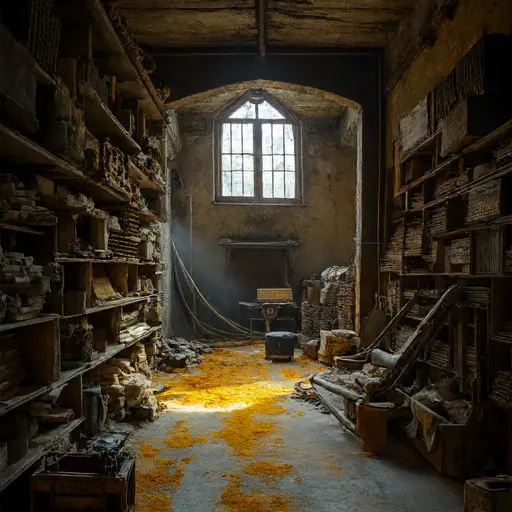
In a shallow drawer beneath the printing frame lies a test swatch: one row of motifs stamped with perfect pressure before the next row bleeds outward into blurred silhouettes. Beneath it Anirban wrote: “Even pattern dissolves when resolve bleeds.”
The textile-dyeing loft exhales into pigment-scented quiet, colors waiting in half-formed memory.
And the house, holding its abandoned dyer’s chamber, remains abandoned.
