The Lost Arendt Bookbinding Vault Where the Spines Slipped Loose
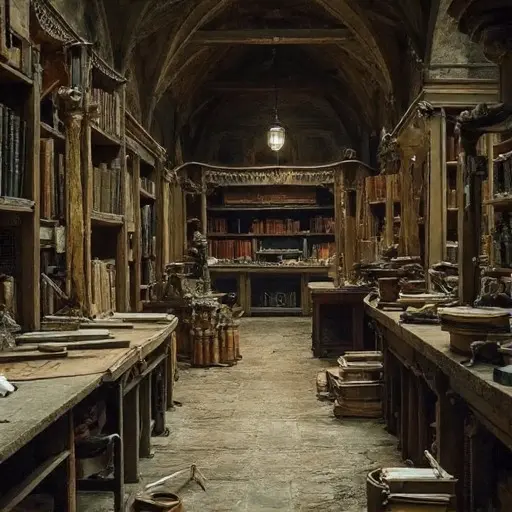
The vault hums with a subdued, papery quiet. The hanging lamp’s wick has burned to a nub, staining the ceiling with a smoke blossom. A quire of folded signatures lies splayed open, thread dangling as though mid-stitch.
Leather spines slump in a slanted row, their gilt flecks dulled under powdery residue. Nothing here is catastrophic—just the sense of work halted in the smallest, most intimate misalignments.
A Binder’s Order Shaped by Quiet Industry
This bookbinding vault preserves the work of Johann Markus Arendt, binder and finisher, born 1871 near Bremen. Raised in a modest family of printers, he learned to sew, press, and trim under the eye of a traveling journeyman. A small embroidered scrap from his sister, Elsa Arendt, sits tucked under a board shear—its stitches recalling lighter days.
Johann measured his life in gatherings and signatures: mornings folding sheets at precise angles, afternoons sewing on linen cords, evenings applying leather and tooling gold leaf. His tools remain placed in methodical grids—awls sorted by thickness, bone folders wrapped in cloth, pastes stored at careful consistencies. His bindings, once prized by merchants and private collectors, carried dependable symmetry.
A Flourishing Craft, Then Subtle Unease
The vault once held the calm of labor well-understood. Marbled endpapers from Hamburg traders fill a crate beside the press. Spools of waxed linen thread shine under a lantern’s rim. A ledger of commissions bears neat columns of finished works, each marked with steady confidence.
But fibrils of disorder slip in. A gilding roll lies crooked, half-cleaned. One binding’s headband sits fractionally too high. Paste has dried along the rim of a pot Johann usually kept immaculate. A set of signatures is trimmed unevenly, edges feathered as though the blade caught. His ledger shows a client’s name circled twice, then crossed out in haste.
Rumors later hinted that a collector accused him of mishandling a rare volume, claiming warped boards or faded tooling. Others whispered of disputes over replacement pages—alleged substitutions for originals. No certainty remains, only these echoing details.
The TURNING POINT Embossed in Silence
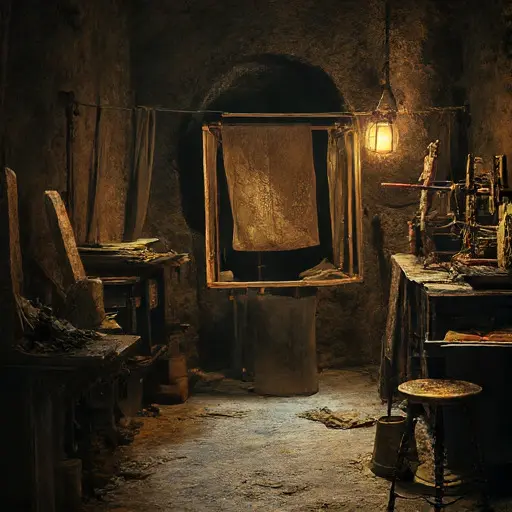
One late night left careful scars. A gilt spine, nearly finished, sits in the laying press with its title imprint smeared. A bone folder lies cracked along its center. A folded note pinned under a heavy volume reads, “Client says I altered the folio count—untrue.” The ink bleeds slightly, as if touched by damp fingers.
A second scrap mentions “replacement sheets demanded,” though Johann rarely agreed to such work without documentation. Tools around the press bear signs of abrupt handling: paste strokes hardened mid-motion, gilding rolls shifted awry, the sewing frame’s cords untied but not removed.
Even the board shear—once his pride—rests off its track, as though pushed too far in a moment of doubt.
A Recess Behind the Board Shear
Behind the tall board shear, a loose panel gives way with a muted sigh. Inside the small cavity lies a tightly wrapped parcel of folded signatures—pristine, perfectly sewn, but lacking boards or spine. A note stitched lightly to the first gathering reads: “For Elsa—when the count is trusted again.” The final words drift into faint, broken lines.
Beside the signatures rests a gilt stamp of a small oak leaf, its surface worn from polishing. It appears untouched since the night uncertainty settled in.
The Last Folded Edge
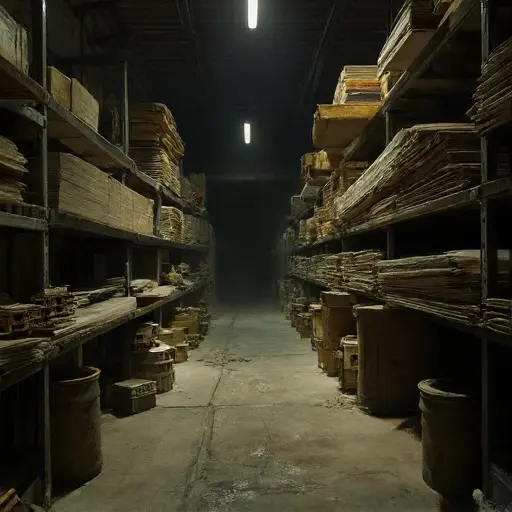
Inside a drawer near the sewing frame lies one final fragment: a test spine, half-tooled, the gold leaf flaking where pressure faltered. Beneath it, Johann wrote: “Alignment failed at the truth they questioned.”
The vault settles again into its papery hush, signatures still and waiting.
And the house, holding its abandoned bookbinding chamber, remains abandoned.
