The Linewatch House at Alder Rail
The Linewatch House sits in a quiet forest clearing where abandoned railway tracks cut a straight, rusting path through the trees. Under soft overcast daylight, the entire scene is evenly lit, with muted tones and no harsh shadows. The forest feels restrained here, as if it naturally yields space to the geometry of the tracks and the long, deliberate presence of the house beside them.
The structure is a long, narrow Victorian residence built from pale brick with white timber accents. Its elongated footprint runs parallel to the railway line, reinforcing a sense of quiet observation rather than domestic isolation.
The façade is orderly, with tall sash windows repeating in a disciplined rhythm along its length. However, subtle irregularities emerge as the eye follows the building: window spacing gradually tightens toward one end, creating a gentle compression that remains structurally consistent and physically plausible.
Despite this distortion in rhythm, the exterior walls remain perfectly straight and intact. The roof is a simple dark slate construction, clean and stable, with a single continuous ridge line extending the full length of the building. Two chimneys stand at opposite ends, evenly proportioned and undamaged, reinforcing the impression of careful, functional design rather than neglect.
Along the track-facing side runs a covered wooden platform that closely resembles a private railway station platform. It is fully intact, supported by evenly spaced posts and simple railings softened by time. Yet the spacing of these supports does not align with the window grid behind them, producing a layered misalignment between two systems of order: architectural and infrastructural.
A side entrance opens toward the railway line itself. The door remains closed and structurally sound, framed in modest Victorian trim. The steps leading to it align not with ground level but with the platform height, creating a subtle dual-access arrangement that suggests intentional coordination with train boarding rather than conventional residential entry.
Windows across the structure remain clear but lightly dusted on the interior. Curtains vary in placement—some fully drawn aside, others left partially closed—creating an uneven pattern of visibility into the rooms beyond. The interiors appear elongated, with corridor-like spaces running parallel to the tracks, reinforcing the house’s directional design.
The railway outside is overgrown but still clearly defined. Rusted rails emerge intermittently from grass and gravel before disappearing into dense forest on either side. No trains remain, and the line appears long abandoned, yet its presence continues to organize the spatial logic of the environment.
Inside, the rooms maintain a quiet, linear order.
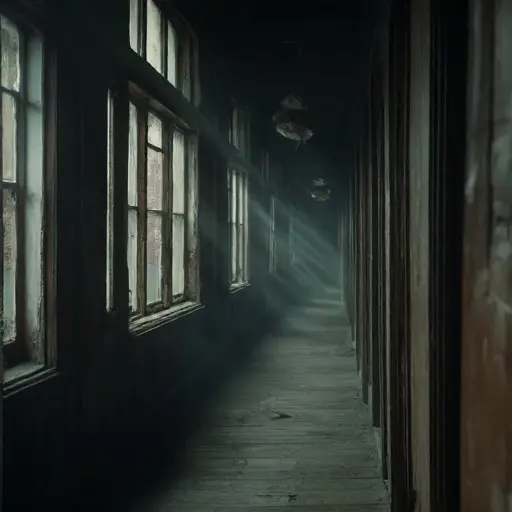
The interior layout feels almost infrastructural in its discipline. Rooms connect in a straight progression, with doors aligned in sequence like checkpoints along a monitored route. The architecture subtly reinforces the idea that this was never purely a home, but a place designed to observe, measure, and anticipate movement along the tracks outside.
In the main living spaces, furniture remains intact and modestly arranged. Tables and chairs sit in functional positions, while shelving and storage are built into the walls in a consistent, repetitive pattern. Nothing appears disturbed, only unused for a long period. The air is still, and the light entering through the windows is flat and consistent, echoing the overcast sky outside.
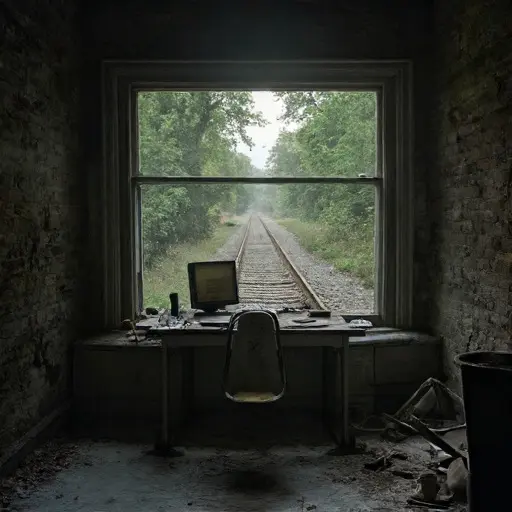
Vegetation remains minimal around the foundation of the house. Short grass and scattered wild plants occupy the immediate perimeter, but the forest itself holds back at a respectful distance. This creates a narrow corridor of visibility along the railway, emphasizing the house’s role as a fixed observational point within the landscape.
The entire structure feels neither damaged nor forgotten in a traditional sense. Instead, it appears paused in function, as though its purpose was tied directly to the passing of trains that no longer arrive. The house remains aligned with the tracks, the platform remains ready, and the forest continues to grow around a system that has stopped moving but not collapsed.
It is a residence built for watching a line that no longer carries anything—quiet, intact, and permanently oriented toward absence.