The Lilac Composite Manor of the Quiet Clearing
Close, slightly off-center front view of an abandoned Victorian family manor fills most of the frame, emphasizing façade structure, layered materials, and architectural texture. The camera sits at eye level with a subtle rightward angle, creating depth across the building’s irregular geometry. Lighting is soft, overcast natural daylight—bright, evenly diffused, and shadow-neutral with no direct sun or harsh contrast.
The manor is a compact Victorian estate with a sculpted, vertically layered composition. It is built from pale ivory stone combined with sections of soft lilac plaster and muted turquoise brick accents, creating a refined but unusual patchwork appearance shaped by multiple construction phases.
Despite its variation, the design feels intentionally cohesive, as if each addition was carefully integrated into a unified vision over time.
The structure is defined by a central three-story block flanked by mismatched architectural extensions. On the left, a narrow tower-like bay rises with stacked arched windows framed in faded cobalt blue. On the right, a wider and lower wing extends outward with elongated horizontal windows and soft coral trim that has faded into pastel tones. This asymmetry gives the manor a distinctive, organic “grown” quality rather than a strictly planned design.
The roof is steep and complex, formed from overlapping slate planes in cool gray, desaturated green, and faint violet hues. A decorative iron ridge crest runs along the roofline in worn teal, broken intermittently by chimneys of varying heights and styles, each subtly different yet structurally coherent.
The main entrance sits centrally but recessed, framed by a shallow stone arch with delicate carved floral detailing. The heavy wooden door remains intact, painted in a muted dusty rose with faint Victorian paneling still visible beneath gentle weathering.
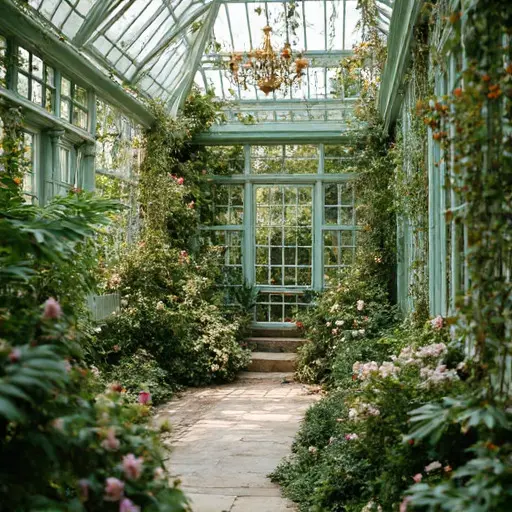
On the right wing, a glass conservatory projects outward like a lantern attached to the façade. Its structure is supported by pale mint-green ironwork with subtle brass accents. Through the clear but aged glass, dense plant life is visible—broad-leaf greenery, pale pink blossoms, and trailing vines arranged in controlled overgrowth under soft daylight.
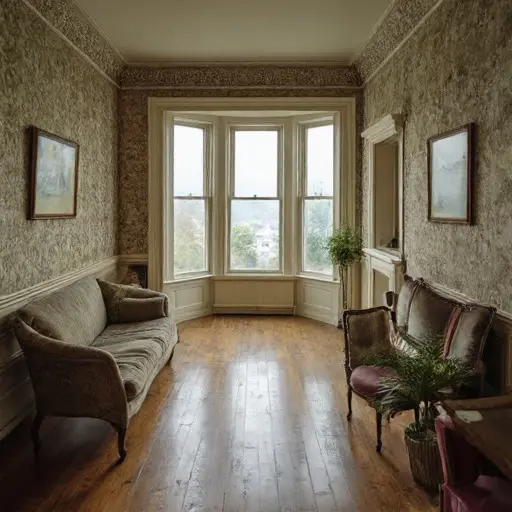
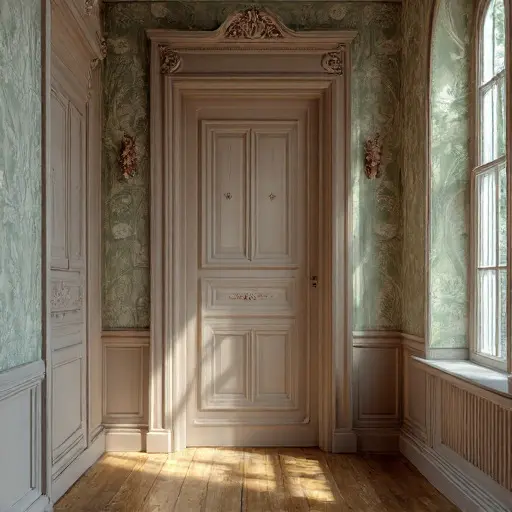
Through the main windows, interior Victorian rooms appear orderly and preserved, with floral wallpaper in cream, pale sage, and light blue tones, intact furniture arranged with care, and polished wooden floors reflecting diffuse sky light. The sense is one of suspension rather than decay.
Foreground remains simple and grounded: a short, slightly worn stone path leads directly to the entrance, bordered by fresh green grass and scattered small white and yellow wildflowers. The background opens into a bright, evenly lit forest edge with lightly spaced deciduous trees under a calm, neutral sky.
The atmosphere is cinematic and realistic—tight architectural framing, strong material clarity, varied Victorian construction phases unified into one estate, and a quiet sense of abandonment preserved under soft natural daylight.