The Leaning Tower House on the Windswept Plateau

The Romanesque-Gothic hybrid Victorian manor was constructed on a windswept alpine plateau where fractured stone ground and sparse grasses defined a harsh, elevated environment. Built from pale basalt-grey stone interwoven with streaked alabaster panels, the three-story residence was conceived as a study in weight, curvature, and controlled asymmetry. Its façade appears softly bulging, as though the masonry has slowly responded to centuries of wind pressure across the plateau.
Thick rounded arches—each with subtly varying curvature—frame entrances and windows, while clustered window groupings break traditional symmetry in favor of distributed structural rhythm. Above, an uneven cascading roofscape of dark slate and oxidized copper sheets shifts in layered planes, designed to shed both snow and wind turbulence while reinforcing the building’s grounded mass.
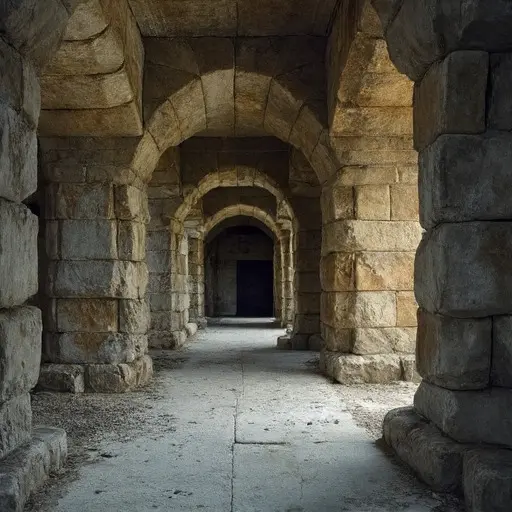
As environmental conditions on the plateau grew more extreme, the manor’s structural balance became increasingly influenced by freeze-thaw cycles and persistent wind shear. The central tower, already imperceptibly off-axis, began to exhibit more noticeable deviation over decades of exposure. Oxidized copper roof sheets darkened unevenly, while slate sections shifted incrementally under snow load redistribution. Vegetation remained sparse but persistent, with alpine grasses pushing through cracks in the surrounding stone ground and creeping toward foundation joints. Access routes deteriorated as erosion carved shallow channels across the plateau, isolating the estate from any nearby settlements and reducing maintenance to intermittent visits that eventually ceased entirely.
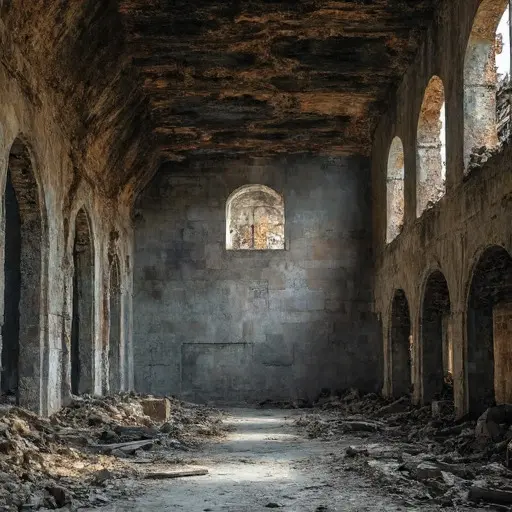
Today, the Romanesque-Gothic hybrid manor stands alone on the plateau, surrounded by cracked stone ground and sparse alpine grass bending under constant wind. The toppled stone sarcophagus-like garden ornament remains near the rusted iron gate, now partially swallowed by vegetation. The manor itself persists as a dense convergence of mass and erosion—its arches still holding their irregular curves, its tower subtly leaning against time, and its layered roofscape continuing to fracture light and weather across its surface in silence.