The Lavender House at the End of the Forest Lane
At the end of a forgotten forest lane, where chestnut and maple trees rise into a dense canopy overhead, a modest Victorian family house rests quietly in a small clearing. The trees do not crowd it so much as surround it, their branches filtering daylight into a soft, steady glow that settles across the leaf-covered ground. Moss spreads between old stones, and traces of a long-vanished garden still shape the edges of the clearing, slowly surrendering to the woodland.
The house is a two-story Victorian home painted in a faded dusty lavender, its once distinct color softened by years of rain, sun, and shade until it feels almost natural against the greens and browns of the forest. Cream trim outlines every edge—windows, corners, and rooflines—giving the structure a calm visual clarity without ornamentation or excess.
It feels like a home designed for living rather than display.
Its façade is gently asymmetrical, giving the house a lived-in character rather than rigid formality. On one side, a tall polygonal bay window projects outward through both floors, capped with its own steep little roof that breaks the main roofline in a subtle, deliberate way. On the opposite side, a broad covered porch wraps around the corner, supported by slender turned wooden columns that have softened with age.
The roof is composed of intersecting gables clad in weathered charcoal slate. Over time, moss has gathered in the valleys where roof planes meet, forming dark green seams that follow the building’s geometry. A narrow brick chimney rises slightly off-center near the rear, its placement reinforcing the house’s unplanned, family-grown evolution rather than architectural symmetry.
Windows are tall and varied, arranged according to interior rooms rather than exterior design logic. Some are paired, others singular, but all share thin divided panes that catch reflections of forest and sky. Behind several of them, lace curtains still hang in place, their fabric faded but intact, gently diffusing the light that passes through.
Around the base of the house, signs of former life remain quietly visible. A circular stone flower bed sits near the porch, now partially overtaken by grass. A weathered wooden bench rests beneath a maple tree, its surface softened by years of exposure. Sections of a white picket fence appear and disappear into the undergrowth, as if the boundary of the home is being slowly reabsorbed by the forest.
Ferns cluster at the foundation stones, and climbing roses have taken hold of the porch railing, their pale blossoms weaving through the wooden structure without overwhelming it. Nothing feels overtaken or ruined—only gently reclaimed.
The forest itself remains calm and open enough to let light in. The lane leading here is nearly gone, but still implied in the spacing of trees and the alignment of the clearing. The atmosphere is quiet, familiar, and deeply personal, as though the house still remembers the rhythms of daily life even if no one remains to continue them.
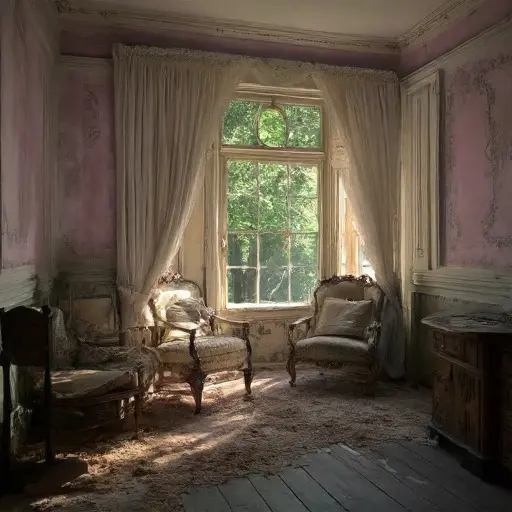
Inside, the front sitting room feels preserved by stillness rather than preservation. A faded rug lies over aged floorboards, and chairs remain arranged in conversational clusters facing a cold hearth. Dust rests lightly on surfaces, yet nothing appears disturbed, as if time simply slowed instead of ending.
The tall bay window fills one side of the room, casting angled light across the interior and reflecting the surrounding forest. From here, the boundary between inside and outside feels thin, almost negotiable, as branches and leaves move gently beyond the glass.
A narrow hallway leads deeper into the house, connecting rooms that follow the building’s asymmetrical shape. Doorways are slightly offset, floors gently uneven with age, and every surface carries the quiet evidence of long habitation rather than decay.
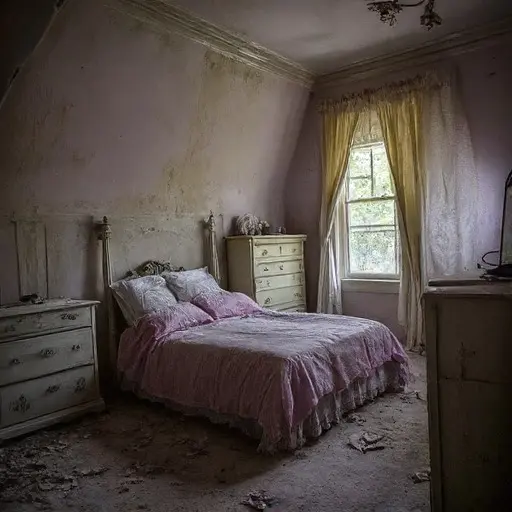
Upstairs, bedrooms sit beneath intersecting rooflines where the geometry of the house becomes more visible. Slanted ceilings and irregular corners give each room a slightly different character. Beds remain made, dressers still hold faint outlines of daily order, and windows open onto branches that move softly with the wind.
Nothing about the house feels abandoned in the dramatic sense. Instead, it feels paused—like a life interrupted at a quiet moment rather than erased.
And as the forest light shifts through the canopy and the clearing settles into evening, the lavender house remains at the end of the lane, unchanged in posture and presence, holding onto its ordinary history with a calmness that refuses to fade.