The Last Manuscript Machine
Some houses seem designed to shelter lives. Others seem designed to preserve them.
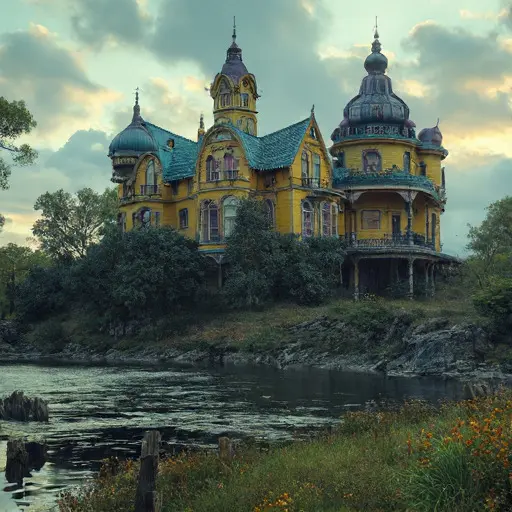
On the edge of a quiet lake where reeds sway against rolling grass and wildflowers scatter across the shoreline, an abandoned Victorian mansion rests in the unmistakable shape of a colossal antique typewriter.
Time has weathered its surfaces and softened its details, yet the structure remains immediately recognizable, as though a machine for writing stories had simply grown large enough to become architecture.
Its citrine-yellow lacquer exterior glows softly beneath years of age, while amethyst-purple trim outlines every curve and corner with surprising elegance. Above, a royal-turquoise roof crowns the structure, rising into a carriage-like observatory that overlooks the water beyond. Beneath an ocean-navy cloudbed sky streaked with fading evening color, the mansion appears less like a building and more like a forgotten instrument waiting for a final sentence.
The estate feels suspended between memory and invention.
Not abandoned in tragedy.
Abandoned in completion.
Architecture Written in Keys
The typewriter form reveals itself gradually as one approaches through the meadow.
Oversized key-shaped terraces spread across the front of the residence, their circular forms transformed into interconnected verandas and garden platforms. Elegant covered walkways stretch between them, occupying the space where sheets of paper might once have traveled through a real machine.
From certain angles, the illusion becomes extraordinary.
The house does not merely resemble a typewriter.
It behaves like one.
Each architectural element appears translated from function into habitation.
Rounded bay windows emerge between key-like forms. Decorative railings trace paths that once belonged to mechanical motion. Broad platforms and layered porches create a rhythm across the facade that resembles language frozen into physical shape.
Thin gold-foil wrought iron detailing follows every contour. Faded enamel lettering motifs remain visible along portions of the trim, their symbols softened by weather but still carrying hints of forgotten craftsmanship.
Nothing feels whimsical for its own sake.
Every detail contributes to the strange impression that stories themselves once occupied the structure.
Rooms Where Sentences Once Lived
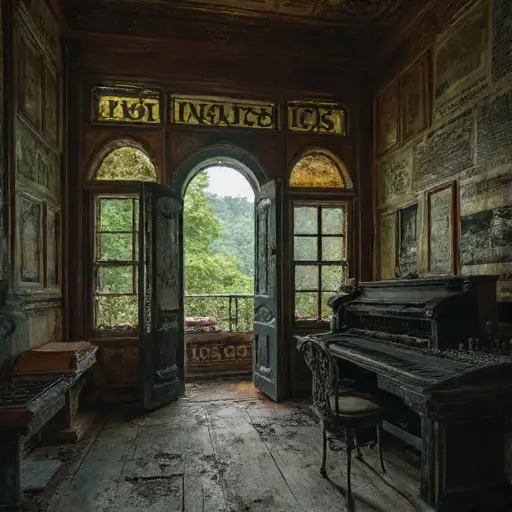
Inside, the mansion continues its quiet conversation with language.
Corridors curve through spaces that feel oddly sequential, as though rooms were arranged like paragraphs leading naturally from one thought to another. The carriage-shaped upper level houses a compact observatory whose windows face both lake and meadow, offering broad views of the landscape beyond.
The walls carry faint decorative motifs inspired by old typography and Victorian ornamentation.
Some patterns resemble flourishes once found in antique books.
Others suggest fragments of forgotten alphabets.
Yet no actual words remain.
Only traces.
The windows stand completely hollow and dark. No lamps glow within. No furniture waits beneath the frames. Wind passes freely through open rooms, carrying lake air, drifting seeds, and distant birdsong.
The silence feels less empty than unfinished.
As if the building paused mid-sentence and never resumed.
The Shoreline of Unwritten Things
Nature has reclaimed the estate with remarkable patience.
Grass grows between terrace stones. Wildflowers spill across former garden borders. Ivy climbs portions of the observatory structure, softening mechanical geometry into something almost organic.
Near the shoreline rests the most striking remnant of all.
A broken silver-gilt carriage mechanism sculpture lies partially collapsed among reeds and flowering plants.
Once it may have served as a decorative centerpiece celebrating the house’s unusual identity.
Now its fractured forms resemble scattered paragraphs from a manuscript lost to weather.
Metal fragments emerge from tall grass at unexpected angles.
Wildflowers bloom through broken framework.
The sculpture appears neither ruined nor preserved.
Simply absorbed.
A winding path threads between the giant key-shaped terraces before curving gently toward the water.
In places, meadow growth obscures the route entirely.
Elsewhere, stones remain visible beneath drifting grass.
Walking it feels like reading a damaged book whose missing pages somehow make the story more compelling.
The Observatory Above the Page
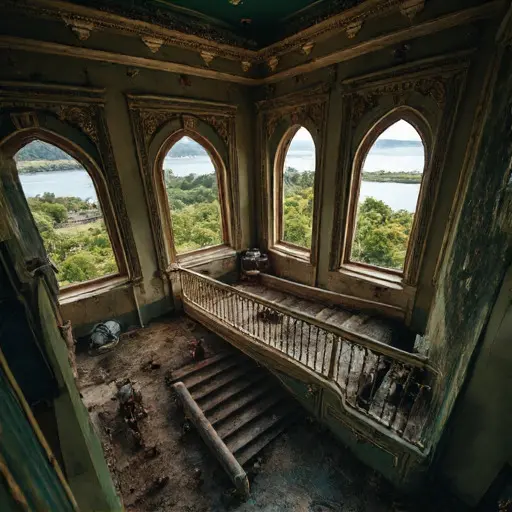
The carriage observatory rises above the mansion like a final chapter elevated above the rest of the narrative.
Here the architecture becomes quieter.
Smaller windows.
Narrow staircases.
Compact rooms designed for observation rather than gathering.
From these upper chambers, the lake unfolds beneath the darkening sky while meadow grasses ripple in slow waves toward distant horizons.
The mansion seems to watch.
Not actively.
Not consciously.
But through the persistence of its design.
Buildings often retain the gestures of their original purpose long after purpose itself disappears.
This one still faces outward.
Still frames views.
Still arranges its spaces around attention and reflection.
The machinery no longer functions.
Yet the intention remains.
A House Built for Stories
Most monuments celebrate certainty.
This mansion celebrates possibility.
A typewriter is not valuable because of what it contains. It is valuable because of what it might contain.
That same feeling permeates every corner of the estate.
The empty windows.
The unfinished pathways.
The silent observatory.
The shattered carriage sculpture.
Everything suggests potential rather than conclusion.
The house feels less like a repository of memories than a machine designed to create them.
Even now, abandoned beside the lake, it continues to evoke stories that were never written and journeys that never fully began.
As evening deepens and the ocean-navy sky settles over the meadow, shadows gather among the oversized keys and along the winding shoreline path. The reeds whisper against the water. Wildflowers sway beneath the fading light. Somewhere within the hollow rooms, the wind moves gently through open windows and empty corridors.
And there, beside the quiet lake, the great typewriter mansion rests patiently—an unfinished manuscript made architectural, exhaling softly like a dethroned emperor remembering the garden.