The Larkwell Pavilion Left Vacant After Estate Garden Failure
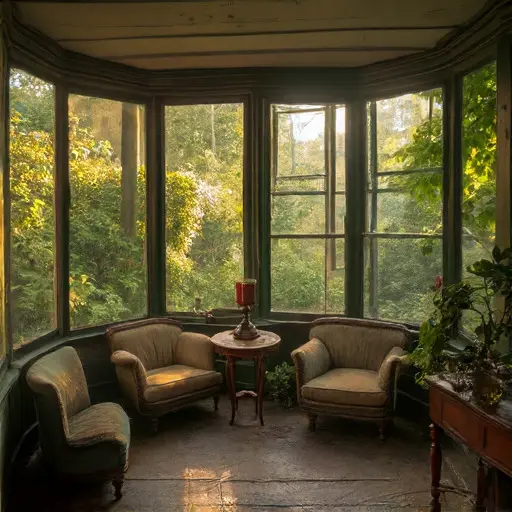
The Larkwell Pavilion was constructed in 1902 at the edge of the Harrington estate gardens, intended as a private retreat and seasonal reception space for the Harrington family—Sir Edmund Harrington, his wife Cecilia, and their daughter Anne. Unlike the main estate house, the pavilion was designed as an intimate architectural jewel, positioned at the boundary between formal landscaping and the surrounding woodland.
Its placement within the garden reflected the Harringtons’ emphasis on controlled natural beauty.
The surrounding grounds were originally maintained in strict geometric patterns, with hedges, gravel paths, and flowerbeds arranged to frame the pavilion as a focal point of leisure and observation.
For more than two decades, the structure served as a quiet extension of the estate’s social life, used for tea gatherings, correspondence writing, and seasonal floral displays.
EARLY SIGNS OF LANDSCAPE NEGLECT AND STRUCTURAL SHIFT
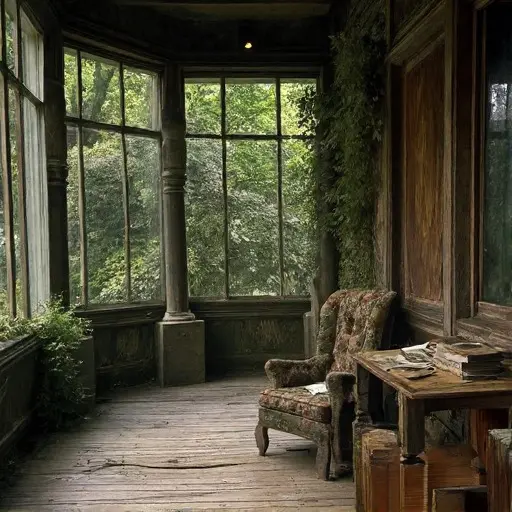
By 1929, the Harrington estate began to experience financial contraction following broader agricultural downturns and reduced inheritance revenue. Maintenance of the formal gardens was gradually reduced, and the structured landscape surrounding the pavilion began to lose its geometric precision.
Without consistent groundskeeping, hedges that once defined strict architectural patterns began to collapse into irregular growth. Gravel paths softened under encroaching grass, and flowerbeds became increasingly overrun by self-seeding wild plants. The pavilion, once framed by carefully curated sightlines, began to feel partially enclosed by its own neglected surroundings.
At the same time, subtle structural changes appeared in the pavilion itself. One side of the foundation began to settle slightly due to soil moisture changes beneath the garden terraces. This caused a gentle skewing of the hexagonal bay room, altering the alignment of window reflections and interior angles.
Cecilia Harrington attempted to preserve the pavilion’s function as a retreat space, but reduced staffing made upkeep increasingly inconsistent.
By the early 1930s, the estate had entered partial administrative restructuring, and the pavilion was no longer considered essential to operations.
FINAL OCCUPATION AND GARDEN RECLAMATION
By 1941, the Harrington family had fully withdrawn from the estate grounds. Sir Edmund Harrington had passed away several years earlier, and Cecilia relocated to relatives in a nearby city. Anne had already established a separate life elsewhere and did not return to the property.
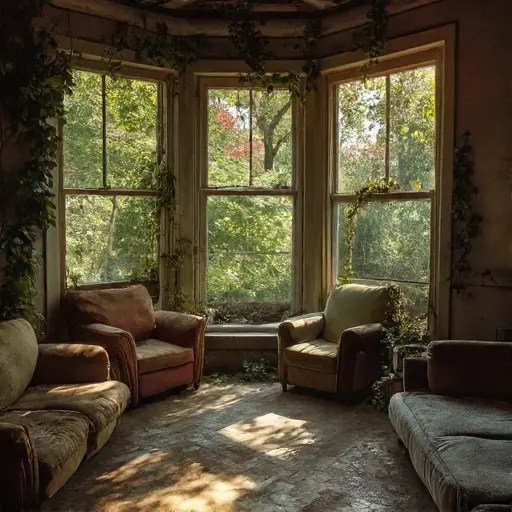
With no remaining family presence and reduced estate funding, the formal gardens surrounding the pavilion were left unmanaged. The structured landscape quickly transitioned into semi-wild growth, erasing much of the original design intent within a few seasons.
The pavilion itself remained structurally intact but increasingly isolated within the expanding overgrowth. The slight foundation shift continued slowly, reinforcing the building’s subtle skewed geometry. Despite this, no collapse or major damage occurred—only gradual environmental adjustment.
By 1948, the Larkwell Pavilion was formally recorded as vacant. No restoration or repurposing was undertaken, as the surrounding land had already reverted to natural growth patterns. The structure remains at the edge of what was once a formal garden, its rooms empty, its geometry gently distorted, and its purpose dissolved into the quiet return of vegetation and time.