The Larkwater Neo-Gothic Townhouse Along the Silent Canal
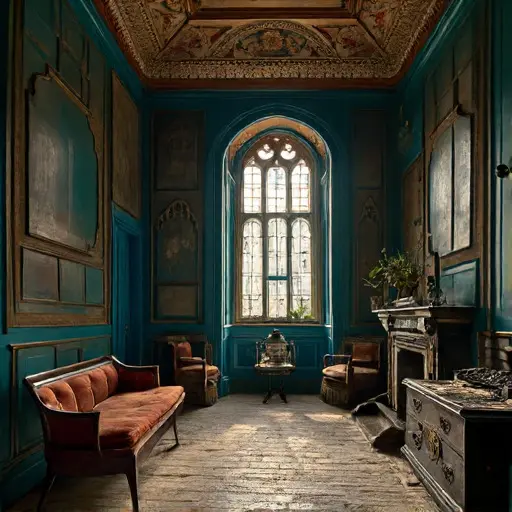
The Larkwater Townhouse was constructed in 1893 for the Delacroix family, who settled along the canal district during a period of expanding trade and residential redevelopment. Designed in the Victorian Neo-Gothic style, the house emphasized verticality and restraint, with its narrow façade, pointed lancet windows, and asymmetrical roofline anchored by a small spired turret. The household consisted of a married couple, their two children, and a long-term caretaker responsible for maintaining both the interior and the canal-facing garden.
Life in the home was closely tied to the waterway, which served as both a practical transport route and a visual extension of the household’s rhythm. The garden, with its iron bench and rose arbor, was used for evening gatherings and seasonal meals, while the greenhouse provided year-round cultivation of herbs and flowers.
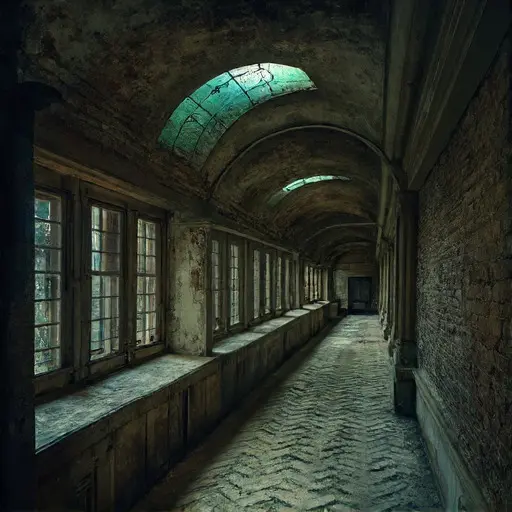
By the early 1930s, the Delacroix family faced sustained financial strain as canal commerce declined and property maintenance costs increased. The townhouse’s complex materials—limestone tracery, copper roofing, terracotta accents, and stained glass—required constant upkeep that became increasingly difficult to sustain. Repairs to the greenhouse and canal-facing balustrade were delayed, allowing structural weakening and vegetation overgrowth to begin simultaneously. The household gradually reduced its use of upper rooms, concentrating daily life in the ground-floor sitting room and kitchen area. The garden began to lose its careful structure as roses overgrew their arbor and ivy spread across stonework. Over time, the house shifted from an actively maintained residence into a partially occupied structure defined by slow withdrawal rather than sudden abandonment.
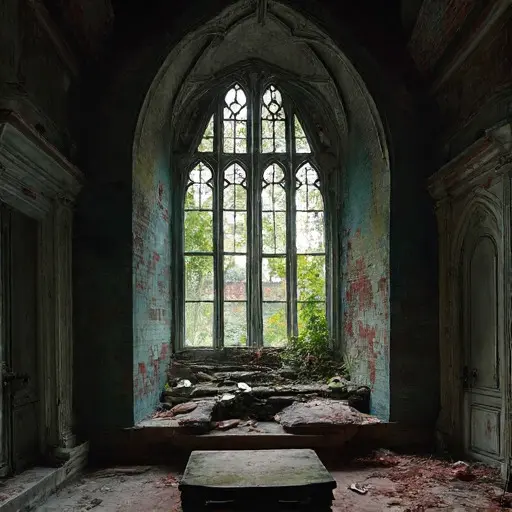
By the mid-1940s, following financial foreclosure proceedings and the final departure of its remaining occupants, the Larkwater Neo-Gothic Townhouse was permanently abandoned. No restoration was attempted, and ownership disputes prevented redevelopment of the property for decades. The canal continued to reflect the empty façade, while the garden slowly dissolved into overgrowth: the rose arbor collapsed under tangled vines, the greenhouse leaned further into ruin, and the iron bench became engulfed in ivy. Inside, furniture, documents, and personal effects were left untouched in their final arrangement. The townhouse still stands along the water today, its Neo-Gothic silhouette gradually eroding under persistent overcast skies, with no return and no resolution recorded.