The Larkspur Second Empire Mansion Left to Forest Stillness
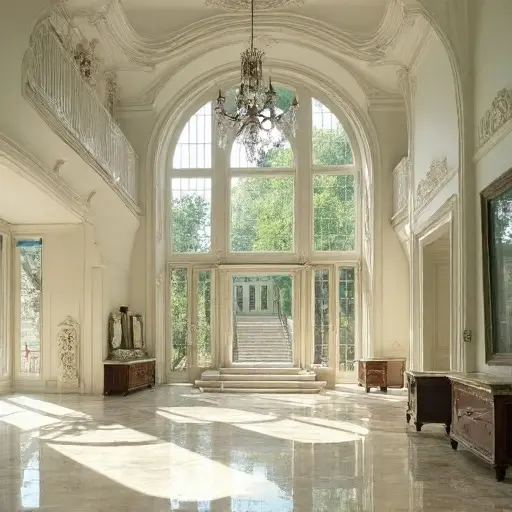
The Larkspur Mansion was constructed in the early twentieth century for a family involved in regional finance and agricultural estate management. Designed in the Victorian Second Empire tradition, the building emphasized symmetry, vertical hierarchy, and formal grandeur through a central pavilion, flanking bays, and a tall mansard roof with multiple dormer tiers. The household consisted of parents, two children, and a small staff responsible for maintaining both the architectural detailing and the surrounding geometric gardens.
Early life in the mansion was organized around seasonal estate governance, social hosting, and administrative correspondence conducted within the formal interiors and terrace-facing rooms. The property functioned as both residence and operational center, carefully positioned within a forest clearing to maintain controlled separation from surrounding wilderness.
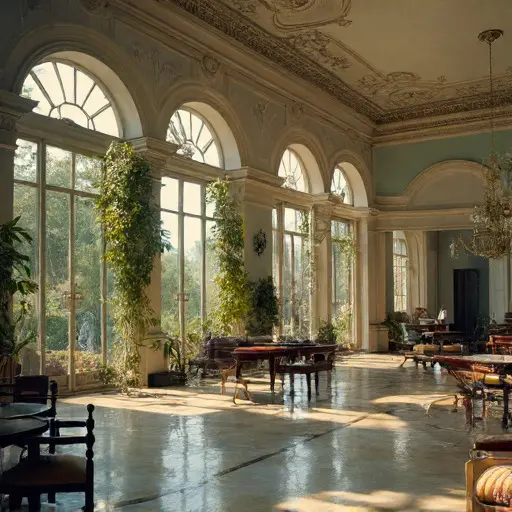
By the late 1920s, the Larkspur household began to experience financial strain due to declining estate revenues and increasing maintenance demands associated with the mansion’s complex mansard roof system and ornate stonework. The steep dormer tiers, sculpted cornices, and symmetrical façade required constant upkeep to prevent weathering and structural fatigue. As resources diminished, repairs were delayed and portions of the residence were closed off to reduce heating and maintenance expenses. Garden care declined, allowing crimson rose arches, violet lavender beds, and overgrown orchard trees to spread beyond their formal geometry. Administrative correspondence slowed significantly, and estate records show increasing gaps in maintenance logs, marking a gradual transition from fully occupied mansion to partially maintained structure within the forest clearing.
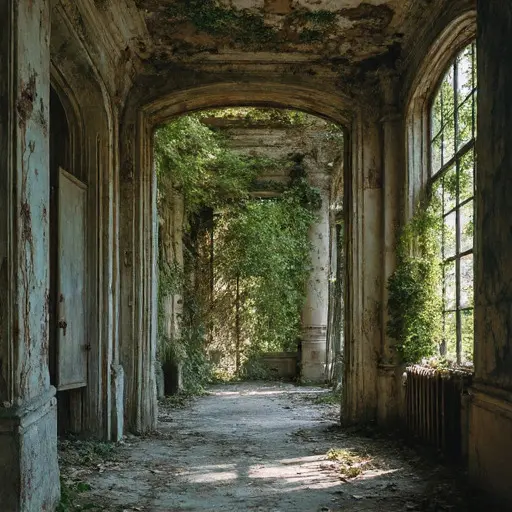
By the early 1940s, after prolonged financial decline and the dispersal of its remaining occupants, the Larkspur Mansion was fully abandoned. No restoration or redevelopment efforts were undertaken, as ownership uncertainty and structural deterioration made intervention impractical. The estate remained standing in the forest clearing, slowly weathering under seasonal conditions and accelerating vegetation growth. Interior spaces were left in their final state of occupation, gradually transforming as ivy, moisture, and structural fatigue reshaped the Second Empire fabric. The mansion persists as an unresolved architectural ruin, neither preserved nor repurposed, with its mansard silhouette quietly dissolving into the surrounding woodland.