The Larkspur Row House Left Vacant After Greenhouse Collapse
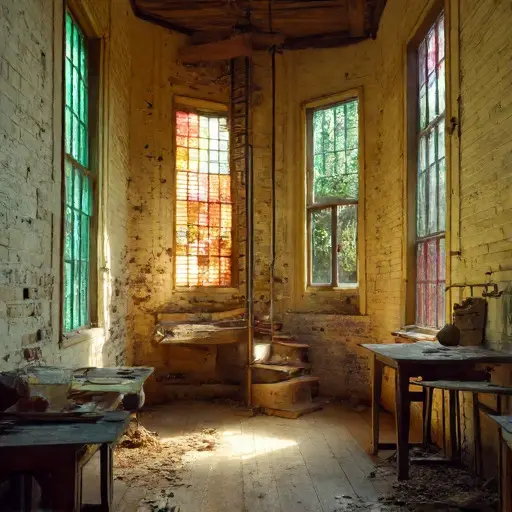
The Larkspur Row House was constructed in 1898 within a dense experimental agricultural district dominated by industrial-scale greenhouse complexes. Positioned between two vast greenhouse structures, the house was never intended to stand alone; it functioned as both residence and administrative anchor for the Verdant Growth Consortium, a private botanical operation specializing in controlled-environment cultivation. When the greenhouses began to fail decades later, collapsing into skeletal frames of steel and fractured glass, the house remained suspended in place like an unintended artifact of the experiment.
Its narrow Victorian façade rose vertically in pale yellow brick, interrupted by pale blue enamel accents that once signaled decorative intent but now read as uneven historical layering. The building’s exterior was divided into vertical “time strips,” each floor aging differently under shifting environmental exposure. The ground level became chalky and sun-bleached, the middle floors darkened with damp iron staining beneath windowsills, and the upper floors remained unexpectedly preserved, shielded by airflow patterns redirected through the collapsed greenhouse corridors.
A warped iron fire escape zigzagged up the façade in irregular geometry, sometimes detaching from the wall and reattaching at higher points using salvaged greenhouse framing. Portions of the staircase were replaced with translucent glass panels, refracting intense sunlight into fragmented geometric projections that shifted across the brickwork throughout the day. The result was a structure that appeared partially assembled from both architectural intention and industrial improvisation.
Inside, the building supported a small administrative household tied to botanical research operations. Dr. Evelyn Harrow managed cultivation records and experimental growth logs, while her partner Samuel maintained infrastructure reports and greenhouse climate data. The house functioned as a monitoring hub, recording environmental conditions from the surrounding greenhouse complex, which once regulated temperature, humidity, and plant development at industrial scale.
Early financial strain
By the late 1920s, the greenhouse consortium began to fracture due to declining agricultural profitability and rising maintenance costs associated with large-scale controlled environments. As funding decreased, maintenance of both greenhouse structures and supporting residences was reduced. Mechanical systems failed in stages, leading to irregular climate conditions that accelerated structural stress in glass and steel frameworks.
Gradual decline within the experimental complex
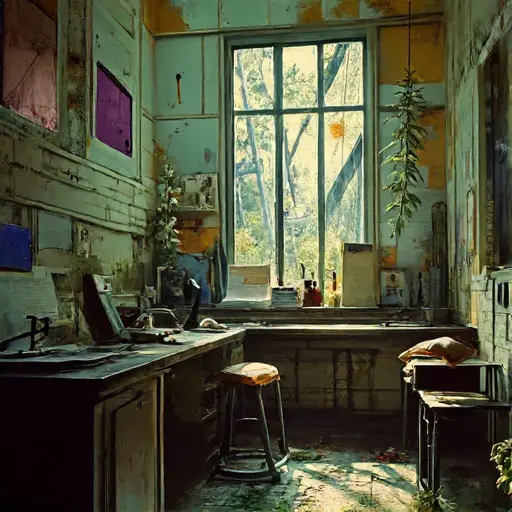
As financial strain increased, entire sections of the greenhouse complex were abandoned. Once-pressurized cultivation corridors decompressed, causing glass panels to shatter or warp outward under thermal stress. The house became increasingly exposed to debris fields of steel ribs and botanical overgrowth. Wild plant species—originally engineered for controlled environments—escaped into the open, forming dense vertical hedges of unnatural color and growth patterns around the structure.
Occupancy within the Larkspur Row House diminished steadily. Scientists and administrators relocated to surviving facilities, leaving the residence increasingly isolated. By the early 1940s, only intermittent occupancy remained, primarily for archival retrieval and equipment salvage.
Final abandonment phase
By 1947, the house was no longer inhabited. Utility systems had failed completely, and no repairs were made to stabilize the surrounding greenhouse ruins. Light intensified through broken glass structures, creating constant shifting patterns across the façade. Fire escape sections continued to warp and detach, held in place only by improvised supports from collapsed agricultural infrastructure.
The house left inside the ruins
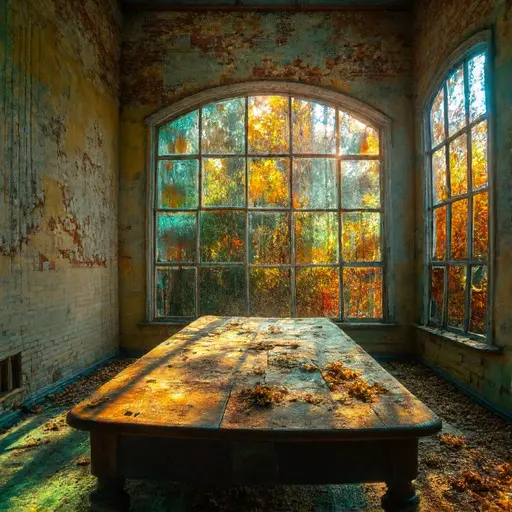
By the late 1940s, no formal ownership or maintenance of the Larkspur Row House remained. Legal responsibility for the property dissolved alongside the collapse of the Verdant Growth Consortium, and no heirs or institutions reclaimed the site. No restoration was attempted, and no structural intervention was made. The house remains wedged between the collapsed greenhouse structures, slowly weathering under intense light, shattered glass, and botanical overgrowth, as if permanently suspended inside the remnants of a failed industrial experiment.