The Larkmere Lagoon Villa Left Quiet at Water’s Edge
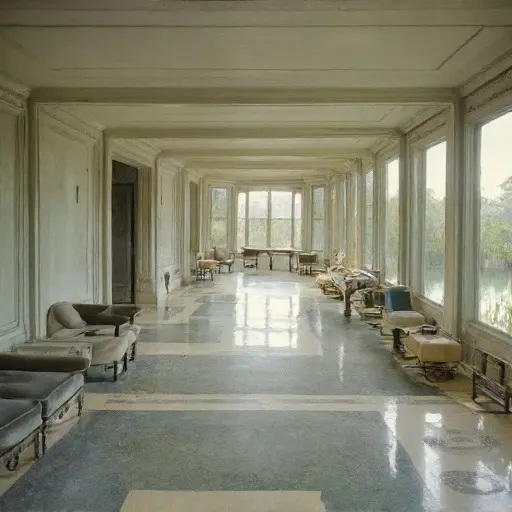
The Larkmere Lagoon Villa was completed in 1896 as a seasonal residence intended for a family engaged in freshwater land management and regional ecological surveying. Unlike more vertically oriented Victorian homes, the villa was designed with an extended horizontal plan that followed the natural edge of the lagoon. Its architecture emphasized continuity with the waterline, creating a domestic environment that unfolded parallel to the shoreline rather than projecting outward from it.
Constructed from pale sand-lime plaster and accented with thin bands of encaustic tile in muted slate-blue, soft mint, and desaturated ivory, the villa was intended to visually dissolve into the surrounding misty aquatic landscape. Over time, these materials developed subtle streaking from persistent humidity and seasonal fog, softening the building’s edges without erasing its structural clarity.
The defining feature of the villa was its continuous water-facing promenade. Sheltered by a delicate colonnade of slender iron columns, it functioned as both circulation space and observational platform. Each column was slightly varied in ornamental detail, with floral capitals that gradually eroded into abstract shapes under long exposure to moisture and wind. The stone pavers beneath were arranged in alternating directional rows, creating a faint rhythm that guided movement along the lagoon-facing elevation.
Early financial strain
By the late 1920s, the Larkmere estate began to experience financial difficulty as regional ecological surveying programs were centralized under larger institutional bodies. Private funding for independent lagoon observation diminished, reducing the need for permanent residential presence at the site. As a result, maintenance schedules for the villa became increasingly irregular.
The elongated zinc roof, originally a gentle uninterrupted form, began to show subtle oxidation, shifting from pale graphite toward cooler silver-green tones. Skylight apertures remained functional but were less frequently maintained, allowing occasional moisture ingress during seasonal storms. Despite this, the villa retained its structural coherence due to its low-rise, horizontally stabilized design.
Gradual decline in the household
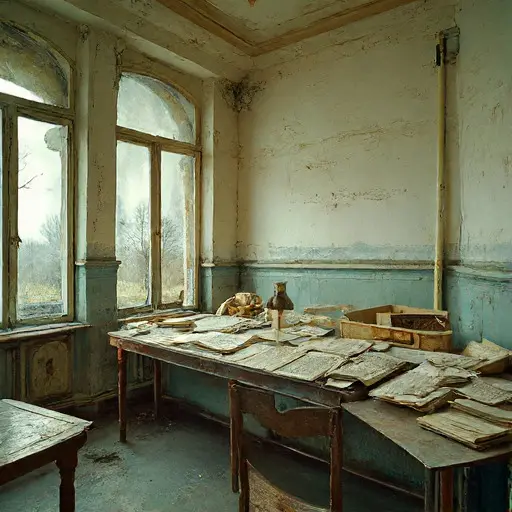
As institutional support declined through the 1930s, occupancy of the Larkmere Villa became increasingly seasonal and eventually sporadic. Sections of the promenade were left unused for long intervals, and interior maintenance was reduced to essential structural upkeep. The colonnade remained intact, but its ornamental detail continued to soften under persistent exposure to moisture-laden air.
Outside, the lagoon remained unchanged in its slow, reflective stillness. Reed beds expanded gradually along the shoreline, encroaching gently toward the villa’s service path but never overtaking the structure. The relationship between architecture and water persisted in a quiet equilibrium, even as human presence diminished.
Final abandonment phase
By the early 1940s, the Larkmere Lagoon Villa was no longer actively inhabited. Administrative oversight ceased following the dissolution of its managing ecological program, and no successor institution assumed responsibility for its maintenance. Without intervention, oxidation spread further across iron columns, and the zinc roof’s tonal gradient flattened into a more uniform silver-green patina.
Final deterioration
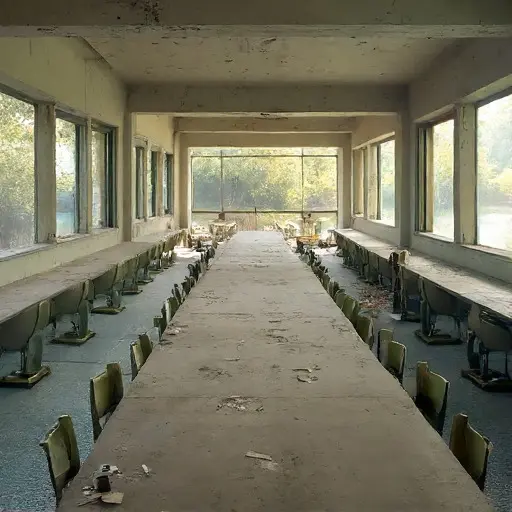
By the mid-1940s, no formal ownership or active stewardship of the Larkmere Lagoon Villa remained. Legal and institutional records were left unresolved, and no restoration efforts were undertaken. The structure persists today at the edge of the lagoon, slowly weathering under humidity, reflection, and time. No reoccupation followed. The house remains empty, continuing its quiet linear dialogue with the water, where architecture and aquatic landscape exist in a sustained, unresolved stillness.