The Langford Linear Manor Abandoned in Forest Growth
The Langford Linear Manor was completed in 1906 for railway financier Arthur Langford, who commissioned the unusual elongated design to reflect his belief in order, expansion, and control over landscape. Situated deep within a managed forest estate, the residence housed Arthur, his wife Helena, and their two sons, alongside administrative staff who managed his growing transport investments. The manor’s strict horizontal composition symbolized industrial precision, with long corridors connecting residential quarters to offices where contracts and shipping records were reviewed daily. In its early decades, the estate functioned as both home and operational headquarters, maintained with disciplined efficiency and constant upkeep.
<img src=”https://beyondvisit.
com/wp-content/imagecontent/uploads/abandoned victorian house 49921121.webp” alt=”” />
The corridor embodied the structured life of the Langford household, but by the early 1920s, external pressures began to weaken the estate’s stability. Shipping revenues declined following postwar restructuring of trade routes, and Arthur’s investments in rail logistics lost value. Maintenance schedules became irregular, and sections of the conservatory wings were closed after minor structural damage went unrepaired. The repeated rhythm of cleaning, inspection, and repair began to break down, leaving portions of the manor increasingly unused and dimly lit.
Financial Contraction and Isolation
By 1929, the Langford family had entered a period of severe financial contraction. Arthur’s business empire fragmented under debt restructuring, and legal obligations forced the liquidation of multiple properties. The manor’s vast scale became unsustainable, leading to the gradual closure of entire wings. Heating was restricted to central corridors, while outer sections were left to cool and decay through winter seasons. Staff numbers were reduced drastically, and correspondence accumulated in unopened stacks across administrative desks.
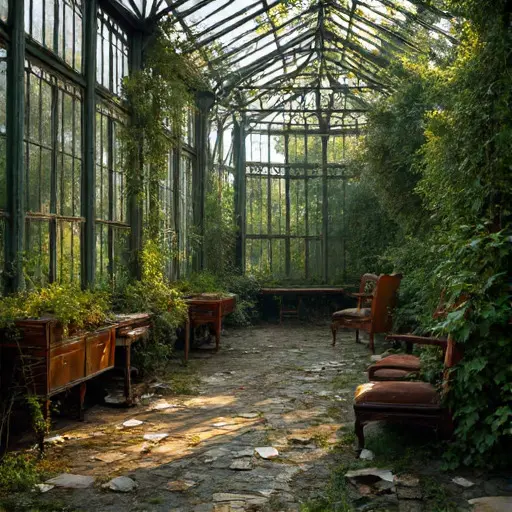
After Arthur Langford’s death in 1933, inheritance disputes among surviving relatives halted any coherent management of the property. Legal claims tied the estate in prolonged litigation, preventing sale or restoration. Helena relocated to a smaller residence nearby, leaving the manor largely unoccupied except for occasional caretakers who soon abandoned their duties due to the scale of decay. The forest began pressing inward, reclaiming service terraces and creeping through fractured sections of the rear structure.
Complete Abandonment and Encroaching Forest
By the early 1940s, the Langford Linear Manor had become fully abandoned. Without maintenance, slate roofing collapsed in sections, allowing rainwater to seep through continuous interior corridors. Iron window frames oxidized and weakened, while stucco surfaces eroded under repeated seasonal exposure. Vegetation advanced steadily across stone terraces, and moss filled drainage channels that once carried water efficiently away from the structure. The rigid architectural order that once defined the estate dissolved into progressive structural failure and organic intrusion.
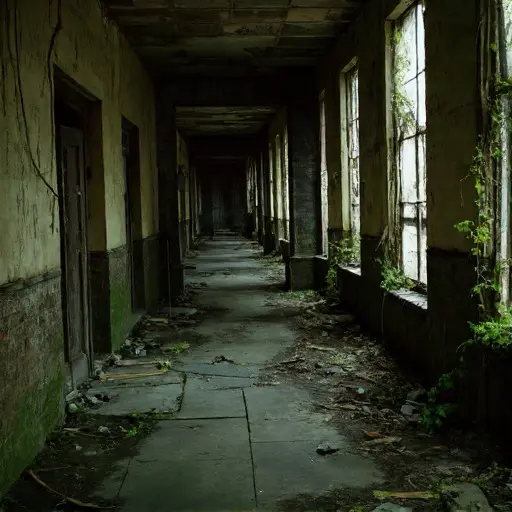
No restoration efforts were ever undertaken, and no descendants reclaimed the property through legal resolution. The Langford Linear Manor remains standing within the dense forest, slowly breaking apart under the combined forces of time and vegetation. Its interior corridors are permanently abandoned, with no remaining signs of habitation or repair, and its condition continues to deteriorate without intervention or future plan.