The Jade Atrium Villa of Evershade Hollow
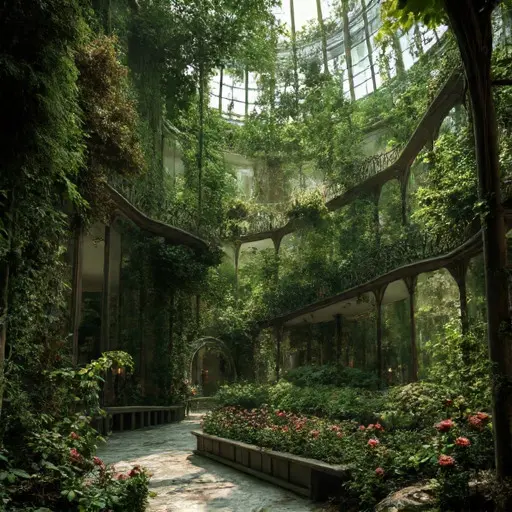
Ultra-detailed cinematic architectural concept art of an abandoned Art Nouveau forest villa concealed within a dense, temperate European woodland clearing, where nature and architecture interweave through organic structural design. The building is a 4-story asymmetrical residence composed of flowing, biomorphic forms rather than rigid geometry, with sweeping curved façades of pearl-white stucco interlaced with obsidian-black structural ribs that appear hand-forged and intentionally fluid. A series of vertical garden towers rise from staggered foundations, each wrapped in climbing ivy and wild climbing roses, their silhouettes softened by decades of vegetation growth.
The most dominant feature is a grand central wintergarden atrium made entirely of jade-green stained glass panels set within intricate smoked-brass Art Nouveau ironwork, forming leaf-like patterns and elongated botanical motifs. Portions of the glass are fractured or missing, allowing daylight to scatter across interior balconies visible through the façade. A sinuous external staircase coils around one side of the structure like a vine, connecting floating terraces and curved balcony platforms edged in ornate iron railings shaped like intertwining stems.
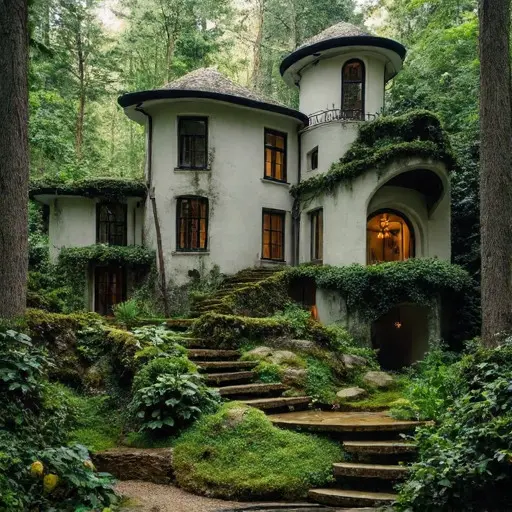
Foreground is composed of low-angle framing through dense forest undergrowth, including tall ferns, moss-covered boulders, and fragmented stone pathway remnants leading toward a partially collapsed ceremonial entrance arch carved in flowing organic reliefs. Midground emphasizes the villa’s sculptural mass emerging from the trees, with layered terraces, curved bay windows, and asymmetrical rooflines blending into one another. Background recedes into tightly packed trunks and filtered woodland depth, providing natural enclosure without obscuring the architecture.
Shot on an ultra-wide 24mm cinematic lens from a low ground-level perspective, amplifying the building’s vertical growth and organic asymmetry. Strong parallax layering between foreground vegetation, midground architectural curves, and background forest density, with cinematic depth of field gently softening distant structural edges while preserving sharp detail in ornamental ironwork and glass textures.
Color palette is dominated by pearl white plaster, jade green glass, obsidian structural framing, warm ochre terracotta roof segments, and restrained smoked brass detailing, creating a high-contrast yet non-monochromatic visual identity where vegetation remains secondary to architectural expression.
Natural soft daylight under a neutral sky evenly illuminates surfaces without dramatic shadows or atmospheric effects. All windows and interior spaces remain dark and inert, reinforcing long-term abandonment with no artificial lighting or glow.
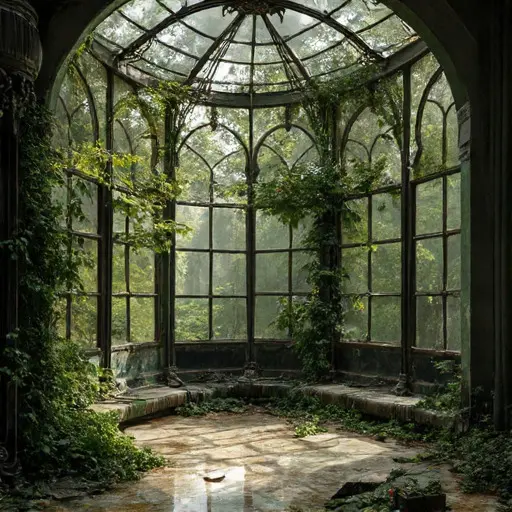
Atmosphere conveys quiet organic grandeur and aristocratic decay transformed through botanical integration, presenting a museum-grade cinematic architectural vision of Art Nouveau craftsmanship reclaimed by an untamed forest environment.