The House That Turned Slightly in Time
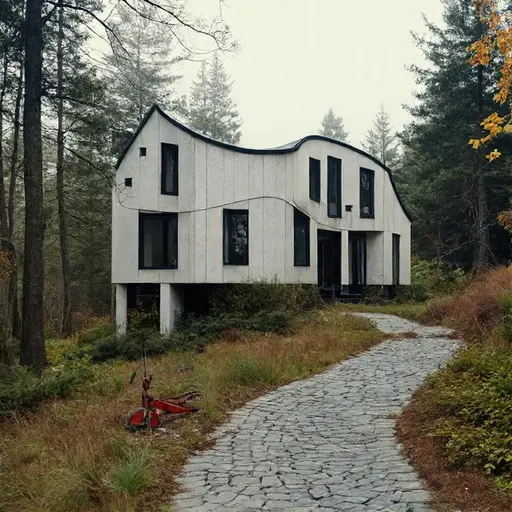
In a quiet residential neighborhood at the edge of a dense mixed forest, an Expressionist Victorian three-story family house stands with a presence that feels gently displaced from normal geometry. Built from pale basalt concrete and fragmented cream ceramic panels, the structure reads as both solid and unsettled, as though time has applied a slow rotational force to its form.
The façade carries a distorted vertical logic.
Lines that should be straight instead drift subtly, giving the impression that the entire building has slowly twisted and settled unevenly over decades. Windows vary in size and proportion, arranged in a drifting rhythm rather than a strict grid. Some are slightly angled off-axis, catching pale daylight in skewed reflections that emphasize the building’s quiet instability.
The roofline breaks from convention entirely. Instead of a clean edge, it forms a sequence of broken planes that rise and fall in soft asymmetry, as if different sections of the structure settled at different moments. The overall silhouette remains intact, but never entirely resolved.
The surrounding neighborhood is quiet and transitional, where modern homes and older houses intermingle along winding streets. Tall conifers and maple trees line the road, softening the architectural contrasts and casting diffuse shadows under the overcast sky.
At the front approach, a cracked stone pathway leads toward a warped metal gate that no longer sits square within its frame. Nearby, a rusted children’s tricycle lies half-hidden in overgrown grass, its presence suggesting abandonment without decay dominating the scene.
All interiors remain completely dark and unlit. No glow or artificial illumination is visible through any window or opening, reinforcing the building as a purely material structure shaped by distortion rather than activity.