The House That Turned in Circles
Hidden within a vast meadow surrounded by bright forest, the abandoned Victorian carousel-house stands like a preserved fragment of another era. It rests beneath a pale silver sky that diffuses sunlight evenly across the landscape, illuminating wildflowers, tall grass, and the colorful architecture with a calm, nostalgic glow. Although decades have passed since anyone lived here, the structure remains remarkably intact, appearing less like a ruin and more like a beloved destination quietly waiting for visitors to return.
Unlike traditional Victorian estates built around long corridors and rectangular wings, this extraordinary residence was designed as a complete circle. The entire building revolves around a massive open rotunda at its center, creating a continuous architectural loop where every room, balcony, and gallery follows a gentle curve.
From above, the house resembles an enormous carousel frozen in time, its circular geometry perfectly integrated into the surrounding meadow.
Its exterior is painted in a striking combination of faded cobalt blue, deep wine red, warm ivory, and touches of aged copper green. These colors have softened over the years, blending together into layered tones that feel lived-in rather than decorative. The result is neither grand nor extravagant, but deeply charming—like an old amusement attraction that slowly evolved into a family home.
The roofline creates one of the most memorable silhouettes in the entire landscape. A collection of overlapping conical towers rises above the circular structure, each painted in a slightly different palette. Some roofs remain deep wine red, others weathered cobalt blue, while several display the oxidized green tones of aged copper. Together they create a playful skyline that feels imaginative without ever leaving the realm of believable architecture.
Encircling the house is a broad veranda supported by hundreds of slender Victorian columns painted in warm cream-white. Decorative panels hang between them, displaying faded geometric patterns in blue, red, and gold. Walking beneath the veranda creates a continuous path around the building, offering uninterrupted views of the meadow and forest beyond.
Large arched windows wrap around the entire structure in nearly unbroken bands of glass. During the day, they reflect shifting patterns of silver sky, green grass, and colorful flowers. From certain angles, the reflections merge seamlessly with the interior, making the boundary between indoors and outdoors feel almost invisible.
The main entrance opens directly into the heart of the house: an enormous circular rotunda that serves as both architectural centerpiece and gathering space. Sunlight pours through towering glass doors and upper windows, illuminating intricate tile floors arranged in sweeping geometric patterns.
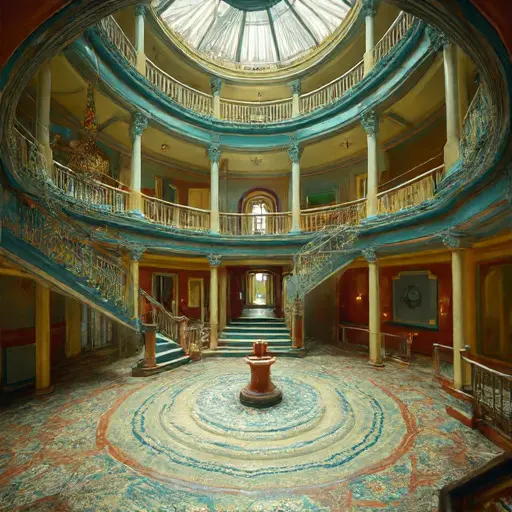
The floor beneath the rotunda forms a magnificent mosaic of faded turquoise, terracotta red, pale yellow, and warm cream tiles. Though softened by time, the colors remain vibrant enough to guide the eye outward toward the curving staircases that embrace the edges of the hall. These grand staircases sweep upward in elegant arcs, connecting upper balconies that overlook the open space below.
The circular design continues throughout the interior. Corridors never end abruptly but instead curve gently around the central hall, revealing new rooms gradually rather than all at once. Every space feels connected to the larger whole, creating a sense of continuous movement even in complete stillness.
Along the outer ring of the house are bright sitting rooms, reading galleries, and sunlit lounges framed by immense arched windows. Their interiors remain preserved beneath layers of dust, with furniture arranged as though the occupants merely stepped away for an afternoon stroll through the meadow.
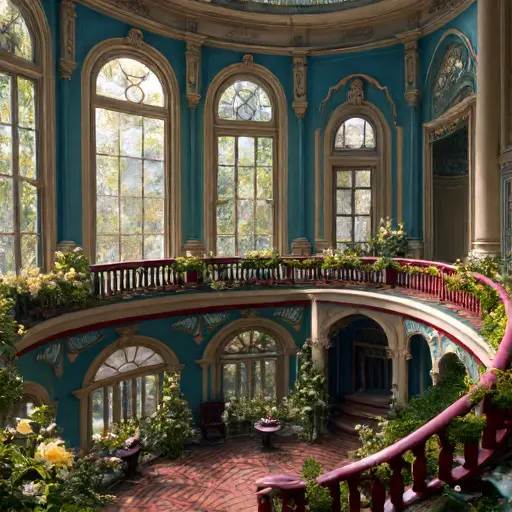
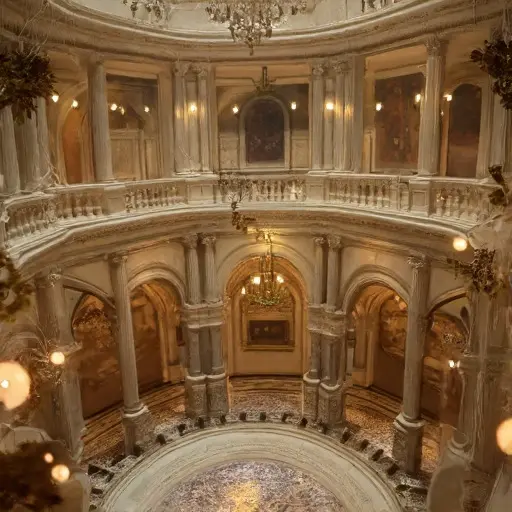
The upper levels contain a sequence of circular balconies and glass galleries that offer constantly changing perspectives of both the rotunda and the surrounding landscape. Looking outward, visitors can see wildflower fields stretching toward the forest edge. Looking inward, they can observe the graceful geometry of staircases, railings, and tiled floors arranged like the mechanisms of a giant ornamental clock.
Beyond the house, the grounds remain just as captivating. Colorful tiled pathways weave through the meadow in broad curves, connecting a collection of recreational structures scattered throughout the clearing. Small pavilions painted pale blue and soft red stand among the flowers, while observation towers rise modestly above the grass, offering views back toward the circular manor.
Several gardens have been arranged in precise circular patterns resembling enormous clock faces viewed from above. Though nature has softened their boundaries, the original designs remain clearly visible beneath the wildflowers. Rings of yellow, red, purple, and blue blossoms create bursts of color throughout the landscape.
The surrounding forest forms a natural boundary around the meadow without feeling enclosing or threatening. Bright green foliage catches the soft daylight, while silver-gray clouds create perfectly even illumination across every surface. The result is a scene filled with clarity, warmth, and quiet discovery.
Nothing about the carousel-house suggests tragedy or decay. Instead, it feels joyful despite its abandonment. Every color, tower, corridor, and veranda speaks of creativity and shared experiences. The architecture seems designed not simply for living, but for wandering, gathering, observing, and delighting in beautiful spaces.
Today, the Victorian carousel-house remains hidden within its meadow clearing, preserved beneath bright skies and surrounded by flowers. It stands as a rare place where architecture feels playful without being fantastical—a circular landmark where color, memory, and imagination continue to revolve quietly around a magnificent central hall, long after the last residents have gone.