The House That Remembered Everything
Some buildings preserve history through records.
Others preserve it through presence.
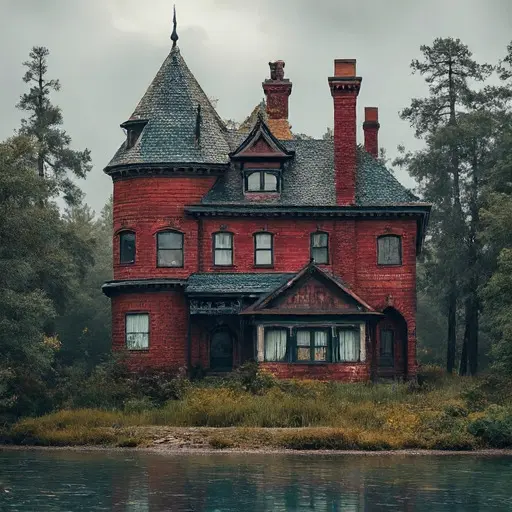
Beside a still forest lake, within a grassy clearing edged by pine trees and flowering shrubs, stands an abandoned Victorian mansion shaped like an enormous antique camera.
Its unusual silhouette rises from the landscape with surprising grace, as though a treasured object from another century had been gently enlarged until it became inhabitable.
The mansion’s vermilion-glass red exterior has faded beautifully beneath years of weather and quiet neglect. Majestic-mint-cyan trim traces every edge with delicate precision, while a violet-royal-plum roof settles comfortably over the structure like a protective cover placed upon an heirloom. Beneath a slate-lavender overcast sky, the natural analogue light drifts softly across every surface, creating the impression that the entire estate exists inside an old photograph.
Nothing here feels dramatic.
Nothing demands attention.
Instead, everything invites observation.
The house seems content simply to remain.
The Camera Beside the Water
From a low-angle perspective, the architecture reveals itself immediately.
The camera silhouette is unmistakable.
The circular lens housing forms the mansion’s central salon, projecting outward toward the lake with quiet confidence. Around its curved exterior, circular bay windows nest comfortably within the lens structure itself, creating a remarkable blend of Victorian domesticity and mechanical inspiration.
On either side, folded bellows become elegant covered galleries.
Their repeating geometry stretches outward into connected wings where corridors, verandas, and sheltered sitting rooms unfold in measured sequence. The transformation from machine to architecture feels strangely natural, as though the camera had always contained a house waiting to emerge.
Thin frost-silver lattice trim outlines every contour.
Faded enamel calibration markings remain visible along portions of the structure, their purpose long forgotten but their beauty undiminished. Moss gathers in corners. Weather softens sharp edges. Time has become another decorator working patiently upon the estate.
The Lens Salon
At the heart of the mansion lies its most remarkable room.
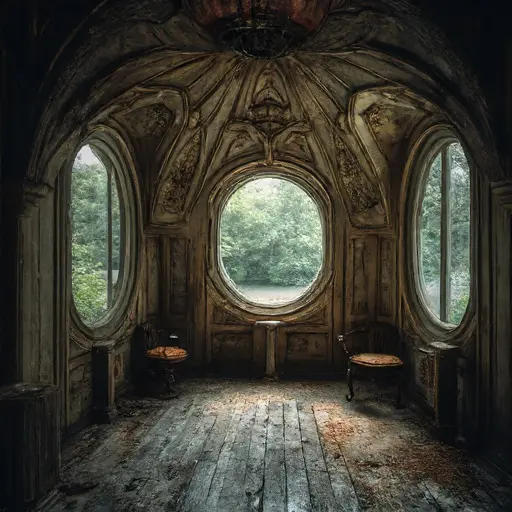
The lens salon occupies the circular front housing where the camera’s great lens would once have focused the world. Here, curved walls embrace a broad central chamber illuminated only by daylight entering through open windows.
The effect is unexpectedly intimate.
The circular geometry softens every movement and every line of sight. Sound seems to linger slightly longer than expected. Even empty, the room feels attentive.
The windows remain completely hollow.
Dark and unlit, they frame only lake water, pine trunks, and drifting clouds. No curtains survive. No lamps wait beside the walls. Forest air moves freely through the chamber, carrying scents of water, earth, and distant rain.
The house records nothing now.
Yet somehow it still observes.
The Bellows Galleries
Beyond the central salon, the former bellows sections contain some of the mansion’s most atmospheric spaces.
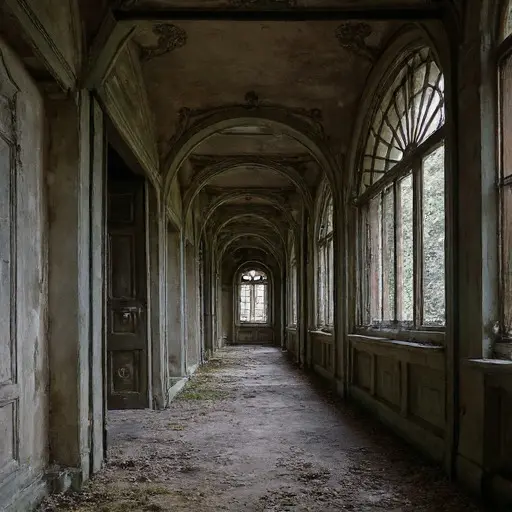
Corridors extend through repeating folds of architecture that create alternating pockets of light and shadow. Small reading alcoves sit beside open windows. Narrow stairways connect modest upper rooms overlooking the clearing.
Everywhere, the geometry suggests motion that has been permanently paused.
The galleries feel like pathways between moments rather than destinations.
Their repeating forms resemble the accordion folds of memory itself—expanding, compressing, preserving fragments of experience without ever fully explaining them.
The silence inside these wings feels layered.
Not empty.
Accumulated.
Photographs Left to the Meadow
Near the shoreline, a cracked mosaic walkway spreads across the grass in scattered fragments.
Designed to resemble oversized photographic plates, its jewel-colored pieces now emerge unevenly through wildflowers and tall grass. Some sections remain intact. Others have vanished entirely beneath years of natural growth.
The effect resembles forgotten images slowly fading from an album.
No single picture remains complete.
Yet together, the fragments tell their own story.
A winding footpath loops through the clearing, disappearing into the pine grove before unexpectedly returning to the water’s edge. Like many elements of the estate, it refuses directness.
It wanders.
It remembers.
It returns.
A Machine for Holding Time
Most cameras exist to capture moments.
This one became a moment.
That transformation gives the mansion its unusual emotional weight. It no longer serves its original purpose. It no longer documents anything. The mechanisms have become rooms. The lens has become a salon. The calibration markings have become decoration.
And yet the building remains fundamentally connected to remembrance.
Every hallway feels archival.
Every window frames a living photograph.
Every weathered surface carries the softness of something handled lovingly and left behind with care.
The estate does not mourn what has passed.
It preserves the feeling that it once existed.
The Last Exposure
As evening deepens over the forest lake, the slate-lavender sky darkens gradually above the pines. Ripples move across the water in slow widening circles. Wildflowers lean beneath the weight of cooling air.
The mansion grows quieter.
Its circular windows become dark discs against the fading landscape. The galleries settle into shadow. Reflections gather along the lake’s edge where water and sky begin to share the same muted tones.
Yet even in abandonment, the great camera-house continues its final act.
Not recording.
Not capturing.
Simply remaining.
Like a cherished photograph forgotten in a drawer and rediscovered decades later, it survives not because it resisted time, but because it accepted it.
And there beside the lake, beneath the deepening lavender sky and among the whispering pines, the mansion exhales softly like a dethroned emperor remembering the garden.