The House That Grew Around the Heartwood
Deep within a mist-laden forest of towering beech trees stands an abandoned family home unlike any conventional residence. Built over generations around a colossal living beech at its center, the structure evolved not according to a single architectural plan, but through decades of adaptation, necessity, and affection. What began as a modest two-story woodland house gradually expanded into a layered network of interconnected rooms, elevated walkways, enclosed porches, and narrow sleeping wings that weave seamlessly through the surrounding forest canopy.
The architecture feels accumulated rather than designed. The original core remains visible beneath later additions, its faded pale turquoise siding softened by decades of rain and filtered forest light.
Weathered white window frames contrast gently against muted gray-blue walls, while aged green metal roofing disappears into the canopy overhead, making parts of the house appear almost camouflaged among the leaves.
At ground level, stone foundations support the oldest sections of the residence. Moss-covered retaining walls outline forgotten garden spaces where ferns now dominate. Narrow pathways curve between trunks and roots before disappearing beneath covered bridges connecting various portions of the home. Some additions rest firmly on masonry, while others stand elevated on timber supports anchored between neighboring trees, creating an intricate vertical village suspended within the forest.
The central beech tree dominates every perspective. Its immense trunk rises directly through the heart of the house, passing uninterrupted through floors, ceilings, and rooftops. Rather than resisting the tree’s growth, successive generations modified the architecture around it. Circular openings were enlarged. Walls curved gently to accommodate expanding bark. Entire rooms were designed specifically to celebrate the living centerpiece that made the home unique.
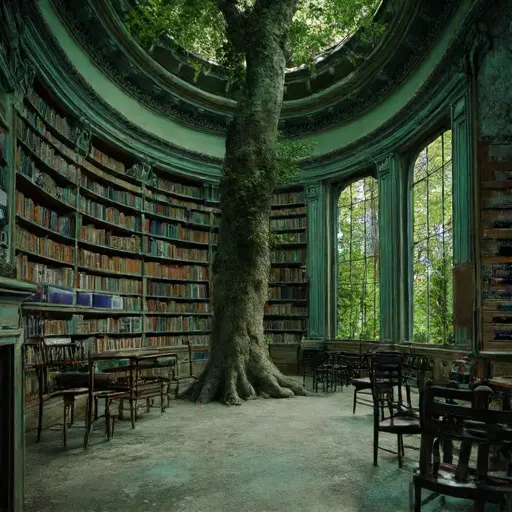
One of the most remarkable spaces is a circular library positioned around the lower section of the trunk. Custom-built bookshelves wrap continuously around the room while the beech rises through the center like a natural column. Dust coats forgotten books, and pale blue upholstered chairs remain positioned near windows overlooking the forest. The room feels less abandoned than paused, as if its occupants simply stepped away decades ago.
Higher levels reveal the organic complexity of the home’s evolution. Exterior staircases climb between wings and balconies, occasionally disappearing behind dense foliage before reemerging several stories above. Enclosed glass breakfast rooms project outward among branches, providing panoramic views into the surrounding woodland. Reading alcoves occupy narrow spaces between trunks, while sleeping quarters extend into elevated sections supported by timber posts hidden among leaves and shadows.
The forest and architecture coexist with unusual harmony. Thick branches pass beside balconies and through carefully framed openings. Fern-filled courtyards occupy spaces left between generations of construction. Moss blankets old stone pathways, softening every hard edge. Rather than consuming the home, nature appears to have negotiated a peaceful coexistence with it.
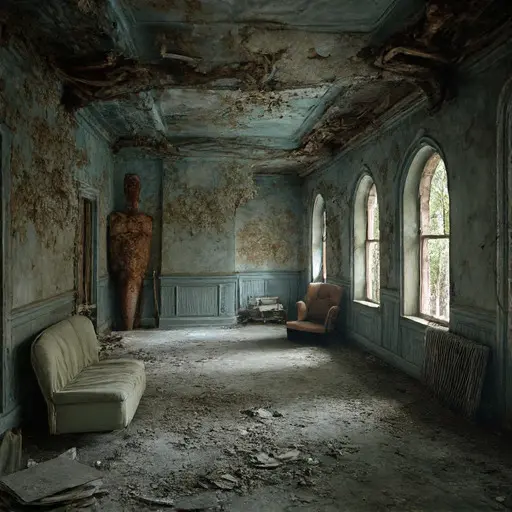
Inside, domestic life remains frozen in subtle detail. Faded fabrics in pale cream, muted sage, and washed blue tones cover furniture left untouched for years. Dining rooms connect unexpectedly to elevated corridors. Small sitting areas overlook hidden courtyards. Dust settles evenly across tabletops and bookshelves, while soft natural light enters through large windows framing endless views of trunks, branches, and drifting mist.
At the highest levels, narrow enclosed bridges extend between neighboring trees, linking sleeping wings and observation rooms perched among the canopy. Here the forest becomes the dominant visual element. Leaves brush against glass. Branches cast delicate moving shadows. The distinction between house and woodland begins to dissolve.
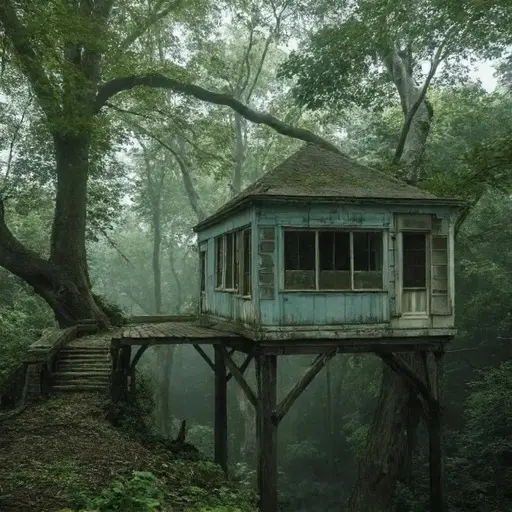
The atmosphere throughout remains calm and overcast. Diffuse daylight filters through layers of leaves, creating soft shadows and muted colors. No dramatic decay, collapse, or violence marks the structure. Instead, every surface tells a story of gradual integration, where architecture and forest slowly adapted to one another across generations.
Today, the house stands as a quiet monument to coexistence between human habitation and living landscape. It is neither consumed by nature nor separate from it. Instead, it occupies a rare middle state—a believable family home that has become inseparable from the forest that nurtured it, with a living tree still standing at the center of every room, every memory, and every layer of its remarkable architecture.