The House That Bloomed Beyond Memory
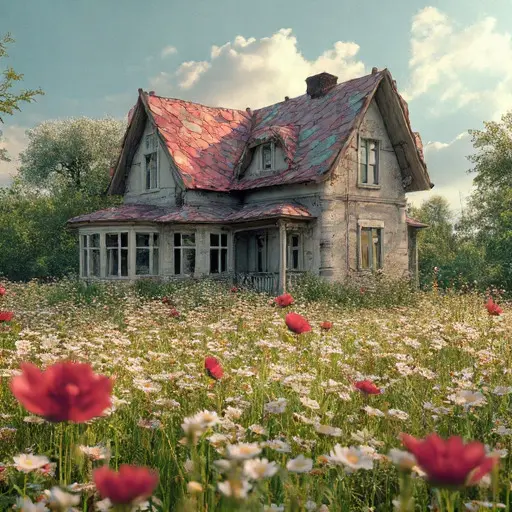
A Cottage Rooted in a Sea of Flowers
Far beyond the nearest village road, where white daisies drift across the landscape like fallen clouds and blood-red poppies scatter vivid color through the grass, stands a Victorian house unlike any other.
At first glance, it appears familiar enough—a cream-colored cottage resting quietly in the center of a vast meadow. Yet the longer one studies the structure, the more difficult it becomes to separate architecture from nature.
The house seems less constructed than cultivated.
Its lower level remains grounded in traditional Victorian craftsmanship. Polished ivory limestone walls rise from the earth with reassuring solidity, interrupted by tall windows and dark green doors weathered by decades of summer sun. The proportions suggest a comfortable family home designed for ordinary routines and quiet afternoons.
But above that familiar foundation, something extraordinary begins to happen.
The second and third floors swell outward in smooth, rounded forms that resemble unopened flower buds suspended in permanent bloom. Curved walls push gently beyond the footprint of the floors beneath them, creating soft organic silhouettes that seem to ignore conventional structural logic while somehow remaining completely believable. Time has transformed the residence into something halfway between dwelling and living organism.
Sunlight slides across glossy ceramic surfaces colored in deep sapphire blue, warm peach, and pale turquoise. Throughout the day, reflections ripple across these curved façades, causing portions of the house to shimmer as though they are still slowly growing.
Architecture in Bloom
Rather than terminating beneath a conventional roofline, the structure culminates in a magnificent crown of overlapping petal-like forms.
Sheets of oxidized copper curve outward like giant leaves unfolding toward the sky. Between them, stained-glass segments catch the summer light, projecting fragments of emerald, amber, ruby, and cobalt across nearby surfaces. From certain angles, the entire upper structure resembles a gigantic flower frozen at the precise moment of opening.
Victorian dormers emerge unexpectedly between these copper petals.
Some appear tucked into hidden folds. Others rise boldly from impossible locations, as though the house itself experimented with new forms as decades passed. Together they create a roofscape that feels spontaneous rather than designed—a century-long conversation between architecture and imagination.
Below, enormous circular bay windows protrude from the walls like glass seed pods. Their intricate brass framing has weathered into a rich green patina, giving every window the appearance of a botanical specimen carefully preserved inside an oversized greenhouse.
Hanging gardens spill from concealed terraces scattered throughout the structure. Ivy trails downward in long curtains while pink climbing roses weave through railings and balconies. Clusters of luminous blue flowers emerge from pockets of greenery, adding still more color to an already extraordinary composition.
Rooms Filled With Summer Light
Inside, the house retains traces of domestic life, though time has softened every boundary between home and garden.
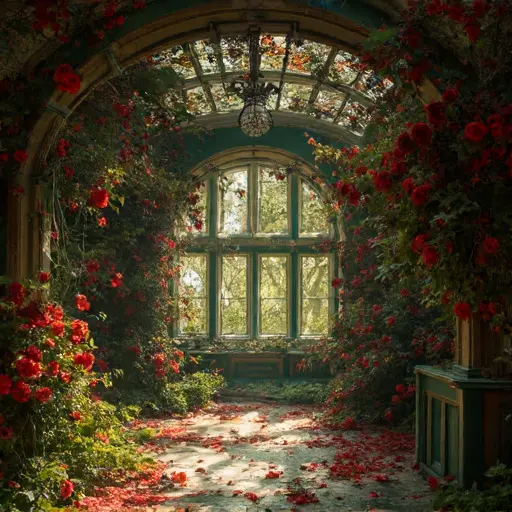
A visitor entering the interior discovers spaces that seem to have adapted alongside the exterior transformation. Traditional Victorian rooms gradually give way to curved corridors and rounded chambers where walls bend gently instead of meeting at sharp corners.
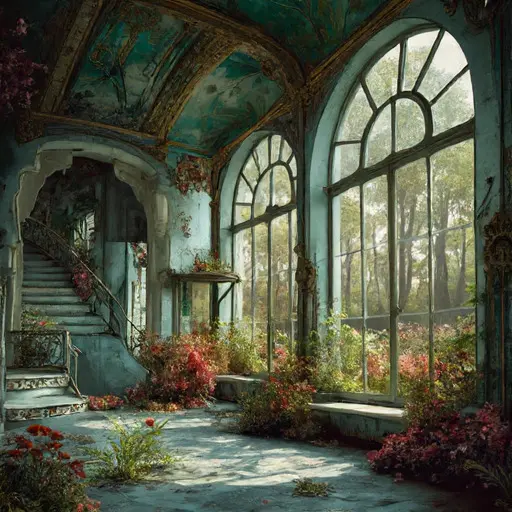
Sunlight enters through circular bays and stained-glass skylights, filling rooms with shifting pools of color. Sapphire reflections drift across floors. Peach light gathers beneath arches. Turquoise highlights slide slowly along polished surfaces as clouds move overhead.
In former reading rooms, vines thread carefully through open windows without overwhelming the architecture. Empty shelves remain intact. Fireplaces stand silent. Staircases continue upward through increasingly unusual spaces where conventional geometry slowly dissolves into flowing organic forms.
Despite its abandonment, nothing feels ruined.
The house appears paused.
Every room holds the quiet expectation that someone may return at any moment to continue a conversation interrupted many years ago.
The Spiral Path Skyward
One of the mansion’s most remarkable features is a narrow spiral staircase that wraps around the exterior like a climbing vine.
Beginning near the garden level, the stair disappears behind curved walls before emerging unexpectedly several stories higher. Along its ascent, small bridges connect protruding rooms that seem to have expanded independently from the main structure over successive decades.
Walking this route feels less like moving through a building and more like exploring a giant flowering plant from the inside.
Each landing reveals a different perspective of the meadow below.
White daisies stretch toward the horizon.
Red poppies sway between waves of summer grass.
The colorful surfaces of the house cast reflections upon one another, creating constantly shifting combinations of ivory, sapphire, coral, turquoise, and weathered copper.
The entire structure behaves like a living participant in the landscape rather than an object placed upon it.
A Beautiful Evolution
Most abandoned houses tell stories of decline.
This one tells a story of transformation.
Somewhere during its long solitude, the house ceased resisting nature and began collaborating with it. The result is neither ruin nor fantasy but a strange architectural evolution—a Victorian family home that gradually adopted the language of flowers, sunlight, and growth.
Warm summer air moves through open windows.
Petal roofs gleam softly above the meadow.
Brass-framed bays catch fragments of sky.
And surrounded by endless fields of white daisies and crimson poppies, the flowering house remains exactly where it has always been, waiting quietly beneath the sun as if blooming were simply another way of remembering.