The House of Seven Ponds
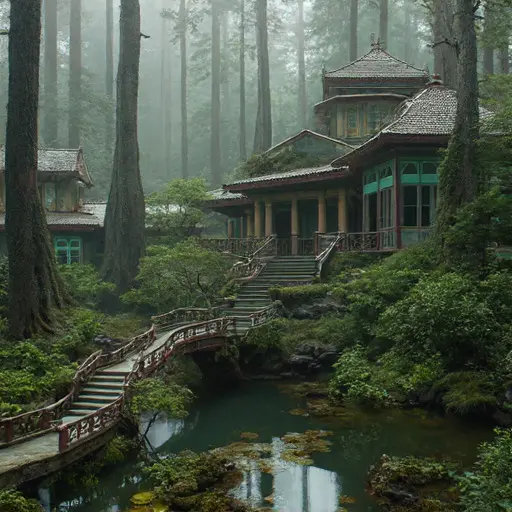
Deep within the cedar forest, beyond the reach of ordinary footpaths and forgotten roads, rests a Victorian residence unlike any other. Hidden beside a cascading chain of terraced lily ponds, the house appears less like a single structure and more like a family history written in timber, glass, and stone. Every pavilion seems to belong to a different chapter, connected through enclosed passages and sunlit corridors that slowly accumulated across generations.
The estate unfolds horizontally through the forest rather than rising above it. Individual pavilions of varying heights emerge between cedar trunks, each carrying its own roofline, proportions, and subtle personality. Together they form an architectural constellation—an arrangement that feels organic rather than planned, as though the house expanded whenever a new dream required another room.
The exterior palette remains unforgettable without becoming implausible. Large stretches of decorative siding are painted in faded jade green, softened by decades of moisture and filtered forest light. Above, intricate fish-scale shingles create alternating patterns of pale apricot and warm ivory that brighten the upper gables. Dark plum-purple trim outlines windows, corners, and roof edges, its original richness weathered into earthy aubergine tones that blend naturally with bark, moss, and shadow.
The roofscape resembles a collection of separate stories joined together. Some roofs rise steeply among the trees, while others sweep low toward the ponds. Slate tiles shift between charcoal black, dusty violet, and oxidized copper green. Rust-softened iron cresting decorates several ridgelines, while one distinctive pavilion carries a broad curved roof whose elegant silhouette stands apart from every surrounding structure.
The Glass Passageways
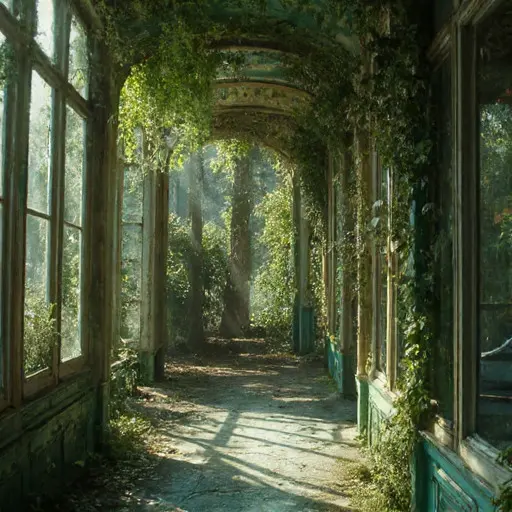
The most remarkable feature of the residence is the network of enclosed passageways connecting each pavilion. These glazed corridors transform movement through the house into a gradual journey through landscape and architecture alike. Walking from one wing to another would have meant passing through shifting reflections of water, cedar trunks, and drifting mist.
The largest of these connections leads toward a magnificent polygonal greenhouse attached to the eastern side of the property. Its faded turquoise metal framework remains visible beneath curtains of ivy and flowering vines. Even in abandonment, the greenhouse appears alive, absorbed into the ecosystem it once carefully cultivated.
Nearby, a covered veranda wraps completely around one of the larger pavilions. Cream-painted columns accented with pale gold support the roof overhead, while moss and climbing vegetation slowly reclaim the edges. From this sheltered vantage point, the terraced ponds spread outward through the forest like a sequence of quiet mirrors.
Reflections Between Water and Wood
The windows throughout the residence vary dramatically from pavilion to pavilion. Tall arched bays stand beside narrow vertical openings. Decorative stained-glass transoms introduce fragments of muted color. Projecting garden alcoves lean gently toward the ponds as though reaching for their reflections.
These reflections become part of the architecture itself. Jade siding merges with cedar shadows. Apricot shingles blend with filtered sunlight. Plum-colored trim dissolves into dark forest tones. The still water gathers every color and rearranges it into shifting compositions beneath the house.
Stone pathways thread between the terraces, crossing tiny moss-covered bridges that arch over narrow channels connecting the ponds. Some paths disappear beneath pergolas entirely consumed by vines and wetland growth. Water lilies spread across the surfaces while reeds and flowering aquatic plants rise from the edges, blurring any distinction between cultivated garden and natural woodland basin.
The Heart of the Estate
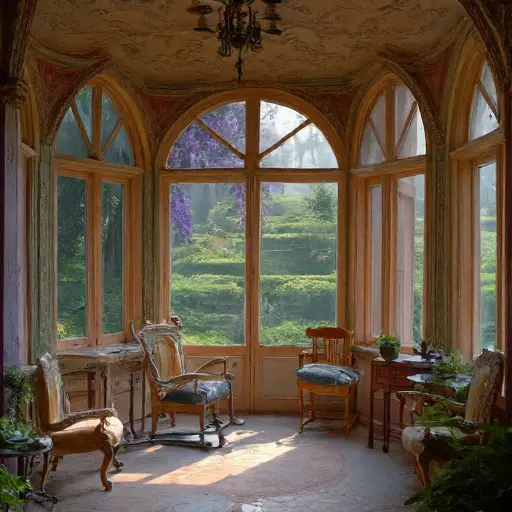
At the center of the property stands the oldest pavilion, believed to be the original house from which all later additions emerged. Though modest compared to the surrounding structures, it possesses a quiet authority. Its windows overlook multiple pond levels at once, and its weathered walls seem to anchor every subsequent expansion.
Inside, silence dominates. The rooms hold only reflected light from the ponds and the distant sound of water moving between terraces. Nothing feels dramatic or haunted. Instead, the atmosphere suggests a home that was deeply loved and slowly outgrown, each generation leaving behind another wing, another corridor, another view of the forest.
Mist rises continuously from the ponds beneath the cedar canopy. Silver daylight filters through overlapping branches and settles gently across slate roofs, stone pathways, and still water. The colors of the house shimmer softly in every reflection, transforming the entire property into a living composition of architecture and landscape.
As evening approaches and the cedar forest grows darker around the terraces, the residence seems to dissolve into its surroundings. Pavilions become silhouettes. Corridors become ribbons of fading glass. The ponds absorb the last traces of color.
And through the quiet water gardens, beneath the towering cedars and among the interconnected roofs built across generations, the house rests like a private memory preserved by the forest itself.