The House of Emerald Roofs
Hidden deep within an aging woodland neighborhood where narrow cobblestone lanes disappear beneath towering chestnut and fir trees, an abandoned French Eclectic Victorian residence quietly endures among gardens reclaimed by nature. Shielded by dense ferns, wild hydrangeas, and moss-covered retaining walls, the house feels less like a forgotten building and more like a permanent part of the forest that has slowly embraced it over generations.
Constructed as a distinguished three-story family home, the residence combines creamy white limestone with soft peach stucco and charcoal flint panels, creating a façade rich in subtle color and texture. Above, hand-laid emerald glazed roof tiles crown the structure beneath an elaborate composition of steep conical roofs whose weathered surfaces shimmer softly under the muted daylight.
The architecture celebrates the picturesque elegance of the French Eclectic style.
Two asymmetrical polygonal towers stand at opposite corners, balancing the composition while giving the house an unmistakable silhouette. Between them stretches a sweeping semi-circular veranda wrapped in delicate wrought-iron lacework that overlooks the once-formal front garden. Whimsical oval dormers emerge from the steep rooflines, adding a playful rhythm to the otherwise stately composition.
Time has altered the building with remarkable subtlety. The masonry walls have gently inflated from decades of slow settling, causing graceful outward curves that soften the original geometry. Each tower leans in its own direction, balconies ripple almost imperceptibly along their edges, and the clustered rooflines rise and fall in gentle waves rather than rigid straight lines. The result is a structure that appears to have gradually adapted to the landscape rather than resisted it.
Approaching from the curved cobblestone lane, visitors first encounter gardens that have quietly reclaimed their former boundaries. Moss blankets old retaining walls while flowering hydrangeas spread freely between winding flagstone paths disappearing beneath carpets of ferns. Every stone and planting reflects years of uninterrupted natural growth without diminishing the estate’s quiet elegance.
Beside the circular lily pond, edged with cracked marble softened by moss and fallen leaves, a faded pale-blue garden bench remains facing the still water. The pond mirrors the surrounding towers on calm days, creating fleeting reflections that seem almost untouched by time.
Toward the rear of the property, a weathered white pergola marks the forgotten entrance to the backyard. Draped entirely in climbing roses and intertwined vines, its aging beams still define the garden’s original layout even as woodland vegetation slowly envelops the structure.
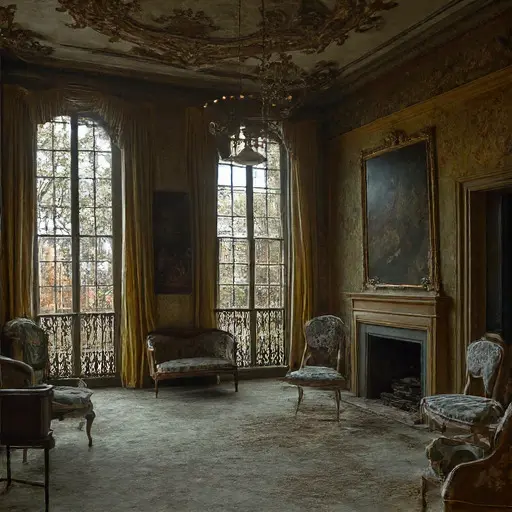
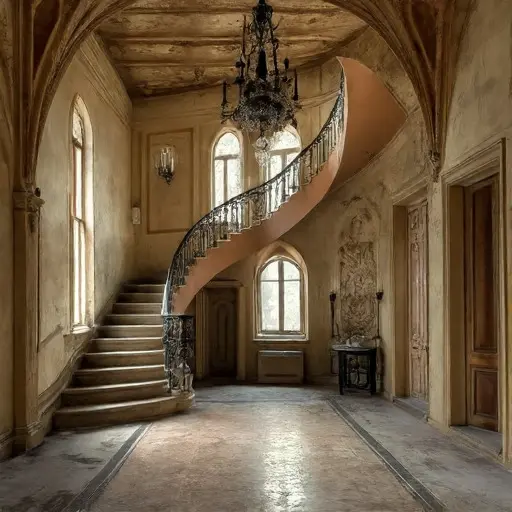
Inside, the residence reveals generous rooms designed for family life and formal entertaining. High ceilings, elegant plaster moldings, curved corridors, decorative fireplaces, and finely crafted woodwork survive beneath layers of dust, preserving the atmosphere of a prosperous Victorian household that slowly slipped into silence.
Natural light filters gently through the oval dormers and tall windows, illuminating worn hardwood floors, faded wall coverings, and forgotten furnishings without disturbing the profound stillness that fills every room. Despite decades of abandonment, the craftsmanship remains remarkably intact.
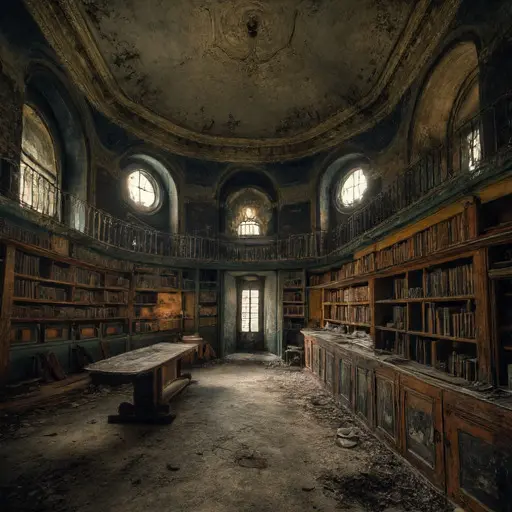
Today, the House of Emerald Roofs stands as an extraordinary example of French Eclectic Victorian architecture transformed by time rather than damaged by it. Its limestone walls, peach stucco, flint panels, emerald roof tiles, graceful towers, and flowing veranda continue to express remarkable architectural beauty beneath the woodland canopy.
Though abandoned for many years, the residence retains the quiet dignity of a family home whose stories remain woven into its walls. Surrounded by flowering gardens gone wild, moss-covered stonework, tranquil water, and towering forest trees, it endures as one of the neighborhood’s most captivating forgotten landmarks.