The House of Embedded Time
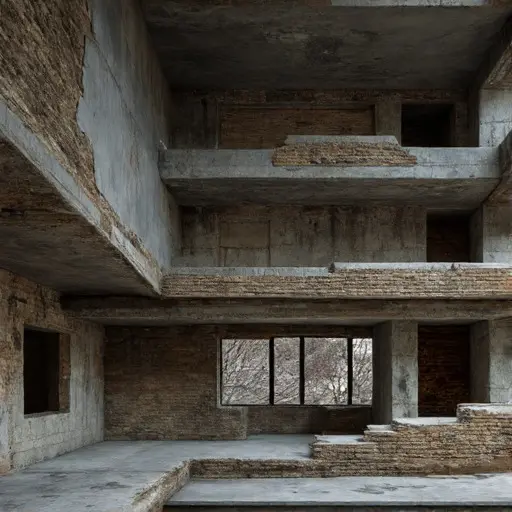
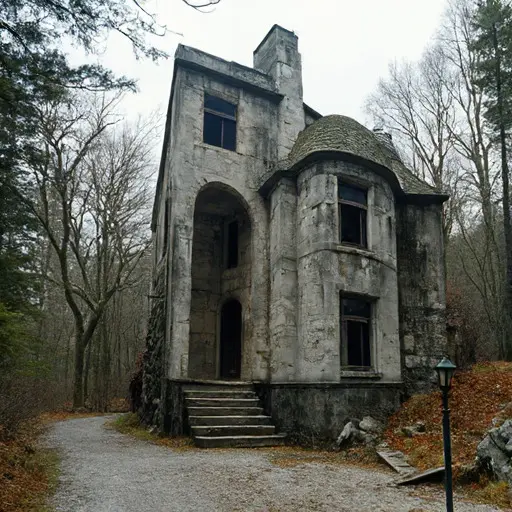
At the wooded edge of a quiet suburban grid, where dense mixed forest presses against orderly residential streets, a Neo-Victorian Brutalist three-story family house rises with a presence defined by compression, weight, and embedded history. Constructed from raw cast concrete fused with fragments of reclaimed Victorian brick and stone ornament, the building reads like a stratified record of architectural eras held together in a single mass.
The façade is unevenly layered, with horizontal bands that shift in thickness and texture as they move across the surface.
Victorian brick fragments and carved stone details are not applied decoration but embedded material, partially consumed by the concrete itself. Above, the upper mass subtly convexes forward, creating the impression that the structure is leaning into space over its lower floors without breaking its structural calm.
Window openings are deep-set and irregularly spaced. Each aperture is slightly skewed, creating a quiet visual rhythm that resists uniformity. The effect is not chaotic, but deliberately off-balance, as though the building’s internal grid has drifted over time.
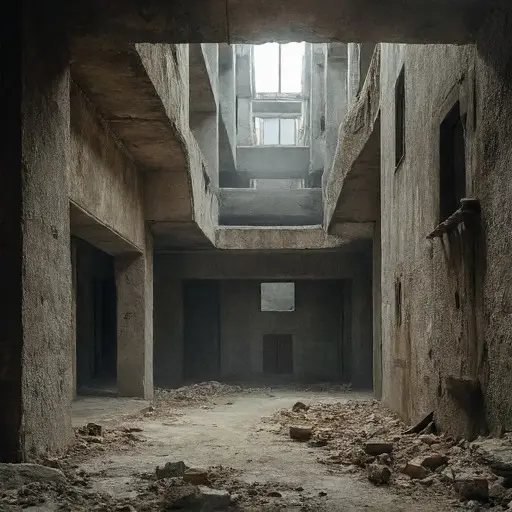
The roof is flat but fractured in expression. Parapet walls rise and fall in staggered heights, interrupting the silhouette with subtle vertical variation. These broken edges soften what would otherwise be a purely rigid form, introducing a quiet instability to the topmost boundary.
The surrounding neighborhood remains restrained and subdued. Tall pines and birch trees frame the property, filtering the overcast daylight into a diffuse, even illumination. The forest edge presses close enough that the house feels partially absorbed into its environment rather than simply placed within it.
A broken stone stairway leads toward a heavy metal door at the entrance, its surface unadorned and solid. Nearby, an abandoned cast-iron lamppost lies tilted beside an overgrown gravel drive, suggesting long-term neglect without dramatic collapse.
All interior spaces remain completely dark and unlit. No glow, reflection, or artificial illumination is visible through any opening, reinforcing the building as a sealed volume defined entirely by material and mass.