The House of Dual Reflections
An abandoned Victorian family house stands within a quiet lakeside cedar forest, designed in an unusual “dual-front reflection” composition where the architecture is explicitly organized around its mirrored relationship with the adjacent lake. Instead of privileging one orientation, the structure maintains two equivalent façades—one addressing the forest clearing, the other addressing the water—each treated with identical architectural rigor. The result is a building that reads differently depending on viewpoint, yet remains internally consistent through strict axial logic.
The exterior is composed of pale sand-colored brickwork paired with broad fields of lacquered timber stained in deep ultramarine. These materials alternate in wide vertical bands, producing a restrained but assertive rhythm that shifts character depending on whether it is seen against cedar trunks or reflected across the lake surface.
Weathering has softened the lacquer into muted indigo and slate-blue gradients, while the brick retains a chalky warmth that anchors the composition in subdued neutrality. The interplay between matte and reflective surfaces reinforces the house’s continuous dialogue with its mirrored environment.
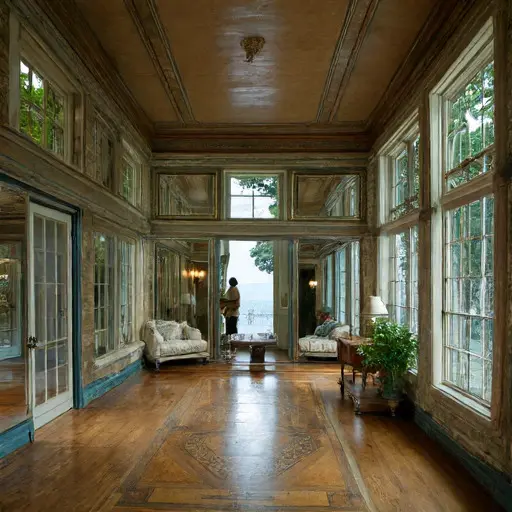
Windows are arranged in precise mirrored pairs, reinforcing the bilateral symmetry that governs the entire structure. Each opening is tall, narrow, and vertically disciplined, framed in brushed brass that has aged into a subdued honey-gold patina. The glazing carries a faint iridescence, shifting between green, violet, and pale blue depending on angle and reflection, making it difficult to distinguish whether one is seeing through the house or into its mirrored counterpart across the water.
The roof is a continuous shallow curve that spans the entire structure without interruption. Clad in overlapping metal shingles, it transitions subtly from deep teal along the central ridge to lighter silver-green at the edges. This gradient emphasizes the symmetry of the form while also echoing the tonal shifts of lake water and cedar canopy, reinforcing the building’s dual existence in both solid and reflective states.
At ground level, the house rests on a precise stone plinth that extends equally in both directions. On the forest side, it dissolves into moss, roots, and cedar needles; on the lake side, it extends into a narrow stone dock aligned perfectly with the building’s central axis. This dock functions as a structural continuation rather than an accessory, reinforcing the concept that the house is equally anchored in land and water.
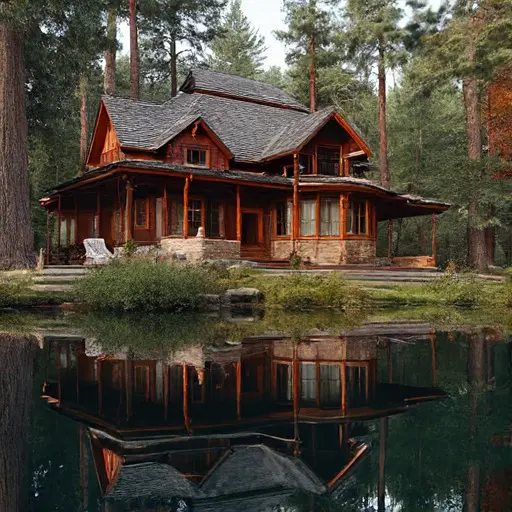
The surrounding environment amplifies this duality. Dense cedar trunks rise in repetitive vertical sequences behind the house, while the lake stretches forward as a near-perfect reflective plane. Together, they create a visual compression of reality into mirrored halves, where architecture and landscape continuously exchange roles.
The atmosphere is still, balanced, and evenly illuminated, emphasizing symmetry, reflection, and spatial equivalence. The result is a grounded Victorian lakeside house that feels deliberately doubled—an architectural system designed not around hierarchy or orientation, but around the quiet precision of mirrored existence across forest and water without repeating prior spatial or compositional frameworks.