The House at Whispering Pines Lane
There are abandoned homes that fade into the landscape, and then there are those that quietly become part of it. Hidden at the end of a narrow woodland lane, this three-story Folk Victorian family house seems less like a building left behind and more like an old memory preserved beneath towering pines. Time has softened every line without erasing the warmth that once made it a home.
Built from pale yellow painted timber resting on sturdy whitewashed brick foundations, the house carries the unmistakable charm of late Victorian craftsmanship. Delicate spindlework still decorates the broad front porch, while slender porch columns support a roof that has weathered into muted shades of green.
Years of rain, snow, and gentle settlement have given the structure an organic character—walls curve almost imperceptibly, roof planes relax into soft waves, and every window sits just differently enough to remind visitors that nothing remains perfectly still forever.
The small offset attic tower rises quietly above the surrounding forest canopy. Once it may have served as a favorite reading room or lookout where family members watched storms gather beyond the trees. Today its dark windows overlook only silence.
The front porch bends naturally around the garden, creating welcoming curves instead of rigid lines. Decorative trim survives remarkably well despite decades without maintenance, though layers of peeling paint reveal generations of changing colors beneath the fading yellow exterior.

Approaching the property feels like entering a forgotten chapter of rural life. Tall pine trees frame the narrow woodland lane, their branches filtering soft overcast daylight across carpets of moss and scattered wildflowers. Nearby homes have long since disappeared behind vegetation, leaving this house standing quietly among nature’s slow reclamation.
A faded clothesline still stretches between two mature trees. Weathered family garments sway gently whenever the forest breeze arrives, their worn fabric suggesting an ordinary afternoon that somehow never truly ended. Beside the overgrown garden path rests a small stone animal statue, its features softened beneath years of lichen and moss until only its gentle silhouette remains visible.
Despite abandonment, there is no violence in the decay. The whitewashed brick foundation remains remarkably stable, while climbing plants respectfully trace porch railings instead of overwhelming them. Every irregularity appears earned through patience rather than destruction.
Inside, the atmosphere changes immediately. The silence becomes heavier, interrupted only by distant creaks from aging timber responding to changing temperatures. Narrow hallways retain their graceful proportions, and decorative woodwork continues uninterrupted from room to room despite dust settling across every surface.
The staircase remains the home’s defining feature. Its hand-carved balustrade winds upward through all three stories beneath a modest skylight that no longer admits much light through weathered glass. The surrounding walls lean just enough to remind visitors of decades spent slowly adapting to the shifting earth below.

Bedrooms occupy the upper floors beneath sloping rooflines that have gradually settled into gentle curves. Built-in wardrobes, iron bedsteads, and forgotten dressers remain exactly where they were left. Curtains have faded into nearly colorless fabric, while dark windows reveal only towering pine trunks outside.
The attic tower provides the house’s quietest room. Small irregular windows frame uninterrupted views across the surrounding woodland, though no light reaches far into the dusty interior. Shelves line the curved walls, now empty except for scattered books damaged by moisture and time.
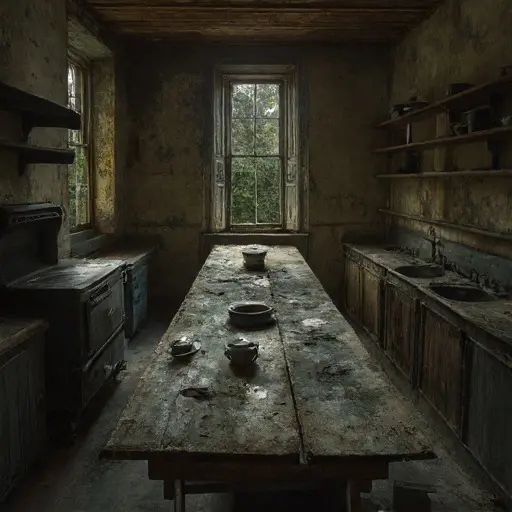
Even the kitchen preserves its sense of domestic routine. Cast-iron cookware hangs above a large range, wooden cupboards remain slightly ajar, and a long farmhouse table occupies the center of the room as though another family meal might somehow still take place.
As daylight slowly fades beneath the dense forest canopy, the house never becomes dramatic. It simply grows quieter. The yellow paint, green roof, white brick foundation, and elegant spindlework settle comfortably into the surrounding woodland, becoming nearly indistinguishable from the landscape that has patiently embraced them for decades.
Rather than resisting abandonment, the old Folk Victorian home seems to have accepted it with quiet dignity. Every softened wall, every gently uneven window, every weathered porch column tells the story of a family house that never truly disappeared—it simply learned how to belong to the forest instead.