The House at the End of the Gravel Track
At the end of a narrow gravel track where farmland gradually gives way to scattered young birch, hazel thickets, and remnants of old hedgerows, an abandoned Victorian family house stands in quiet isolation. The landscape here feels transitional rather than wild—fields dissolving into woodland in slow, uneven patches, under a soft overcast sky that diffuses light evenly across every surface.
The house is a compact three-story Victorian residence built from pale cream brick that has aged into a warm, chalky tone. Its design is restrained and practical, avoiding ornament in favor of proportion and clarity. Even in abandonment, it retains a sense of order, as though it was built to endure long stretches of silence.
The façade is organized with disciplined symmetry. A central entrance anchors the composition, framed by a shallow brick arch and a simple stone lintel. Above it, tall narrow sash windows rise in strict vertical alignment across all floors. Their painted wooden frames have faded into a subdued gray-green, softening the geometry without breaking it.
A small enclosed entry vestibule projects from the front, capped with a modest pitched roof. It feels functional rather than decorative, a sheltered threshold between outside and inside. Beneath it sits a heavy timber door painted in faded slate blue, its surface worn smooth by years of weather and use.
The roof is a straightforward pitched structure covered in overlapping slate tiles that have darkened into muted gray-green tones. Two chimney stacks rise symmetrically from either end of the ridge, constructed from the same pale brick as the walls. Their stone caps show slight erosion, but the structure remains solid and composed.
At the rear, the house extends into a lower single-story kitchen wing. Smaller windows line this section, and a secondary door opens toward what was once a service yard. That space has begun to soften at the edges, with grass and wild plants slowly reclaiming the ground, though the building itself remains clearly intact.
A narrow stone path leads from the front door back to the gravel track. Old wooden posts line its edges, the last remnants of a fence that once defined the property boundary. No formal garden remains—only faint traces of planting beds now absorbed into uneven soil and grass.
The surrounding woodland is gentle and in-between in character. It is not dense enough to feel enclosed, nor open enough to feel exposed. Light filters through evenly spaced trees, illuminating the house without casting harsh shadows, reinforcing its quiet presence within the landscape.
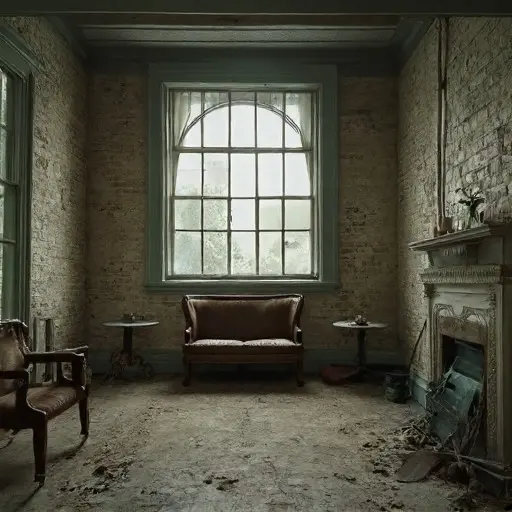
Inside, the front sitting room is modest and functional. Furniture remains arranged in familiar positions, shaped by daily routines rather than display. Light enters through tall sash windows, falling evenly across wooden floors and muted textiles. Nothing appears disturbed—only paused.
A narrow hallway runs through the center of the house, connecting rooms with understated efficiency. Doors are evenly spaced, their paint softened by time. The architecture emphasizes movement and function rather than ornament, guiding space in a clear, linear rhythm.
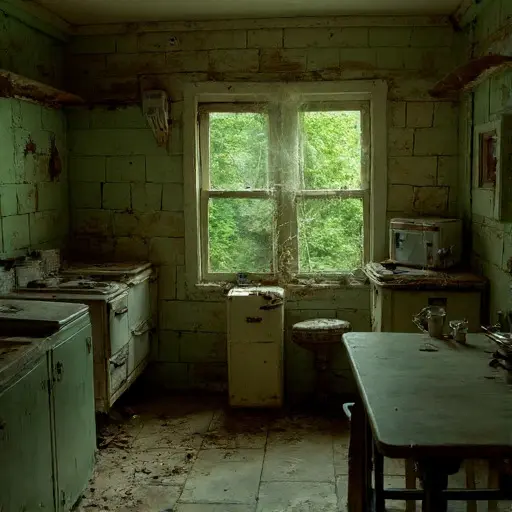
At the back of the house, the kitchen wing feels slightly more utilitarian. Surfaces are simpler, windows smaller, and the light more subdued. Yet even here, the sense of continuity remains intact, as if the house still remembers how it was meant to be used.
Upstairs, bedrooms sit beneath the pitched roof, where the geometry of the structure becomes more apparent. Slanted ceilings frame simple furnishings, and tall windows look out toward the treeline beyond the gravel track. The rooms feel personal but not ornate, shaped by routine rather than excess.
Nothing in the house feels theatrical or exaggerated. Instead, it carries the quiet dignity of an ordinary family home—one that was lived in steadily, without grandeur, and then left without disruption.
And as the overcast light settles across the gravel track and the woodland edges soften into evening, the house remains exactly where it has always been—simple, intact, and quietly persistent at the threshold between farmland and forest.