The House at the Crooked Gate
At the quiet end of a forgotten residential street, where cracked pavement dissolves into towering oaks and dense deciduous forest, an abandoned Italianate Victorian home still commands quiet attention. Once painted with immaculate cream brick walls and accented by pale olive stone lintels, the three-story residence now wears the slow imprint of time. Ivy climbs its graceful veranda, moss softens the faded red clay roof, and every surface reflects decades of patient neglect rather than sudden ruin.
The home’s architecture remains unmistakably Italianate. Tall arched windows stretch upward beneath heavily bracketed eaves, while elaborate cornices continue to cast delicate shadows despite years of weathering.
The square belvedere tower, once built as a proud lookout above the neighborhood, now leans ever so slightly, its gentle tilt revealing generations of slow settlement instead of structural collapse. Nothing about the house feels violent; it has simply relaxed into the landscape.
Approaching through the weathered wooden picket fence, visitors encounter a crooked garden gate that still swings with surprising ease. Beyond it, the cracked stone walkway disappears beneath thick grass and creeping moss. A rusted child’s tricycle waits beside the path exactly where it was abandoned years ago, quietly transformed into part of the garden itself.
Inside, the entrance hall still hints at remarkable craftsmanship. Wide timber floors curve almost imperceptibly beneath age, while elegant plaster arches connect one room to another with understated refinement. Every doorway remains open to silence.
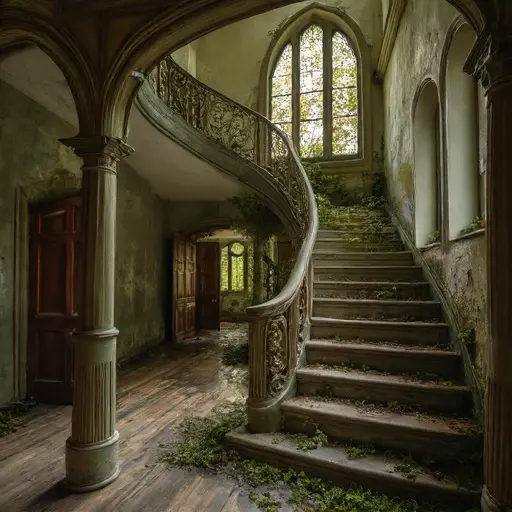
The front parlor occupies the rounded corner created by the veranda’s graceful curve. Tall arched windows wrap around the room, their glass slightly uneven from age, allowing muted daylight to wash across faded wallpaper and intricate ceiling moldings. Loose shutters gently rest against their frames, while vines weave through sections of the porch railings outside, creating shifting botanical silhouettes across the floor.
Although the house has stood empty for many years, the craftsmanship remains evident everywhere. Decorative ceiling medallions, carved wooden baseboards, and plaster cornices survive beneath layers of dust. The subtle outward bowing of the upper walls gives the rooms an unexpectedly organic character, as though the building has slowly adapted to its environment rather than resisted it.
Further upstairs, the bedrooms become increasingly quiet. Narrow hallways lead toward the gently tilting belvedere tower, where every window frames dense woodland reclaiming what was once a refined suburban garden. The silence here feels complete, interrupted only by the occasional movement of leaves beyond the glass.
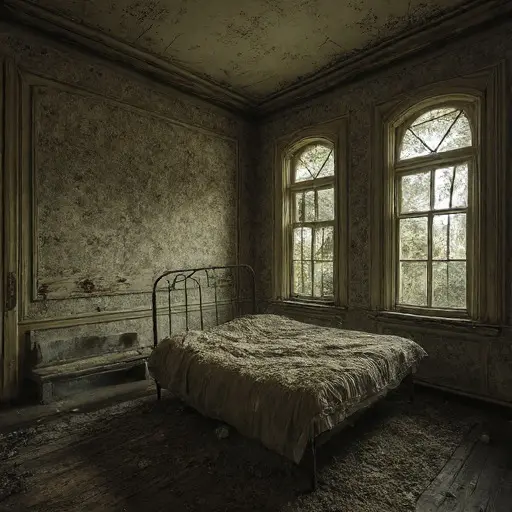
The belvedere itself remains one of the home’s defining spaces. From its windows, mature maples and towering oaks surround the property in every direction, while overgrown hedges conceal neighboring homes that have long since disappeared behind vegetation. The tower’s slight lean is visible from within, creating barely perceptible angles that give the room a strangely intimate atmosphere.
Below, the veranda continues to wrap around the rounded corner of the façade, its decorative columns softened by weather and wrapped in climbing ivy. Moss gathers between loose floorboards, while faded shutters hang at irregular angles against cream-painted brick. Despite decades of abandonment, the proportions remain elegant, and every architectural detail continues to contribute to the home’s quiet dignity.
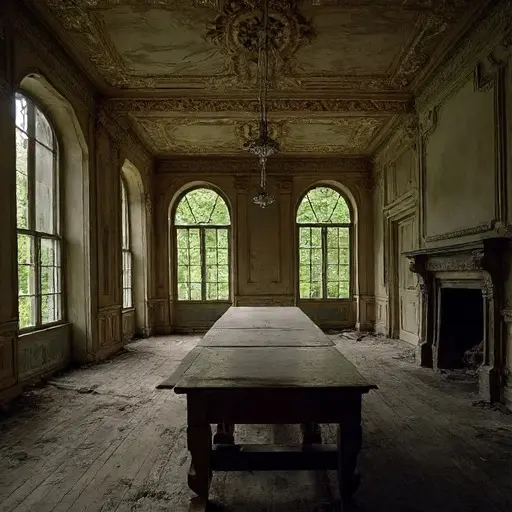
In the rear of the house, the former dining room overlooks what was once a carefully maintained garden. Today, ferns, tall grasses, and self-seeded saplings have replaced flower beds, pressing gently against the windows while filtered daylight fills the otherwise lifeless room.
The surrounding neighborhood has changed just as gradually as the house itself. Residential streets now end beneath dense forest canopies, old hedges blur former property lines, and woodland slowly reclaims every neglected garden. Yet this Italianate residence continues to stand with remarkable composure. Its bowed walls, leaning tower, faded shutters, and ivy-covered veranda tell not a story of collapse, but one of endurance—an elegant family home quietly settling into the landscape that has patiently grown around it.