The House Above Emerald Quarry
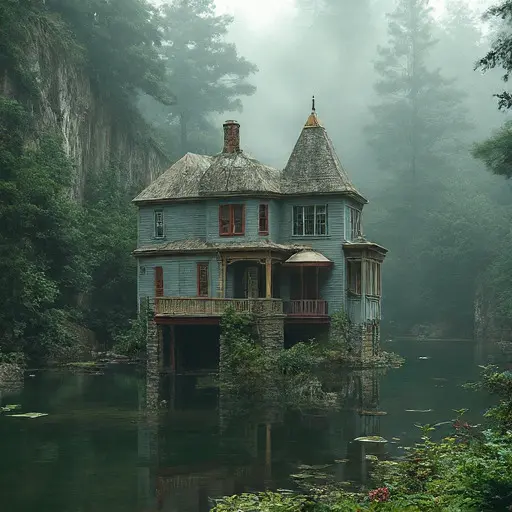
Few houses appear so completely shaped by their landscape. Hidden deep within the forest, where an abandoned stone quarry has slowly transformed into a clear emerald lake, stands a Victorian residence unlike any other. Rather than occupying a hilltop or clearing, the house rests on a narrow shelf between towering quarry walls and the flooded basin below, stretching gracefully along the cliff edge as though following a geological contour drawn long before its construction.
The structure unfolds horizontally across the quarry rim, creating a dramatic relationship with the water beneath. Every section seems aware of the drop below, and every window appears positioned to capture the remarkable view. Despite the unusual setting, the house never feels extravagant. Instead, it carries the quiet confidence of a place designed to belong exactly where it stands.
Its colors remain among its most memorable features. Large wall surfaces are painted in faded powder blue, softened by decades of rainfall, mist, and forest shade. Above and between these sections, projecting bays and upper gables introduce weathered tones of dusty rose and muted saffron yellow. Ivory detailing outlines windows and eaves while deep bottle-green trim anchors the composition, creating a layered Victorian palette that feels rich without overwhelming the surrounding landscape.
The years have transformed these colors into subtle gradients. Blue fades gently into gray. Rose tones soften toward muted clay. Saffron surfaces drift toward pale gold. Together they create an exterior that appears painted by both human hands and the passage of time.
The Bays Along the Quarry Edge
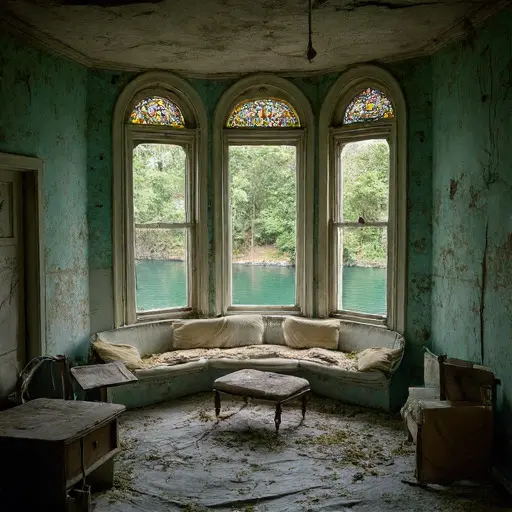
The façade is defined by three remarkable projecting bays, each entirely different from the others. One emerges in a hexagonal form, extending confidently over the quarry edge. Another projects as a traditional rectangular volume, while a third curves outward in a softer gesture that contrasts beautifully with the angular stone cliffs beyond.
Together they create an irregular rhythm across the elevation, preventing the long structure from ever feeling repetitive. Their colorful exteriors alternate between combinations of powder blue, dusty rose, cream, and green, giving each section its own quiet identity.
Above them rises an extraordinary collection of steep gables and clipped roof peaks. Slate tiles shift between charcoal black, blue-black, silver-gray, and scattered patches of oxidized copper green. The roofline appears almost geological itself, echoing the fractured quarry walls that surround the property.
The Veranda Over the Water
Running nearly the entire length of the quarry-facing side is a remarkable elevated veranda suspended above the rocky drop. Delicate Victorian railings painted cream and bottle green trace the edge, their decorative patterns softened beneath vines and hanging moss.
From this vantage point, the flooded quarry spreads outward like a hidden lake enclosed by stone. The emerald water reflects fragments of the colorful house above, breaking them into shifting patterns that drift across the basin whenever mist or breeze disturbs the surface.
Beneath the veranda, old retaining walls disappear into dense vegetation. Ferns emerge from cracks in the stonework. Moss blankets shaded ledges. Small shrubs grow where mortar once held firm. The boundary between architecture and geology has become increasingly difficult to distinguish.
Gardens on the Cliff
Long ago, terraces were carved directly into the quarry edge to create ornamental gardens overlooking the water. Time has reshaped them into something wilder.
Stone pathways weave between retaining walls now draped in ferns. Flowering shrubs rise from abandoned beds. Young birch trees emerge from corners once carefully maintained. The terraces remain visible, but only just, as though the forest is gently reclaiming every trace of cultivation.
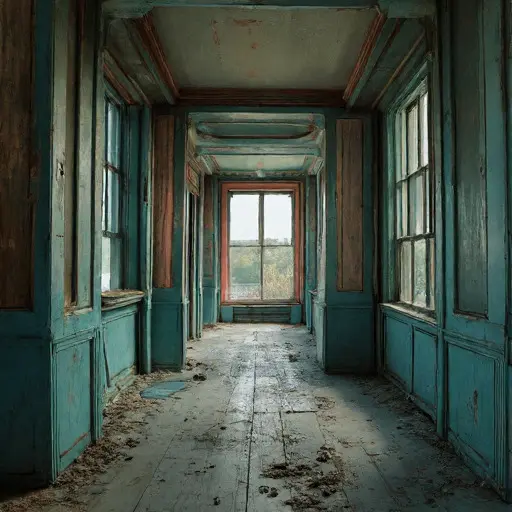
The stained-glass transoms above many windows still survive. Faded fragments of ruby red, amber, and cobalt blue catch the pale daylight and scatter softened color into empty rooms. Reflections from the quarry water mingle with these fragments, creating constantly shifting layers of light across floors and walls.
A House Suspended Between Stone and Water
The quarry itself has become the estate’s defining presence. Its clear emerald depths mirror cliffs, trees, and architecture alike. Pale mist drifts slowly between stone faces, softening distances and reducing sound until the entire basin feels separated from the outside world.
Here, the powder-blue walls appear cooler. The rose-colored bays become richer. The saffron gables glow softly against dark slate roofs and emerald reflections.
The house never dominates its surroundings. Instead, it participates in them. Every veranda post, retaining wall, stained-glass panel, and projecting bay seems shaped by the quarry’s existence. Without the flooded basin, the house would lose part of its identity.
As evening settles into the forest and mist gathers above the water, the colorful structure becomes fragmented across the lake’s surface. Reflections drift between stone cliffs and shadowed trees. The long veranda fades into silhouette.
And perched above the emerald quarry it has watched for generations, the house remains suspended between architecture and landscape, resting quietly on the edge of both.