The Hollowridge Stick-Eastlake Hillside House Left in Mist Stillness
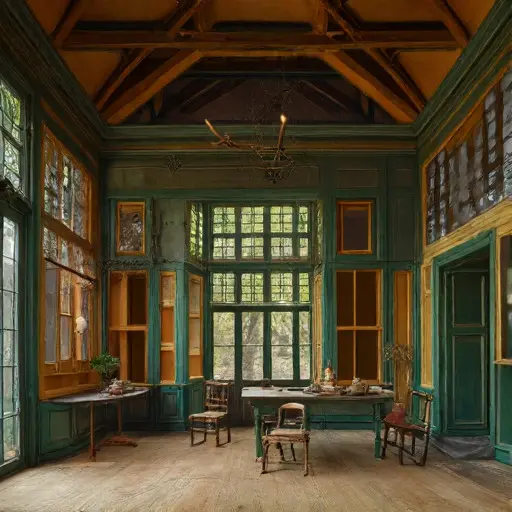
The Hollowridge House was constructed in the early twentieth century on a steep wooded hillside by a family of carpenters and land surveyors who specialized in adapting small residences to uneven terrain. Designed in the Stick-Eastlake style, the structure emphasized visible framing, modular expansion, and functional articulation rather than decorative excess. The household consisted of parents and two children, supported by intermittent laborers who assisted with terrace construction and hillside stabilization.
Daily life was shaped by elevation changes, weather conditions, and the constant negotiation between built form and natural slope. Each level of the house served a distinct purpose, with the stepped layout allowing the family to live in direct relation to the land’s gradient and seasonal behavior.
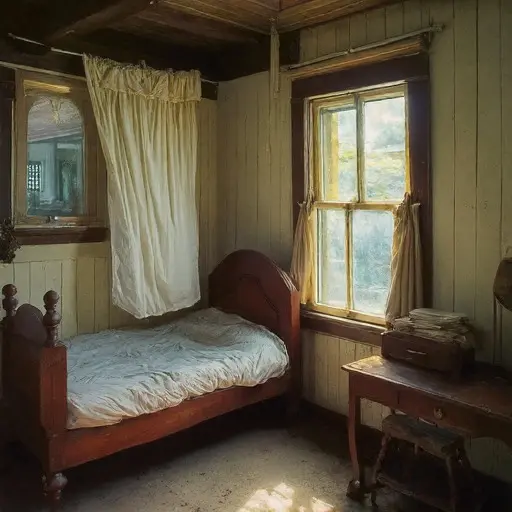
By the late 1920s, the Hollowridge House began to experience financial and logistical strain as access to the hillside property became increasingly difficult during winter months. Maintaining the exposed timber framing, graphite metal roof, and stepped terraces required constant upkeep due to moisture, wind exposure, and soil movement. Portions of the house were used less frequently during colder seasons, and maintenance of upper terraces and side balconies became irregular. Wildflowers continued to grow along the platforms, but their arrangement gradually lost structure as pruning cycles were interrupted. Household correspondence slowed, and repair documentation accumulated without consistent action, reflecting a gradual reduction in active stewardship of the property.
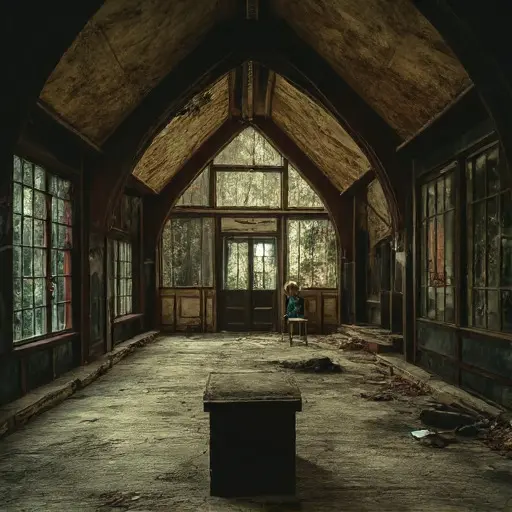
By the early 1940s, following prolonged economic difficulty and the dispersal of the family to lower valley settlements, the Hollowridge House was fully abandoned. No restoration efforts were undertaken, and the remote hillside location prevented any practical redevelopment. The structure remained anchored to the slope but deteriorated slowly under seasonal moisture, shifting soil, and vegetation encroachment. Interior spaces were left in their final state of use, preserving furniture, tools, and domestic records beneath layers of dust and mist. The house endures as an unoccupied Stick-Eastlake residence, quietly integrated into the hillside, gradually fading without return, renewal, or resolution.