The Hollowmere Stack House Left Abandoned in the Basin Forest
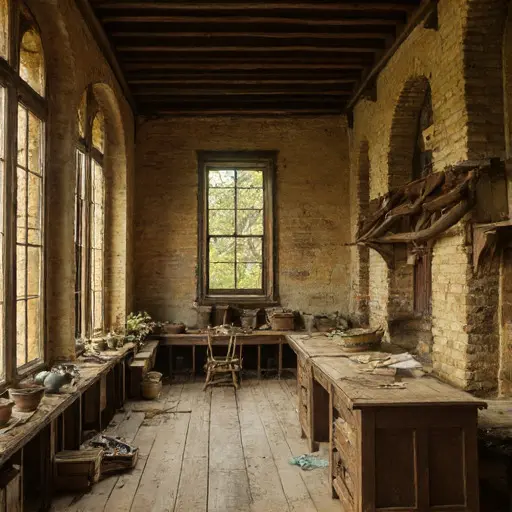
Hollowmere Stack House was constructed gradually between 1889 and 1927 within a shallow forest basin shaped like a natural amphitheater. Unlike conventional Victorian homes, it did not begin as a single unified structure. Instead, it developed as a sequence of vertically offset residential modules added over time, each constructed in response to shifting family needs and the uneven forest terrain.
The result was a tall, segmented residence that appeared carefully composed but structurally experimental.
The materials used across the house remained consistent with regional Victorian construction practices—aged yellow brick, dark oak timber framing, and pale limestone foundations—but their arrangement varied significantly between modules. Some sections were predominantly timber-framed with exposed beams and infill plaster, while others were built almost entirely from stone. Later additions combined both materials in visible transitional seams, clearly indicating distinct phases of expansion without disrupting overall cohesion.
The roof system reflected this incremental development. A layered arrangement of steep Victorian pitches and flatter transitional spans formed a stepped crown that descended unevenly across the structure. Slate shingles weathered into muted tones of dusty blue-gray, soft brown, and occasional greenish patina due to persistent forest humidity. Intersections between rooflines created sheltered pockets where rainwater gradually carved shallow channels into the structure over decades.
Inside, the Hollowmere Stack House functioned as a multi-level family residence with each segment serving distinct domestic roles. Upper modules housed sleeping quarters and private studies, while central levels contained communal rooms and administrative spaces. Lower stone-based sections provided storage and service areas integrated into the slope of the basin floor. Movement between modules occurred through narrow staircases and transitional corridors that subtly shifted in alignment between construction phases.
Early stability and gradual fragmentation
For several decades, the house supported a stable multi-generational household. The architectural segmentation, while unusual, allowed expansion without disrupting existing living areas. However, by the early 1920s, demographic changes and economic shifts began reducing the size of the resident family. Younger members left for urban employment, while maintenance demands increased as forest moisture began affecting timber joints and stone transitions.
Environmental integration of the structure
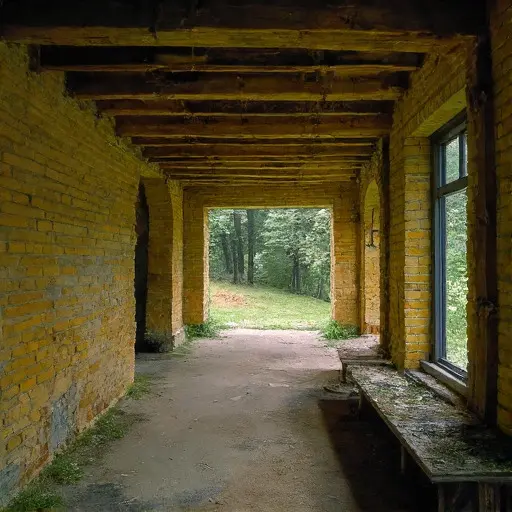
As occupancy declined, entire modules of the Hollowmere Stack House were gradually abandoned. Upper wooden sections became less frequently used due to maintenance challenges, while lower stone rooms remained intermittently occupied for storage and seasonal shelter. The transitional corridors between modules began to accumulate moisture and plant growth, subtly blending interior and exterior environments.
By the late 1930s, the house existed in partial use. Some sections remained active while others were completely sealed off due to structural concerns or simple disuse. The forest basin environment continued to reclaim surrounding spaces, with moss, clover, and low wildflowers expanding into courtyards and stone seams.
Final abandonment phase
By the early 1940s, Hollowmere Stack House was no longer continuously inhabited. The remaining residents relocated to nearby settlements as access and maintenance became increasingly impractical. Utility connections were gradually discontinued, and the segmented structure was left to stabilize naturally within the forest basin environment.
The house left within the basin
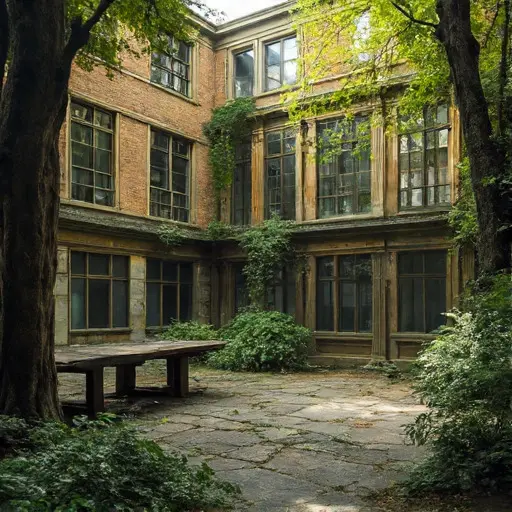
By the late 1940s, no formal ownership or active maintenance of Hollowmere Stack House remained. The structure was left legally unclaimed, though not destroyed or altered. No restoration efforts were undertaken, and no descendants returned to occupy it. The house remains embedded in the forest basin today, its stacked Victorian modules slowly weathering under stable canopy light, gradually merging with the surrounding ecology while retaining its quiet, segmented architectural logic.