The Hollowfield Forest House Left After Studio Wing Closure
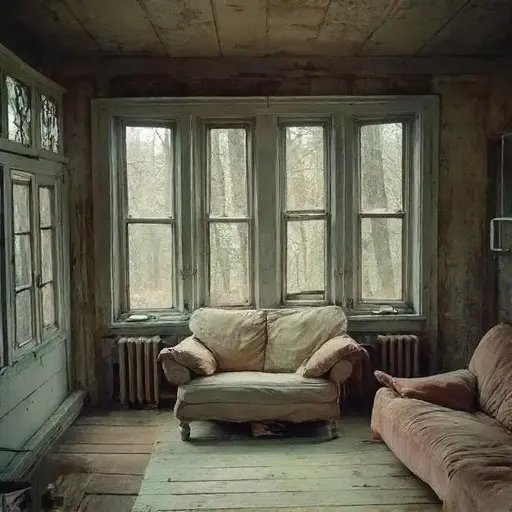
The Hollowfield House was constructed in 1879 at the edge of a dense woodland boundary where farmland gave way to unmanaged forest growth The original structure was a modest two-story Victorian family home built for the Carrington family, who had relocated from a nearby village after inheriting the land The site was chosen for its isolation and access to natural light filtered through the tree canopy, which provided a stable environment for both domestic life and small-scale artistic work
The split-level studio wing was added in 1908 as an expansion to support the increasing artistic and design work carried out by the Carrington daughters This extension was deliberately set slightly lower than the main house, stepping into the slope of the land and rotating a few degrees off alignment to follow the natural contour of the terrain Although asymmetrical in layout, the wing remained structurally integrated through shared stone foundation systems and timber framing connections
The combined structure developed gradually over several decades with small modifications including extended window bays, reinforced roof sections, and minor interior reconfigurations These changes were implemented without altering the fundamental compact Victorian proportions of the original house The result was a layered architectural form where domestic and creative spaces coexisted within a single evolving footprint
Gradual Withdrawal Into the Forest Edge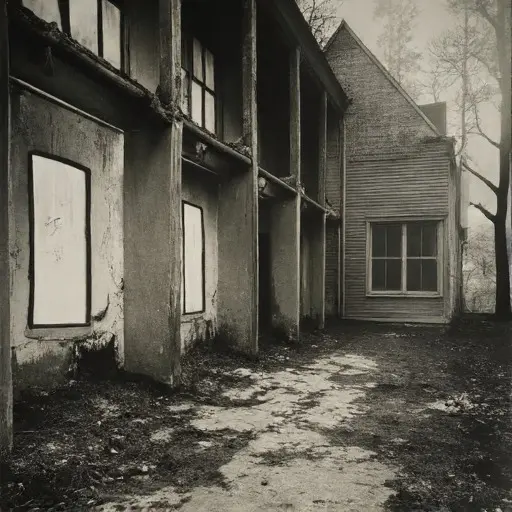
By the early 1930s, the Carrington family began to reduce their time at Hollowfield as urban opportunities for artistic work became more viable The studio wing, once the center of daily activity, saw the first signs of neglect as seasonal visits replaced permanent residence The forest surrounding the property began to expand subtly into the edges of the clearing, altering light patterns and increasing moisture retention around the lower structures
Maintenance of the property became increasingly irregular Wooden doors began to warp slightly, and window seals deteriorated under constant humidity exposure The studio wing remained structurally sound, but the separation between domestic and creative use spaces became more pronounced as both were gradually abandoned
Despite these changes, no structural collapse occurred The house and studio wing remained intact, supported by stable stone foundations and gradual hillside settlement that had been accounted for in the original construction
Final Abandonment at the Forest Boundary
<img src=”https://beyondvisit.
com/wp-content/imagecontent/uploads/abandoned victorian house 23984034.webp” alt=”” />
By 1949 the Hollowfield Forest House was fully vacated following the relocation of the remaining Carrington descendants to a coastal town where artistic commissions and infrastructure access were more reliable No further occupation or restoration efforts were recorded after this transition
In the following years the structure remained physically unchanged while gradually responding to environmental exposure The forest edge advanced slowly toward the clearing, and moisture accumulation increased along shaded walls and foundation lines The studio wing, once the most active space in the house, became fully silent but remained structurally stable
By 1950 the Hollowfield House and its split-level studio wing remained standing at the forest boundary fully abandoned and intact No collapse occurred, no redevelopment followed, and no return was recorded The structure persisted in quiet isolation, partially embraced by the encroaching woodland and the steady stillness of overcast light