The Hollowbrook Carpenter Gothic Farmhouse Beyond the Woods
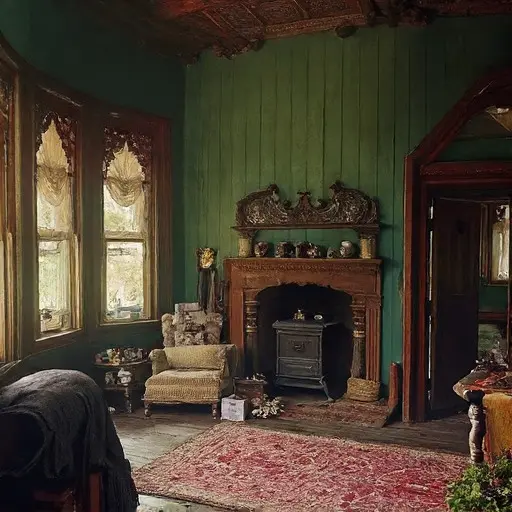
The Hollowbrook Farmhouse was built in the late 1880s by Samuel and Eliza Mercer, who settled beside the woodland after purchasing inexpensive acreage on the edge of a growing rural route. Samuel worked intermittently as a carpenter and mill laborer, while Eliza managed the household, garden, and small orchard that sustained the family through long winters. The Carpenter Gothic design, with its steep gables, intricate wooden trim, and wraparound porch, was Samuel’s own work, constructed gradually over several years as materials became available.
Life in the house was shaped by seasonal cycles: planting in spring, preservation in late summer, and long indoor months spent sewing, repairing tools, and maintaining correspondence with distant relatives. Over time, the property expanded into a deeply personal homestead where every object had a function and every corner reflected continuous care.
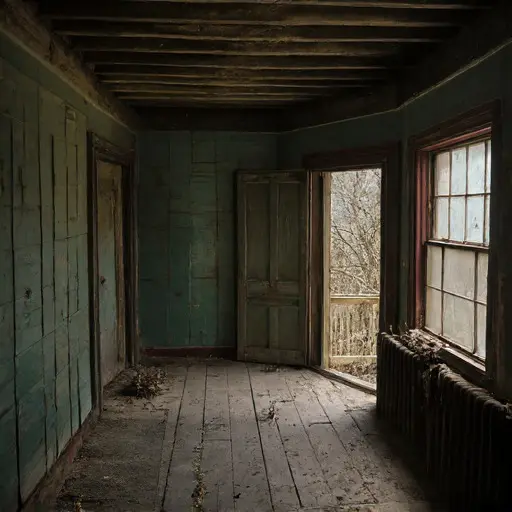
By the early 1930s, economic instability and declining rural employment severely affected the Mercer family. Samuel’s work became sporadic, and income from carpentry could no longer cover maintenance costs for the aging structure. Repairs to the roof and chimney were postponed repeatedly, allowing water to infiltrate upper rooms during heavy rains. Eliza reduced garden production to essential crops, while decorative plantings and ornamental care were gradually abandoned. The children moved away in search of employment, leaving the parents to manage a house that had grown increasingly difficult to maintain. Rooms were closed off to conserve heat, and parts of the porch fell into disuse as structural wear progressed. What had once been a fully active homestead slowly transitioned into a partially occupied dwelling under quiet financial strain.
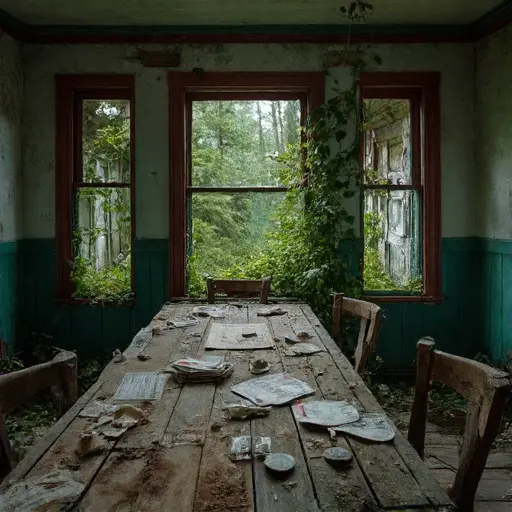
By 1942, following Samuel’s death and unresolved property debts, the Hollowbrook Farmhouse was officially vacated. No restoration was attempted, and legal complications prevented sale or redevelopment of the land for many years. The garden continued its slow transformation without human care: grapevines overtook the arbor, sunflowers grew from abandoned tools, quilts decayed on the clothesline, and herbs spread into wild, uncontained clusters along the walkway. Inside, furniture, documents, and personal belongings remained exactly as they were left. The house was never reclaimed by descendants, and it still stands at the forest edge, slowly surrendering to ivy, weather, and time without resolution or return.