The Hollow Sphere Botanical Observatory
Abandoned Victorian structure fused around a colossal hollow stone sphere buried in the earth, as if architecture and geology were grown together rather than constructed. The building wraps the curvature of the sphere in fragmented layers of dark mahogany ribbing, cracked green glass, and pale limestone panels, forming a partially collapsed observatory that never fully separated from its core subject. The geometry feels inevitable rather than designed—like the house is still obeying the shape it was built to study.
The sphere itself emerges through broken apertures in the structure, its stone surface etched with faded Victorian botanical diagrams, spiral measurement grids, and radial notations suggesting long-obsolete scientific intent. Sections of the house align precisely with these engravings, as though corridors and windows were positioned to track specific lines of growth, depth, or unseen subterranean patterns.
Exterior surfaces are heavily weathered but structurally coherent: mahogany beams curve like exposed skeletal supports, anchoring fractured walls of oxidized glass and mineral-stained stone. The glass retains faint green tinting, now uneven and clouded, catching sunlight in broken spectral fragments that shift across the interior like moving specimens under observation.
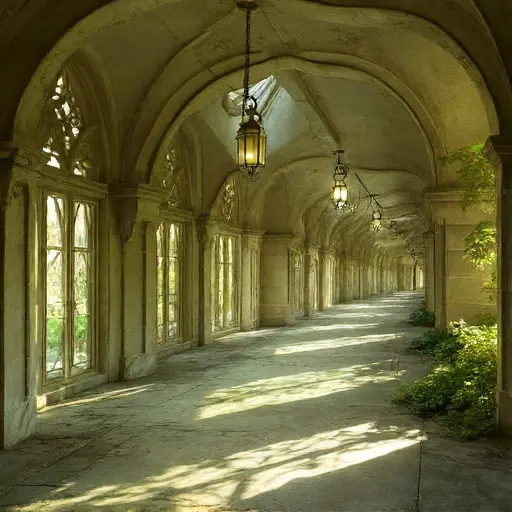
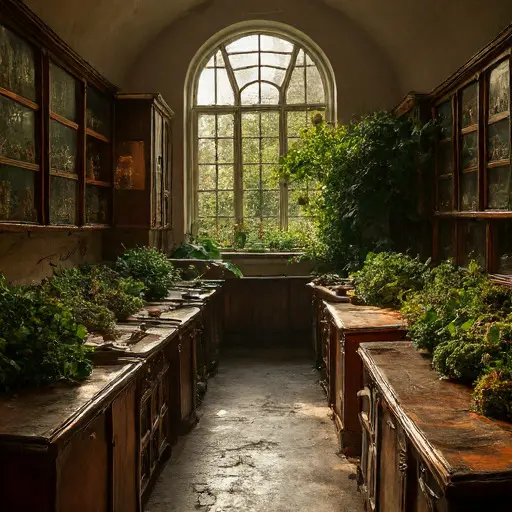
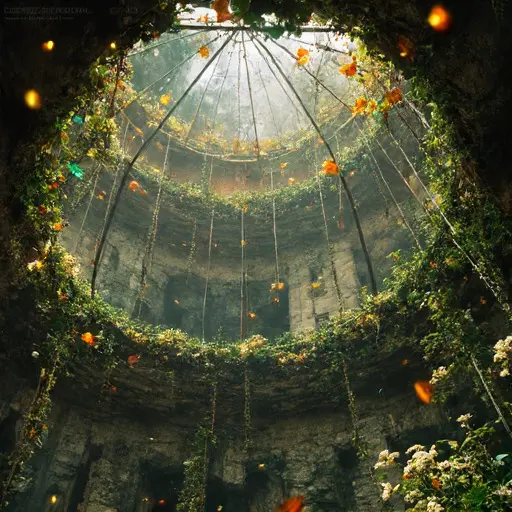
Inside, rooms are arranged in concentric but imperfect layers that follow and occasionally reject the sphere’s logic. Some corridors curve smoothly along the stone’s interior arc, creating seamless circular motion through space. Others break away abruptly, producing angular Victorian rooms that feel misaligned yet still structurally plausible, as if repairs and expansions attempted to resist the original geometry over decades.
The collapsed glass dome crowns the structure like a shattered lens. Its fractured segments resemble petals frozen mid-fall, scattering light into sharp bands of green and warm amber across stone, timber, and plant growth below. Iron suspension rings hang from the remaining frame, tangled with ivy and flowering vines that have claimed the observatory’s original instrumentation.
The surrounding ground mirrors the internal geometry in a quieter language. Moss spreads in circular patterns around the base of the sphere, and oversized wildflowers bloom in radial arrangements that subtly echo engraved diagrams beneath the house. Shallow pools of rainwater collect in natural depressions, reflecting distorted fragments of the architecture above as broken, curved reflections.
Lighting is warm, late-afternoon sun filtered through broken glass and foliage, producing layered shadows that wrap around curved surfaces instead of falling cleanly. The entire scene reads as a photoreal architectural impossibility that still feels physically grounded—a Victorian botanical observatory that did not collapse outward, but inward into the shape it was always trying to understand.