The Hollow Crown of the Crater Lake
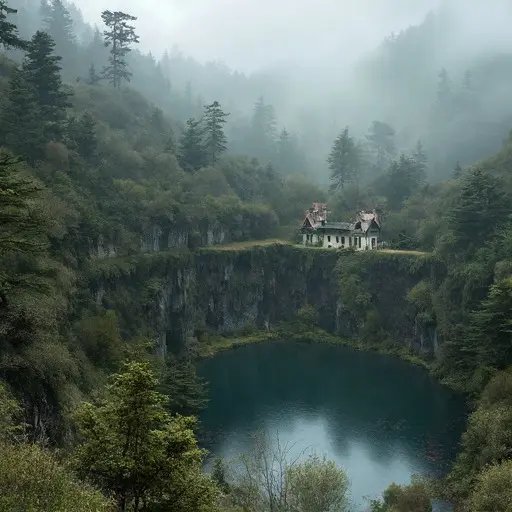
Within the collapsed bowl of an ancient volcanic crater, where forest has reclaimed every slope except the still, reflective lake at its center, the house clings to a basalt ridge like a memory that refused to erode. It does not sit upon the land so much as follow it—its segmented Victorian form tracing the inner curve of the crater wall in a continuous, flowing arc.
From above, the structure reads as a deliberate architectural response to geology.
A strong central hall anchors the composition, while multiple pavilions extend outward in staggered intervals along the ridge. Each volume turns slightly to align with the crater’s curvature, creating a rhythm that feels less constructed than discovered.
The foundation is carved from near-black basalt, the same volcanic stone that defines the crater itself. Above this heavy base, the house transitions into plastered masonry in subdued, atmospheric tones—pale jade white, smoky lavender-gray, and muted coral sand. These colors do not sit flat on the surface; they fade and blend where rain has traced mineral paths downward over decades, forming delicate vertical streaks that echo the cliffs beyond.
The roofscape is fragmented and expressive without becoming chaotic. Steep gables rise and fall across interconnected wings, joined by lower transitional sections that follow the terrain beneath. Slate tiles shift between graphite black, deep indigo, and occasional oxidized copper-green where repairs once interrupted the original pattern. The skyline is punctuated by two contrasting chimneys—one cylindrical in red brick, the other square and heavier in dark stone—creating a subtle imbalance that feels intentional rather than accidental.
The Ridge-Hall Windows
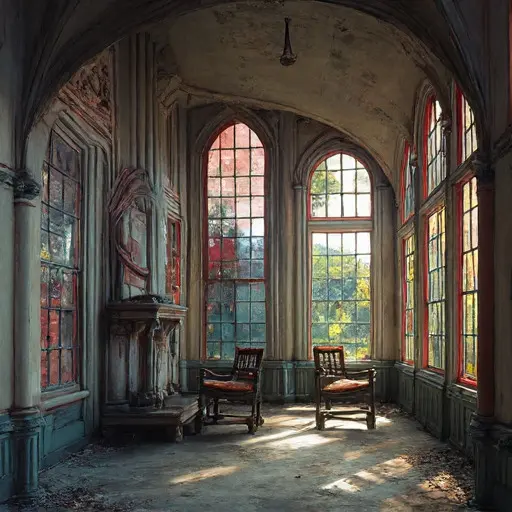
Inside the central hall, height becomes the dominant sensation. Tall narrow sash windows rise in disciplined intervals, framing fragments of the crater lake and the surrounding forest canopy. The basalt foundation walls remain exposed at lower levels, grounding the interior in the same volcanic material that defines the ridge outside.
Light enters in softened gradients, filtered through distance, mist, and layered glass. Subtle reflections from the lake below ripple across plastered surfaces in shifting tones of steel blue and muted green-black. The space feels less like a room and more like an architectural channel between crater and sky.
The Pavilion Gallery Above the Basin
Along one of the side pavilions, a long glass-enclosed gallery runs parallel to the ridge edge. Supported by thin iron columns anchored into basalt, it appears almost suspended above the crater’s inner drop.
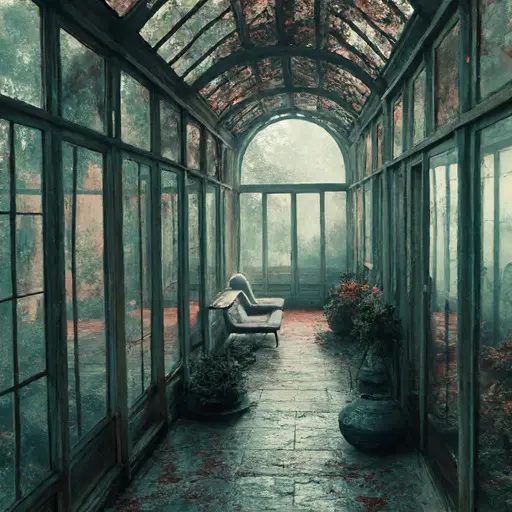
The glazing is slightly irregular, aged by time and volcanic moisture, producing fractured reflections of the crater lake below. Water, forest, and sky merge into layered gradients of green-black, steel blue, and dim silver. Inside, the corridor becomes a space of shifting transparency—neither fully enclosed nor fully exposed.
As mist rises from the crater floor, it presses gently against the glass, dissolving edges between interior and exterior. The result is a continuous visual loop in which the house reflects the crater while the crater reflects the house.
The Entrance Carved Into Stone
The main entry is set directly into the basalt base, accessed by a short stair carved into the ridge itself. The doorway sits within a heavy stone frame, its presence more geological than architectural.
The door is finished in a deep matte teal, its surface softened into a desaturated blue-green-black that absorbs light rather than reflecting it. Around it, the basalt blocks remain rough and unadorned, emphasizing the contrast between human refinement and volcanic permanence.
Outside, the crater forest closes in densely, forming a continuous green wall around the basin. The lake remains still at its center, reflecting inverted silhouettes of ridge, roofline, and sky. At certain hours, mist drifts across its surface like breath held inside a sealed chamber.
From within the crater, the house appears both isolated and inevitable—as though it was always meant to occupy this arc of stone, waiting for the forest to grow around it and the water to settle below.
And as volcanic dusk light spreads across the basin, the segmented pavilions, fractured rooflines, and basalt foundation merge into a single continuous form—quiet, enclosed, and permanently shaped by the crater that holds it.