The Hohenwald Secession Villa Left on the Hillside
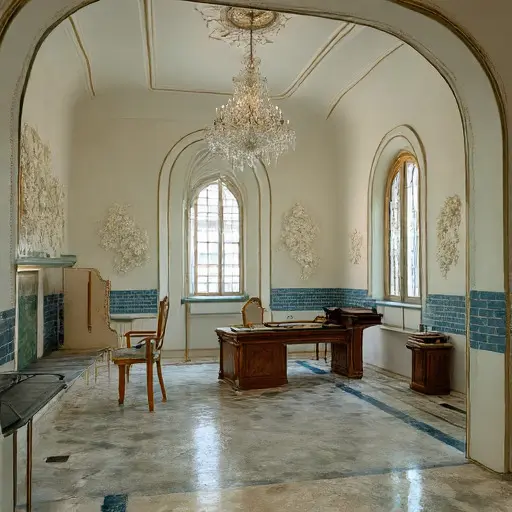
The Hohenwald Villa was constructed on a stepped hillside at the edge of a dense forest in the early 1900s by a reform-minded industrial family influenced by the Austrian Secession movement. The estate was designed as a unified architectural composition, emphasizing clarity, abstraction, and controlled ornamentation rather than traditional historicist excess. The household consisted of two generations supported by administrative staff responsible for managing industrial investments, forestry leases, and regional property holdings.
Early life within the villa was structured around precise routines, with financial and operational decisions conducted in the main salon and adjoining offices. The terraced gardens were integrated into the architectural vision, extending geometric order into the natural slope through controlled planting patterns and stonework alignment.
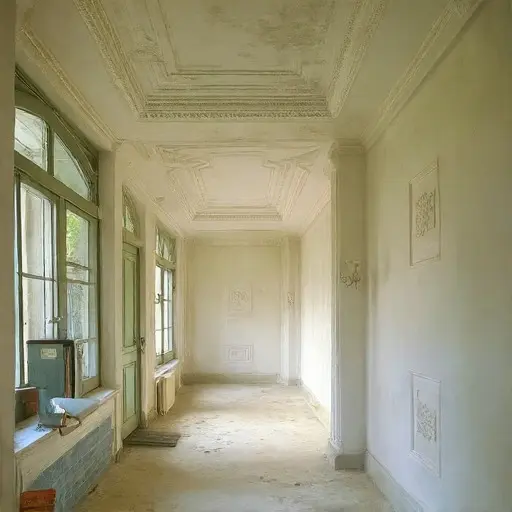
By the late 1920s, the Hohenwald estate began to experience financial strain as industrial markets fluctuated and regional investments became less reliable. Maintenance of the villa’s modernist detailing required specialized materials and consistent upkeep, which gradually became more difficult to sustain under reduced revenue. Portions of the complex were closed off to conserve heating and operational costs, resulting in uneven use across the interconnected volumes. Administrative correspondence accumulated without timely response, particularly regarding forestry leases and investment settlements. Moisture from the surrounding hillside began to affect plaster joints and metal frames, subtly eroding the crisp separation between structural planes and decorative bands. The estate transitioned from active administrative residence to partially maintained structure with increasing functional fragmentation.
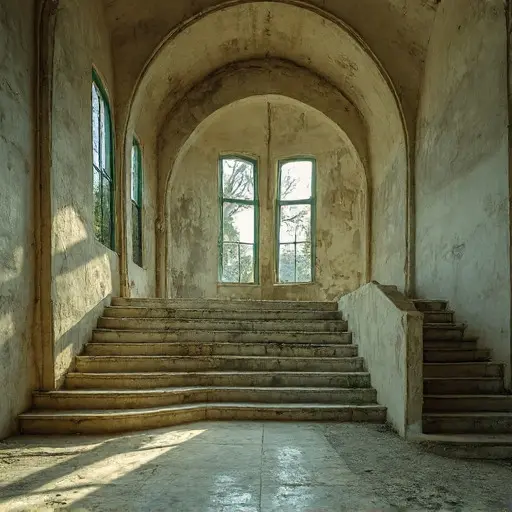
By the early 1940s, following prolonged financial collapse and unresolved inheritance fragmentation, the Hohenwald Villa complex was fully abandoned. No restoration efforts were undertaken, and legal disputes prevented any unified intervention or redevelopment of the estate. The structure remained intact on its forested hillside but deteriorated steadily under seasonal weathering, vegetation encroachment, and structural fatigue. Interior spaces were left in their final operational states, preserving furnishings and records beneath accumulating dust and moisture. Over time, the once precise Secessionist order dissolved into quiet decay, leaving the villa as an uninhabited architectural composition slowly reclaimed by forest growth, hillside erosion, and the passage of time.