The Hillside Library House Left to Forest Silence
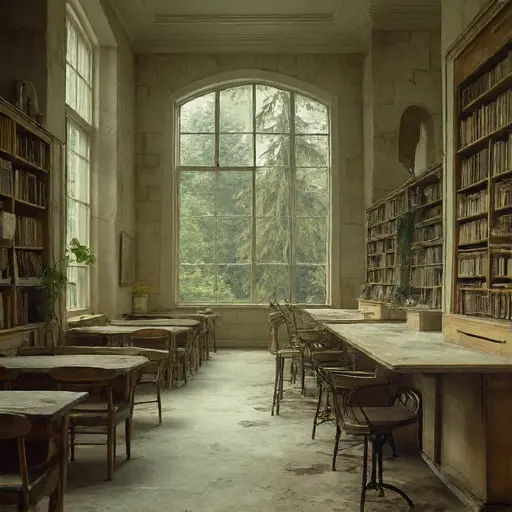
The middle tier of the hillside library house served as its primary communal and intellectual space, where the family once lived alongside an extensive private collection of books gathered over generations. The architecture reflects this dual purpose with restrained clarity: pale limestone walls provide thermal stability against the damp forest air, while vertical timber framing creates rhythm between continuous shelves and open living space. The room arrangement is practical rather than decorative, built for long periods of reading, writing, and quiet conversation.
Abandonment here did not arrive as rupture but as gradual withdrawal from routine. The last recorded use of the library coincides with a period of increasing seasonal isolation, when forest access paths became unreliable during long wet cycles. After that, the house remained structurally maintained for a short period, but no further occupation followed. Books were left exactly where they had been placed—some open, some stacked in careful piles—suggesting departure without urgency rather than evacuation.
Over time, humidity began to alter the interior in subtle ways. Paper softened at the edges, timber shelves absorbed moisture and shifted microscopically under load, and the air itself became heavier with the forest’s slow breath. Yet nothing collapsed. The room persists in a stable but unattended equilibrium, where human order is still visible but no longer actively maintained.
The Lower Archive Level Beneath the Slope
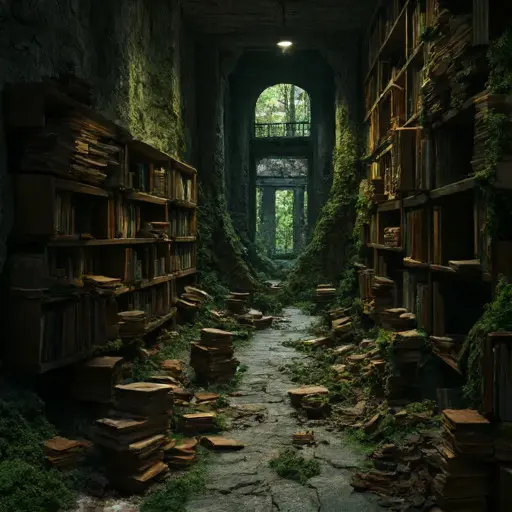
The lowest level of the house, embedded deeper into the hillside, functioned as the archival heart of the library. This space holds older volumes, documents, and personal records stored with greater environmental sensitivity in mind, protected by thick stone walls and limited light exposure. Despite this, long-term forest moisture has gradually influenced the materials, producing slow deformation rather than sudden decay.
The abandonment process here appears almost administrative in origin. Records suggest the family reduced visits gradually rather than ending them abruptly, likely due to changing professional obligations in nearby towns during the mid-20th century. As access became more difficult and maintenance less frequent, the archive was effectively left in place “between uses,” a condition that never resolved into either active occupation or formal closure.
The Upper Reading Gallery in the Canopy
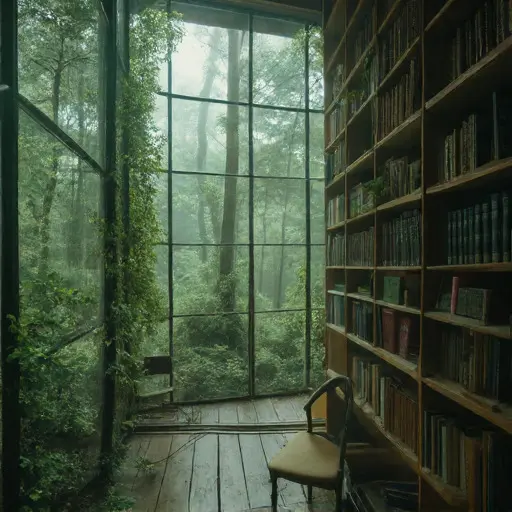
The upper level of the hillside library house is the most visually exposed yet the quietest in function. A narrow reading gallery extends along the canopy line, enclosed in large glass panels framed by faded sage-green metal. From here, the forest is no longer a backdrop but a surrounding presence, with branches pressing close enough to touch the exterior glass in still weather.
This level represents the final phase of occupancy before abandonment became complete. It was likely used intermittently in the final years, reserved for quiet reading or seasonal retreat rather than daily life. Eventually, even those visits ceased, leaving the gallery in a state of suspended attention—furniture still oriented toward the view, books aligned on shelves, and light continuing to move through the space each day without human interpretation.
No restoration efforts ever followed the departure. The house remains structurally intact, integrated gently into the hillside and forest ecology, its library function preserved in form but not in use. It stands as a quiet record of intellectual domestic life gradually absorbed by the surrounding woodland, where time replaces maintenance and silence replaces reading.