The Hillside Greenhouse Villa Slowly Taken by Forest Mist
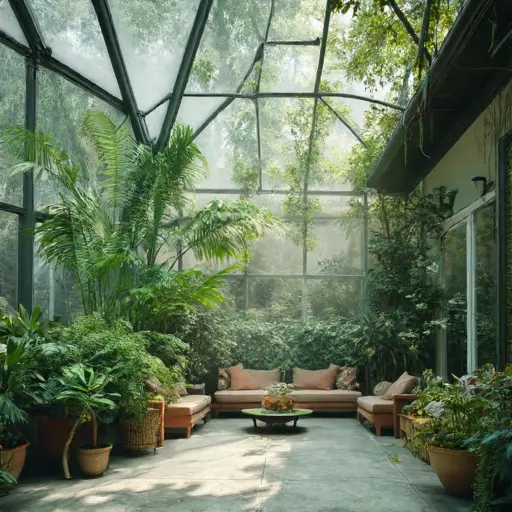
The main living level of the hillside greenhouse villa reflects a deliberate blending of domestic architecture and controlled botanical space. Designed during the mid-century period as an experimental residence for seasonal living in a coastal forest environment, the structure emphasizes openness, light, and continuous visual contact with vegetation. The living room, kitchen, and transitional corridors are arranged without rigid separation, instead flowing into one another through subtle changes in flooring and ceiling height.
Abandonment did not arrive as a single moment but as a gradual fading of occupancy tied to shifting family circumstances and increasing difficulty maintaining the greenhouse systems. As heating, ventilation, and seasonal pruning became irregular, plant life began to assert itself more freely within the structure. What was once curated greenery slowly transitioned into self-directed growth, merging botanical and domestic spaces without regard for architectural intent.
Despite this, the building retains a quiet structural dignity. Furniture remains in place, softened by dust and humidity rather than destruction. The glass panels still admit light effectively, though now filtered through condensation patterns that transform the interior into a diffuse, green-tinted environment. The result is not ruin, but a slow recalibration of purpose—where living space and greenhouse are no longer distinct categories.
The Curved Conservatory Spine
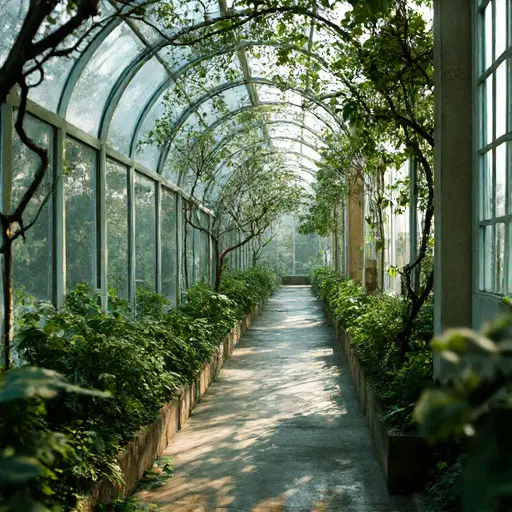
The greenhouse section forms the architectural heart of the villa, extending along the slope as a curved spine of glass and steel. It was originally designed for year-round cultivation of ornamental and experimental plant species, integrating botanical growth directly into the circulation path of the home. Over time, however, maintenance cycles became irregular, allowing natural growth patterns to exceed their intended boundaries.
As abandonment progressed, the conservatory shifted from curated garden to semi-wild interior ecosystem. Vines trace along structural joints, moisture accumulates in low corners, and plant beds expand beyond their original limits. Yet the structure remains intact, its engineering resilient enough to accommodate this gradual transformation without failure.
The Lower Terrace Rooms Embedded in the Slope
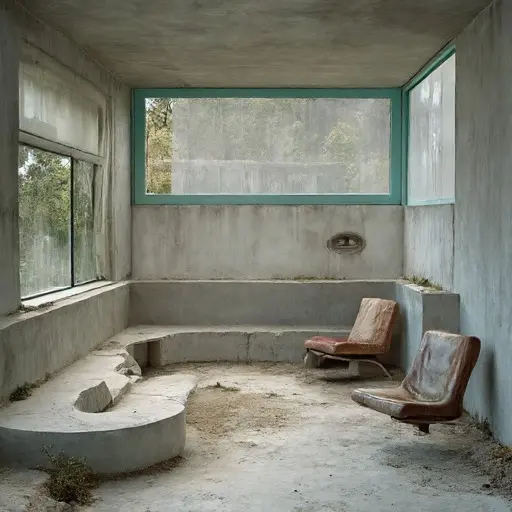
The lowest tier of the hillside greenhouse villa is partially embedded into the earth, creating a series of sheltered rooms that once served as private quarters and utility spaces. These areas are more enclosed than the upper levels, designed for thermal stability and protection from coastal winds. As the forest environment matured around the structure, soil moisture and root systems began to subtly interact with the building envelope.
Abandonment in these rooms is defined less by decay and more by insulation from time. The spaces remain physically stable, with furniture still positioned as it was last used and structural elements largely unaffected by external vegetation. However, faint signs of ecological proximity are visible—thin root lines tracing along foundation edges, moss forming in shaded joints, and subtle humidity patterns marking long-term environmental contact.
The villa remains unclaimed and unrestored. No effort has been made to remove plant life or reverse its integration into the architecture. Instead, the house persists in a balanced state between design and ecology, where abandonment has not led to collapse, but to a slow merging of built environment and forest atmosphere under constant mist and diffuse coastal light.