The Highridge House Left Vacant After Ridgeline Decline
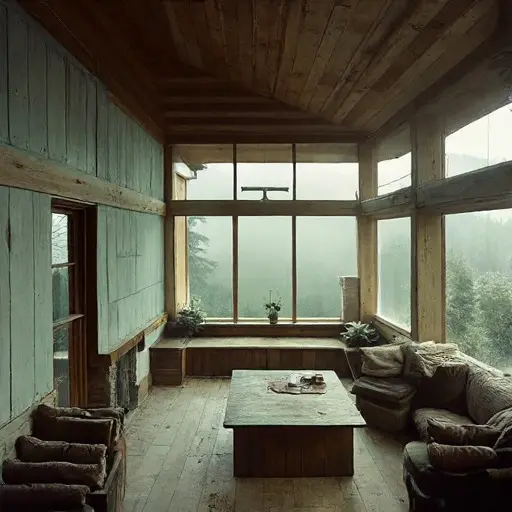
The Highridge House was completed in 1906 for the Marston family, who oversaw forestry boundary management and ridge surveying operations across the twin valley system. Unlike traditional hillside estates, the structure was not placed upon the land so much as drawn along it, following the natural ridge spine in a stepped, cascading sequence of connected volumes. Each section responded directly to slope, wind direction, and sightline, creating a linear residence that felt more assembled by terrain than constructed upon it.
Built from alternating layers of pale quartz stone and horizontally laid timber planks, the house developed a distinctive striped façade that shifted with light conditions. Quartz surfaces carried a soft mineral glow in milky white, pearl gray, and pale blue tones, while timber sections darkened into ink-black, faded turquoise, and muted rust-brown. The result was a restrained but expressive rhythm that mirrored the geological layering of the ridge itself. Above, segmented sawtooth-like roof sections stepped along the spine, their slate tiles varying between graphite, storm indigo, and occasional pale mineral green blooms, with thin skylight strips partially softened by moss growth at their edges.
Inside, life followed the elongated geometry of the structure. Arthur Marston managed forestry demarcation records and ridge access permits, while his wife Eleanor handled correspondence, logistical planning, and household coordination. Rooms were arranged in sequence along the ridge, each one subtly shifting in elevation and orientation, reinforcing the sensation of movement through terrain even while indoors. The house functioned as both residence and administrative outpost, closely tied to environmental observation and territorial management.
Early financial strain
By the late 1920s, centralized forestry regulation reduced the need for localized ridge management, and the Marston family’s administrative role gradually diminished. Funding for surveying operations declined, and maintenance of the long, segmented structure became increasingly difficult. Timber sections began to weather unevenly along exposed wind corridors, and quartz surfaces lost some of their luminous quality under accumulated dust and moisture. Repairs to skylight strips and roof seams were delayed as resources tightened.
Gradual decline in the household
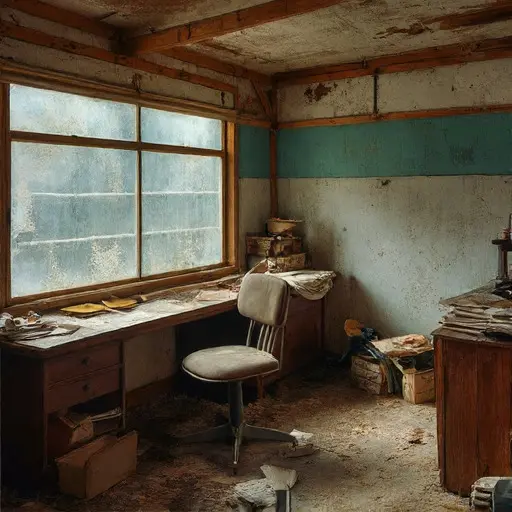
As financial strain increased, entire sections of the Highridge House were gradually closed off. Lower ridge rooms became inaccessible due to reduced heating capacity, and upper cantilevered spaces were used only intermittently. The long horizontal windows began to accumulate moisture and windborne debris, softening their once-clear connection to the opposite valley. Forestry correspondence diminished, and recordkeeping slowed to sporadic entries tied to residual administrative obligations.
Family presence declined in parallel. Younger members relocated to valley towns and later to urban centers where employment opportunities were more stable. Visits became infrequent and eventually ceased, leaving the house without regular occupation. The structure remained intact but increasingly detached from the human systems it once served.
Final abandonment phase
By the early 1940s, the Highridge House was no longer fully inhabited. Utility services were reduced and eventually disconnected following sustained arrears. Without maintenance, ridge winds intensified their presence inside the structure, passing through long window bands and empty corridors. Mist rising from the valleys below frequently enveloped the cantilevered sections, blurring interior boundaries and accelerating material wear.
Final deterioration
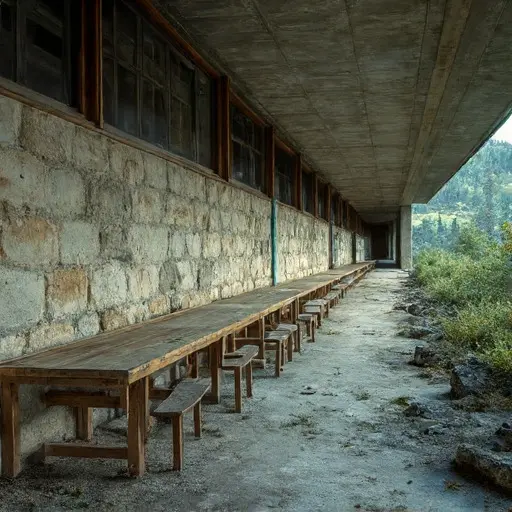
By the mid-1940s, no formal ownership or maintenance of the Highridge House remained. Legal records regarding the estate were left unresolved after repeated notices were returned undelivered. The structure persisted along the ridge spine in a state of quiet abandonment, slowly weathering under wind, mist, and geological exposure. No restoration or reoccupation followed, and the house remained an empty linear silhouette absorbed into the rhythm of the twin valleys.