The Highridge Gothic House Left Silent on the Limestone Spur
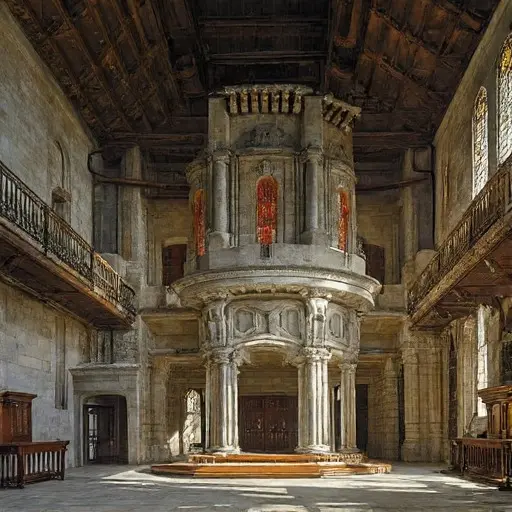
Highridge Gothic House was completed in 1882 for the Caldwell-Hartley family, who managed grazing rights and small-scale agricultural leasing across the surrounding heathland. Positioned deliberately on a narrow ridge of uplifted limestone, the residence was intended to be both visible and authoritative, rising above the flat moor as a structured architectural landmark. Its High Victorian Gothic design reflects a period of confident structural expression, where masonry logic and vertical emphasis defined status as much as function.
The building is constructed from alternating bands of pale limestone and darker basalt, producing a strong striped masonry effect that reinforces its verticality. This material rhythm runs continuously across walls, towers, and gables, giving the house a disciplined architectural identity even in its asymmetry. Rather than relying on ornament alone, the structure derives its presence from massing, proportion, and contrast.
The façade is carefully composed but deliberately asymmetrical. A tall central stair tower projects slightly forward, acting as the building’s primary vertical anchor. It is capped with a steep slate roof and delicate iron finial work, while its stacked lancet windows align in strict vertical order. Each window is framed by carved stone surrounds that taper into pointed arches, reinforcing the Gothic structural language.
To one side, a large gabled wing breaks the composition, filled with tall stained glass windows. These remain intact but weather-muted, their original vibrancy softened into deep ruby, forest green, and smoky amber tones. The interplay between this colorful wing and the austere central tower creates a controlled tension between ornament and structure.
Architectural depth and interior hierarchy
The entrance is set within a deeply recessed stone porch, framed by a heavy arch supported by clustered columns that divide into slender shafts near the capitals. This structural branching reflects Gothic engineering principles, where weight is visually distributed through articulated stone geometry. The wooden double doors are reinforced with iron strapwork in repeating geometric patterns, still intact but dulled by decades of exposure.
The roofscape is highly articulated, composed of intersecting steep gables and narrow clerestory openings that once illuminated upper halls. Slate tiles vary subtly in tone, forming natural gradients across the roof surface. Multiple chimneys rise at different heights, each detailed with restrained brick corbelling rather than excessive ornamentation, emphasizing functional clarity over decoration.
The surrounding ridge landscape is open and wind-exposed. Low purple heather, coarse grasses, and scattered limestone outcrops define the terrain, while a narrow stone-edged footpath approaches the house before fading into the heath. The building remains visually dominant within this sparse environment, its vertical composition contrasting sharply with the horizontal expanse of the moor.
Gradual withdrawal from ridge operations
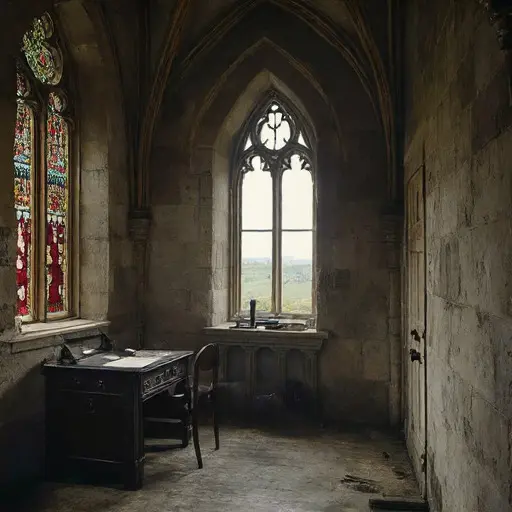
By the early 20th century, changes in agricultural leasing practices and the consolidation of rural land management began reducing the need for localized estate oversight. Larger administrative systems gradually absorbed functions once handled directly from properties like Highridge House. As a result, the Caldwell-Hartley family’s active role in ridge management diminished.
Occupancy patterns shifted gradually. Certain wings were used seasonally, while others were closed entirely during extended periods. Maintenance of more remote structural elements, particularly upper clerestory sections and exterior stonework, became less frequent. Despite this, the building remained structurally sound, preserved by its robust masonry construction.
Final abandonment phase
By the late 1940s, the remaining family members had relocated to urban centers, and Highridge Gothic House was fully vacated. No redevelopment proposals followed, as the structure remained architecturally significant and physically stable within the landscape.
The house left behind
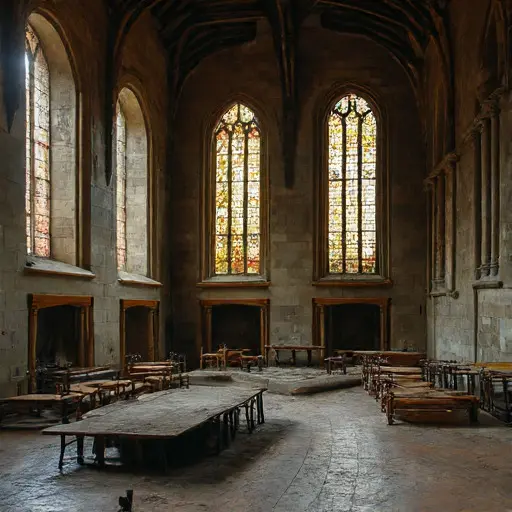
By the early 1950s, Highridge Gothic House stood entirely vacant. No restoration or repurposing was undertaken, and no new occupants arrived. The structure remains intact on its limestone ridge, a sharply defined example of High Victorian Gothic architecture preserved within an open, windswept heathland that gradually moved on without it.