The Highland Manor That Shifted Between Timelines
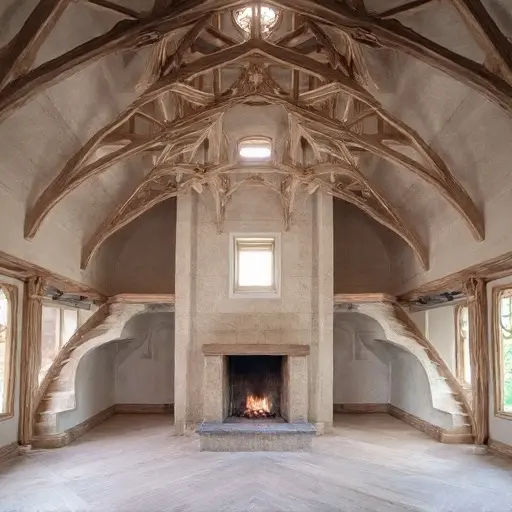
The Highland Manor was built in the late 19th century as a private residence for a land survey family responsible for mapping grazing territories across a remote highland valley. Unlike conventional Victorian estates designed for fixed hierarchy and symmetry, this structure was conceived as a living interpretation of landform and memory, where each architectural volume responds to different views of the surrounding terrain.
The manor is composed of three primary Victorian forms, each subtly rotated relative to the others.
Rather than a single unified block, the building behaves like a constellation of connected structures, producing shifting perspectives depending on the viewer’s position. This design gives the impression that the house is not static, but composed of overlapping architectural moments.
Its exterior is built from pale limestone softened by weather into tones of lilac-gray and warm stone beige. Timber framing runs through the façade in gentle arcs rather than strict orthogonal lines, subtly bending the visual rhythm of the structure. Victorian ornamentation remains present but reinterpreted: carved floral cornices, flowing wooden trims, and iron detailing that resembles botanical sketches rather than rigid fabrication.
Architectural drift across the valley edge
The roofline forms an elegant cascade of overlapping gables, each offset in height and orientation. Slate tiles catch diffuse highland light like muted watercolor brushstrokes, shifting between soft charcoal, blue-gray, and desaturated green depending on cloud cover. Dormer windows appear irregularly placed, not according to strict symmetry but in response to interior volumes and external sightlines.
Around the base of the structure, shallow terraces extend outward into the heather-covered valley floor. These are not heavy foundations but gentle architectural extensions, allowing the house to merge gradually with the terrain. Wild grasses grow through lower structural edges, brushing against stone and timber so consistently that the boundary between building and landscape becomes visually ambiguous.
The surrounding environment is defined by low drifting clouds that move close to the ground. Pale heather fields and soft moss carpets absorb light evenly, reinforcing the muted tonal palette of the manor. There is no harsh contrast between structure and setting; instead, everything transitions slowly from built form to natural surface.
Gradual fading of occupancy across rotated volumes
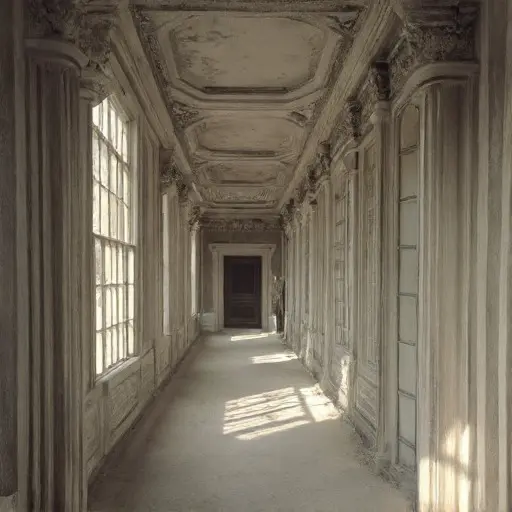
By the early 20th century, the Highland Manor’s original surveying function diminished as regional mapping systems became centralized and mechanized. The need for a permanent, terrain-responsive residence in the valley decreased, and the house transitioned from active occupation to intermittent seasonal use.
Despite reduced occupancy, the structure remained physically stable due to its robust limestone construction and careful timber integration. However, as time progressed, interior use became uneven across its three rotated volumes. Certain sections were maintained longer due to favorable views or structural comfort, while others fell into disuse earlier, reinforcing the impression of a house existing in multiple temporal states simultaneously.
By the mid-1940s, the manor was fully abandoned. No restoration followed, as its complex geometry and remote highland position made practical reuse unlikely.
Final equilibrium within the drifting valley
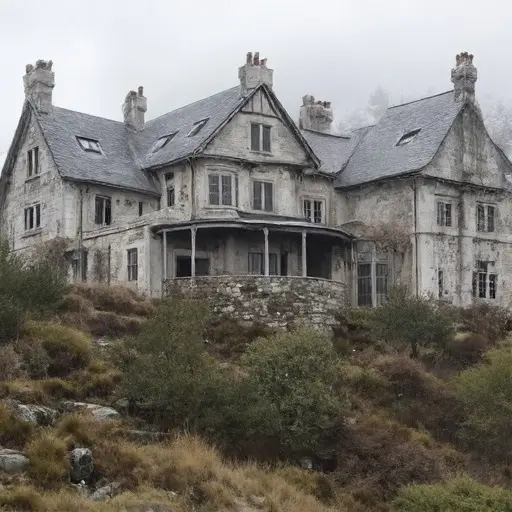
Today, the Highland Manor remains abandoned and unchanged. No reconstruction or redevelopment has been attempted. It stands in the highland valley as a softly displaced Victorian structure—composed of overlapping architectural memories, quietly suspended between land, cloud, and time.