The High Alpine Plateau Residence Left Silent Above the Peaks
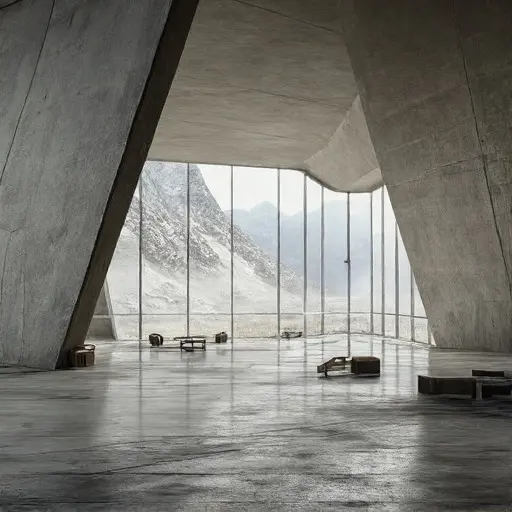
The High Alpine Plateau Residence was completed in 1991 as part of a high-altitude architectural research initiative exploring large-scale habitation systems designed to function as engineered extensions of natural terrain rather than conventional buildings Situated on a remote alpine meadow above the tree line, the structure was conceived as a colossal grounded form composed of folded reinforced concrete planes and precision-cut titanium latticework that allowed it to stretch horizontally across uneven mountain terrain without relying on traditional vertical massing The design prioritized structural clarity and environmental resilience over aesthetic ornamentation, resulting in sweeping angular walls, deep recessed corridors, and monolithic slab bridges that intersected in complex but fully load-bearing configurations Large industrial glass sections were embedded throughout the structure, providing continuous visual connection to the surrounding alpine environment while maintaining thermal and structural integrity in extreme conditions
From the outset, the residence functioned less as a traditional home and more as a continuous architectural landscape, with interior spaces scaling up to atrium-like volumes that mirrored the vastness of the surrounding plateau The use of titanium latticework allowed for long-span structural stability while minimizing material deformation under temperature fluctuations Reinforced concrete slabs were engineered with expansion tolerances to accommodate freeze-thaw cycles, while embedded joint systems distributed load across irregular terrain without visible settlement The interior layout followed a non-hierarchical logic, with corridors, halls, and open chambers arranged as interconnected spatial fields rather than discrete rooms
Gradual Abandonment in Extreme Altitude Conditions
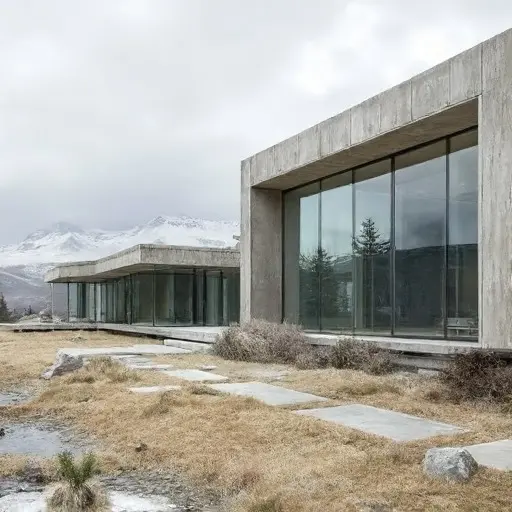
By the early 2000s the High Alpine Plateau Residence began to experience gradual decline not through ecological overgrowth but through long-term exposure to extreme high-altitude conditions that slowly affected its material systems Seasonal freeze-thaw cycles introduced micro-fracturing in exposed concrete surfaces, while titanium lattice joints developed subtle oxidation at connection points despite their high corrosion resistance The structure remained physically stable due to its over-engineered load distribution systems, but maintenance operations became increasingly difficult due to its remote location and the logistical challenges of sustaining large-scale infrastructure at altitude Occupancy steadily declined as operational teams reduced presence, leaving only intermittent inspections and partial system shutdowns across interior zones The building transitioned from active habitation to inert architectural monumentality without undergoing significant structural failure
Final Abandonment and High-Altitude Stillness
<img src=”https://beyondvisit.
com/wp-content/imagecontent/uploads/abandoned victorian house 86544210.webp” alt=”” />
By 2014 the High Alpine Plateau Residence was officially decommissioned following structural reassessments confirming long-term micro-fracture accumulation and increasing maintenance impracticality at extreme altitude No demolition was undertaken due to environmental protection constraints and the structural integration of the building with the alpine terrain, and no restoration was pursued due to the scale and complexity of its engineered systems Ownership and operational responsibility were formally relinquished, leaving the structure outside all active habitation and infrastructure networks The residence remains in place as a monumental grounded architectural field on the alpine plateau, preserved in silence under cold diffuse light and extreme environmental stillness
The High Alpine Plateau Residence persists as a silent engineered landscape above the mountains Its concrete planes and titanium latticework remain structurally intact despite long-term abandonment No return has ever occurred, and no reconstruction has been attempted The structure endures as a quiet convergence of architecture and alpine terrain, suspended in stillness above the peaks under pale overcast skies