The Hidden Whitcomb Binding Cradle and the Spine That Trembled
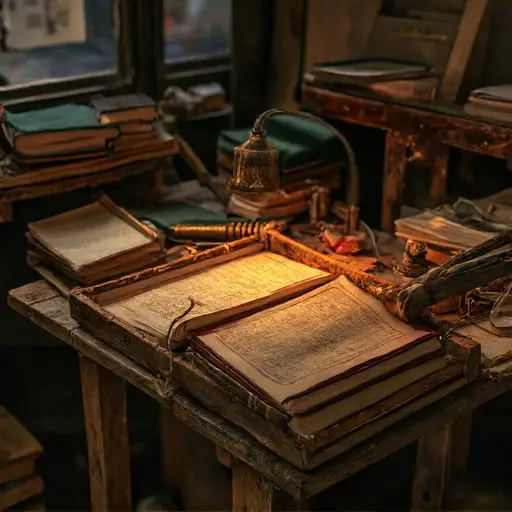
The Binding Room exhales a hush threaded with starch and linen. The binding cradle’s jaws remain slightly parted, gripping nothing. Torn paper threads cling to the floor near a sewing frame, their curve suggesting a gesture cut short.
A trimming knife rests at an unintended angle, its handle touching the cloth roll as if placed down mid-thought. Even the drying rack holds only two dampened boards, squared but never married to their text block. Something in here struggled between order and uncertainty, and the room has kept the moment unbroken.
The Deliberate Practice of Edmund James Whitcomb, Bookbinder
The furnished rooms echo Edmund James Whitcomb, born 1875 in Bath, apprenticed among modest English binderies where patience shaped every fold. In the Finishing Alcove, letter dies engraved with serifed fonts sit in regimented ranks beside gold leaf packets. A brass polisher leans against a stove used for heating type. Edmund’s small script appears on tags labeling endpaper marbling samples—greens, blues, ochres—each chosen with quiet confidence.
His routine likely ran from dawn sewing signatures at the frame to dusk tooling spines over heated pallets. In the Reading Niche, handmade volumes rest under cloth: a collected sermon, a botanical treatise, a worn novel. Their hinges open true, revealing joints aligned with almost reverent care. These pieces whisper of a man comfortable in the measured rhythm of page and thread.
Quiet Disturbances in a Once-Steady Craft
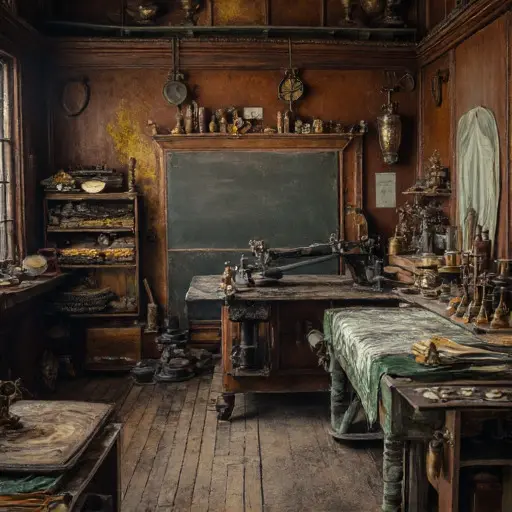
Strains surface in subtle corners. In the Upper Washstand Chamber, a jar of paste water has soured, its surface clouded—an oversight foreign to Edmund’s usual rigor. A crumpled invoice from a London supplier—edges blurred by moisture—lists sharply rising costs for calfskin. In the Guest Cot Room, a travel coat lies open but empty, save for a folded sanding pad used for spine rounding. No trunk, no books, no tools prepared for departure.
A warped board leans near the washstand, its curve newly formed by uneven drying. A sewing cord hangs slack at the frame, one end tangled, suggesting a moment of shaken focus. These details trace a quiet decline: perhaps debt narrowing his margins, perhaps a tremor in his hands undermining the consistency he relied upon.
A Spine That Refused Its Line
Returning to the Binding Room, all unease converges on that curling spine strip resting on the cradle. Its adhesive has dried in ripples, betraying hesitation in application. The sewing frame’s rods stand uneven; one laced signature slouches sideways, unheard of for Edmund’s discipline. A heated pallet lies cooled on the bench, its handle angled off the linen cloth as though set down too quickly.
A thin sprinkle of gold leaf dust glimmers across the floor near the finishing press, scattered without pattern. The lamp above the cradle flickers faintly, revealing the imprint of a thumb pressed into paste on the bench’s corner—an inadvertent mark of indecision.
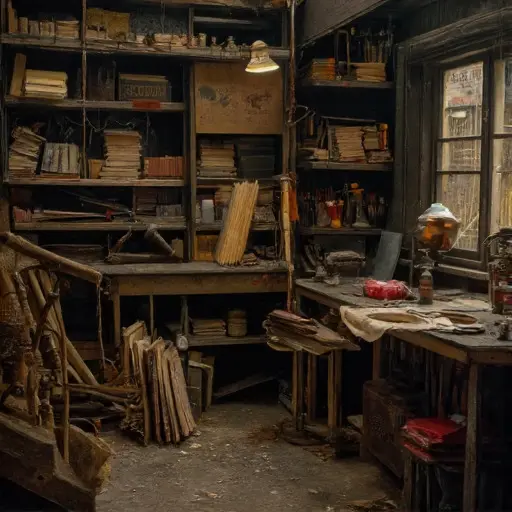
Beneath the drafting cloth on the cradle’s lower shelf lies his final attempt: a text block half-sewn, its kettle stitch wavering near the end. The tension falters, the thread slackens, as though certainty left his fingers in mid-draw. No inscription explains the lapse—only the quiet imprint of a craftsman undone by one line he could not steady.
The house gives no clarity, and it remains abandoned still.
