The Hidden Weight of the Kestral-Ridge
The Kestral-Ridge, a forbidding example of Stick Style architecture with its complex rooflines and textured shingles, was erected in 1898 on the highest point overlooking the city. It was a statement of vertical aspiration and guarded privacy. To step inside the main hall is to feel an immediate drop in temperature and an unsettling pressure of silence, a weight that has settled into the very timbers of the structure.
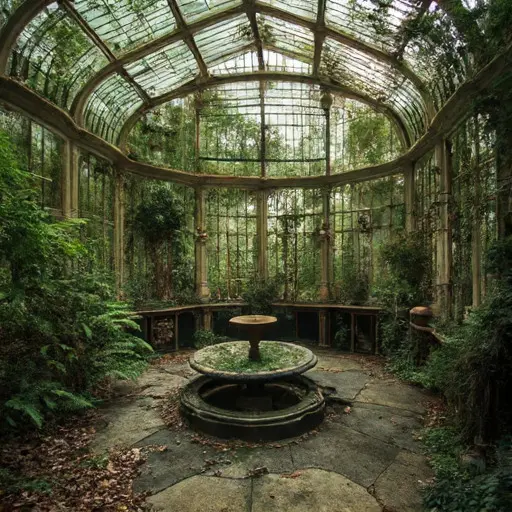
The Conservatory, a magnificent glass structure adjoining the principal Drawing Room, is perhaps the most vulnerable and poignant space. It is here, amidst the rusted iron and dead foliage, that the hidden tragedy of the estate’s final years becomes most apparent.
The Isolated Perfectionist, Dr. Amos Thorne
The mansion was built by Dr. Amos Thorne (1852–1925), a man whose professional life was dedicated to the meticulous, demanding field of cartography and topographical surveying. He created maps of unparalleled precision, and his profession instilled in him an obsessive, almost crippling need for perfection and control over his environment. Socially, he was intensely private, known for his reclusiveness.
Amos married Clara Henderson in 1880, but the marriage was one of convenience, devoid of deep emotional connection. They had one daughter, Beatrice. Amos’s personality was defined by his exacting nature; he could tolerate no disorder, no imperfection, and certainly no spontaneous emotion. His daily routine involved hours of silent, tedious work in his specially ventilated Map Room on the second floor. His ambition was total intellectual mastery; his greatest fear was a loss of control, particularly in his personal life.
The Conservatory was Clara’s one insistence—a refuge from the sterile order of the rest of the house. Amos permitted it, provided its climate and foliage were catalogued with scientific precision.
The Withdrawal in the Map Room
The tragedy that caused the Kestral-Ridge to be abandoned was a gradual, internal collapse rooted in emotional estrangement. Beatrice, the daughter, was intensely sensitive and fragile, suffering from crippling anxiety exacerbated by her father’s unrelenting demands for intellectual rigor. She became increasingly withdrawn, her only comfort being the warmth and life of her mother’s Conservatory.
Clara, the mother, passed away unexpectedly in 1915 from influenza. Her death removed the last buffer between the demanding father and the fragile daughter. Amos, incapable of processing grief, simply threw himself into his work, forbidding any mention of Clara’s name in the house. Beatrice retreated entirely, spending all her time either in the now-cold and neglected Conservatory or locked in her small boudoir.
The final break occurred in the Map Room. In 1925, Amos, while preparing a complex topographical survey, discovered that Beatrice had used a small, valuable piece of his imported drafting paper to write a highly emotional poem about her mother. The resulting confrontation—a rare moment of explosive rage from the usually constrained father—caused Beatrice to suffer a complete mental breakdown. She was immediately institutionalized by her father, never to return.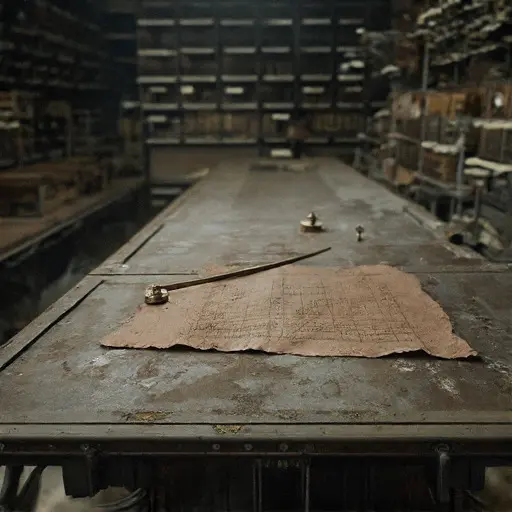
The Unmoved Globe in the Boudoir
Dr. Amos Thorne, now entirely alone and consumed by guilt he could not articulate, continued his work for only six months. His body failed him entirely; he died of a sudden, quiet stroke in his bed later that year.
The Kestral-Ridge was inherited by Beatrice, but she remained institutionalized. The executors of the estate, having no personal interest in the property and facing massive institutionalization fees, simply stripped the house of all portable valuables (artwork, silver, smaller antiques) to cover the costs. They left the heavy, unusable items, including all of Amos’s drafting equipment and Clara’s iron plant stands. They paid the minimal taxes for a few years, allowing the house to fall into disrepair and eventually into an unsolvable, state-held trust after Beatrice’s death in 1955.
In Beatrice’s former boudoir, a small, feminine room overlooking the Conservatory, a single, unusual object remains: a small, intricately carved wooden globe, a gift from her father before her mother’s death. It sits on a narrow vanity table, the cartography of the globe—her father’s world—perfectly preserved beneath the dust, but the small wooden stand is cracked, a final hidden symbol of a broken connection.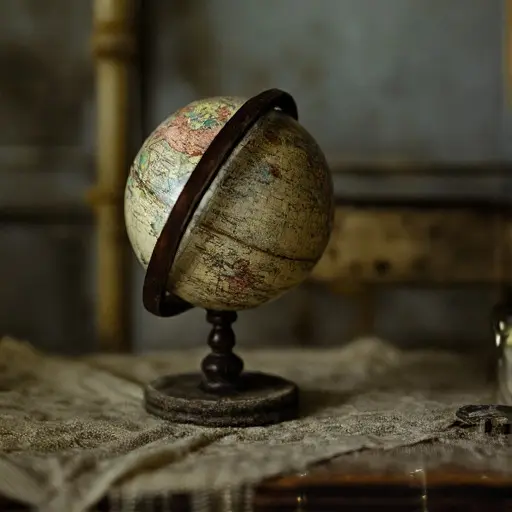
The Kestral-Ridge remains today, its imposing silhouette stark against the sky, a magnificent, empty cage. It is a monument to a man who successfully mapped the entire earth but utterly failed to navigate the smallest territory: the human heart. Its silence is the final, cold testament to the costs of intellectual perfection over emotional connection.
