The Hidden Torgersen Ship-Model Loft Where the Hull Lines Drifted Wide
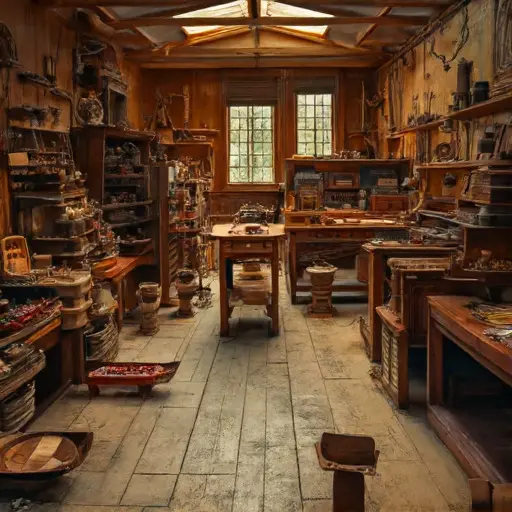
Distinct quiet fills the narrow rafters. A half-shaped model ship rests on its stand, starboard lines crisp while port curves splay slightly outward. A sanding block lies tipped on one edge as if put down in mid-arc.
A brass pin vise sits open, its tiniest bit rolled beneath a plank. It’s not a scene of chaos, only of measured work arrested just before correction.
A Craft Guided by Memory and Deliberate Hands
This ship-model loft bears the touch of Sven Olav Torgersen, model builder and coastal draughtsman, born 1872 near Ålesund. Raised among modest fishermen, he learned miniature hull carving from a traveling boatwright who prized accuracy of line above flourish. A woolen armband from his sister, Ragna Torgersen, hangs from a beam near the rigging station.
Sven’s days followed loyal routine: dawn trimming of keel blocks, midday fitting of planks, dusk rigging sketches by lamplight. His tools remain in practiced order—carving knives wrapped in hide, sanding blocks graded by grit, rigging needles sorted by gauge. Merchants once favored his models for their precise interpretation of working vessels from Nordic coasts.
Forms Once Sure, Now Quietly Askew
At his peak, the loft hummed with confident shaping. Bundles of cedar planks arrived in crates marked with Norwegian trade stamps. Completed half-hulls glowed with burnished surfaces. Riggers’ thread hung in perfect skeins along the rafters.
But subtle drift appears. The port planking on one model slackens, misfitting by a millimeter. A hull curve deviates slightly from the pencil marks below it. A scrap of paper shows repeated recalculations of beam width, numbers struck out heavily. His commission ledger lists a prominent buyer’s name rewritten several times, then crossed out. A short note in Norwegian reads: “They say the lines lie.”
Rumors whispered that he was accused of misinterpreting a historic vessel’s proportions for a museum patron. Others claimed he refused to alter archival drawings to satisfy an official demanding cosmetic changes.

The TURNING POINT Scored in Woodgrain and Doubt
One dim night left telling clues. A larger model hull sits clamped to the main bench, its final plank fitted too tight, creating a subtle warp. A rib template has cracked along its thinnest point. A discarded rigging plan bears Sven’s cramped handwriting: “They insist I falsified their vessel.”
Another torn fragment mutters: “Compensation demanded far beyond the fault.” Pencil marks drift into ragged scratches. A fine-toothed rasp lies scored from an unusual angle, as if struck in frustration. And the loft’s measuring beacons—thin rods used to verify hull symmetry—stand in uneven pairs, one missing entirely.
Even the thread bundles for rigging are tangled, a rare lapse for him.
A Hollow Tucked Behind the Timber Rack
Behind the tallest rack of cedar strips, a loose plank yields a narrow recess. Inside rests a small, unfinished half-hull: carved with impeccable grace, but left incomplete along the port side. The shaping stops abruptly where the curve should tighten.
A folded note lies beneath it, Sven’s careful script wavering at the edges: “For Ragna—when the hull finds its true line again.” The last word flares, then fades. The half-hull’s grain feels newly shaped, untouched by varnish.
Beside it sits a pristine cedar block, chosen with reverence, awaiting work that never began.

The Last Measured Trace
Inside a drawer of templates, a single test plank rests: planed to a perfect taper on one side, abruptly thickening on the other. Beneath it, Sven wrote: “True alignment falters when doubt intrudes.”
The ship-model loft settles into its resin-scented quiet, curves half-drawn in patient wood.
And the house, holding its abandoned builder’s chamber, remains abandoned.
